Garage Doors: The Buyer's Guide That Cuts Through the Noise
Compare garage door types, prices, and features in this complete buyer's guide. Learn what to expect from materials, openers, and insulation options.

You're about to spend somewhere between $1,500 and $4,000 on a garage door, and every product page you've opened has told you it's the best one. That's not helpful. What you need is three decisions — the door material, the opener, and the insulation — and once you've made those, everything else is a detail.
This guide walks you through those three decisions in the order they matter, tells you what most people should buy, and tells you when you're the exception.
The price you should actually expect
Before anything else: a mid-grade insulated steel door with a belt-drive opener, professionally installed, runs $1,950 to $3,900 in 2026 for a standard 16x7 double-car opening. That's the number to anchor on. If a quote comes in below $1,800, something is being cut — either the door is single-skin, the opener is builder-grade, or the installation doesn't include haul-away of the old door. If a quote comes in above $4,000 and you didn't ask for wood or custom hardware, someone is padding.
Everything below either fits inside that range or pushes you above it for a specific reason.
Decision one: the door itself
There are three door materials worth considering for most homeowners. Everything else — fiberglass, aluminum full-view, composite — is a specialty answer for a specialty problem.
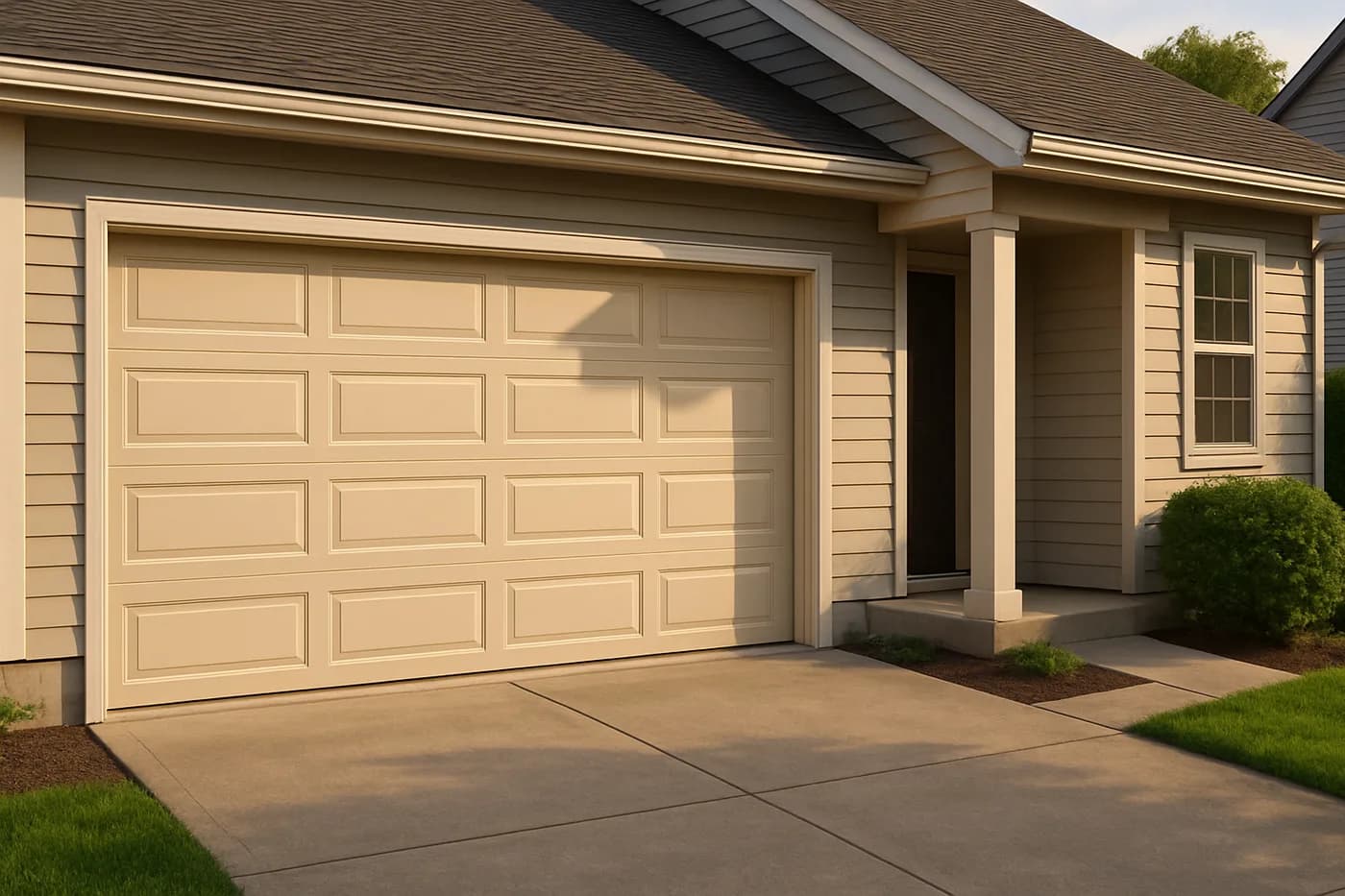
Insulated steel is what most people should buy. A mid-grade insulated steel door uses polyurethane foam sandwiched between two steel skins, hits R-12 to R-18, and is the sweet spot for most attached garages in North America. It's quiet, it's stiff, it doesn't dent as easily as single-skin steel, and it holds up for 20 to 30 years with almost no maintenance. Expect $1,400 to $2,500 for the door alone, installed. The Amarr Olympus is a three-layer polyurethane sandwich door that reaches up to R-18, putting it in the same thermal class as an insulated exterior wall, at $1,700 to $2,900 installed for a standard 16x7 opening — a representative product in this category, not the only one.
The failure mode: bottom sections can rust if your driveway pools water against the door, and dents in the outer skin are cosmetic-only but can't be popped out the way an aluminum panel can.
Single-skin steel is the builder-grade option. It's cheap, it's loud, it has no insulation value worth measuring, and it will telegraph every basketball impact for the life of the door. It's the right answer only if the garage is detached, unheated, and you're selling the house in under two years.
Custom wood is the specialty answer. Custom wood garage doors run $4,000 to $15,000 installed depending on species and hardware, and require refinishing every three to five years. Buy wood if the door is a design element of the house and you've budgeted for the maintenance. Don't buy wood because you saw it on a Craftsman bungalow on Instagram and forgot that the owner refinishes it every spring.
Decision two: the opener
Three drive types, one right answer for most people, one wrong answer for almost everyone, and one edge-case winner.
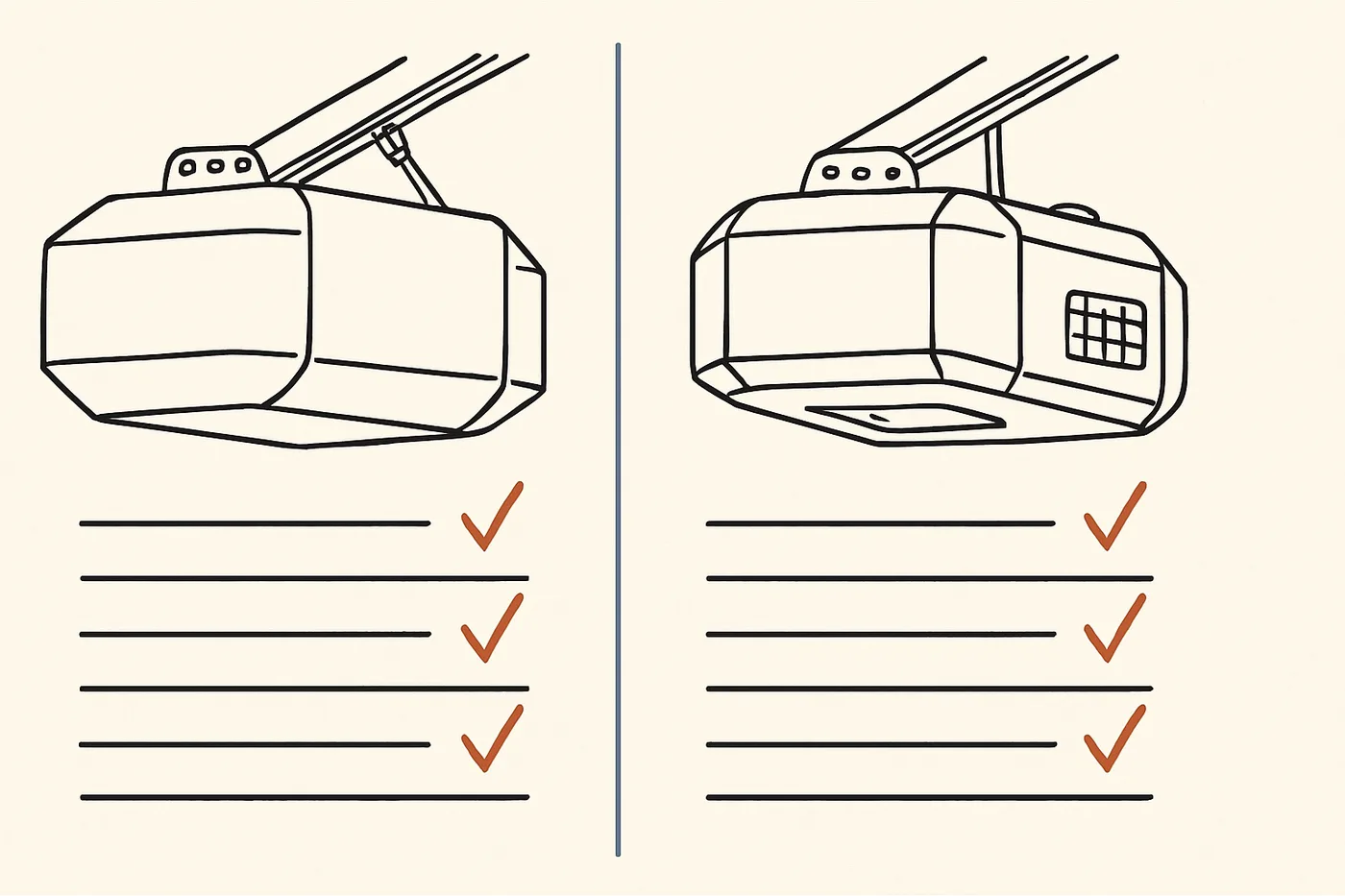
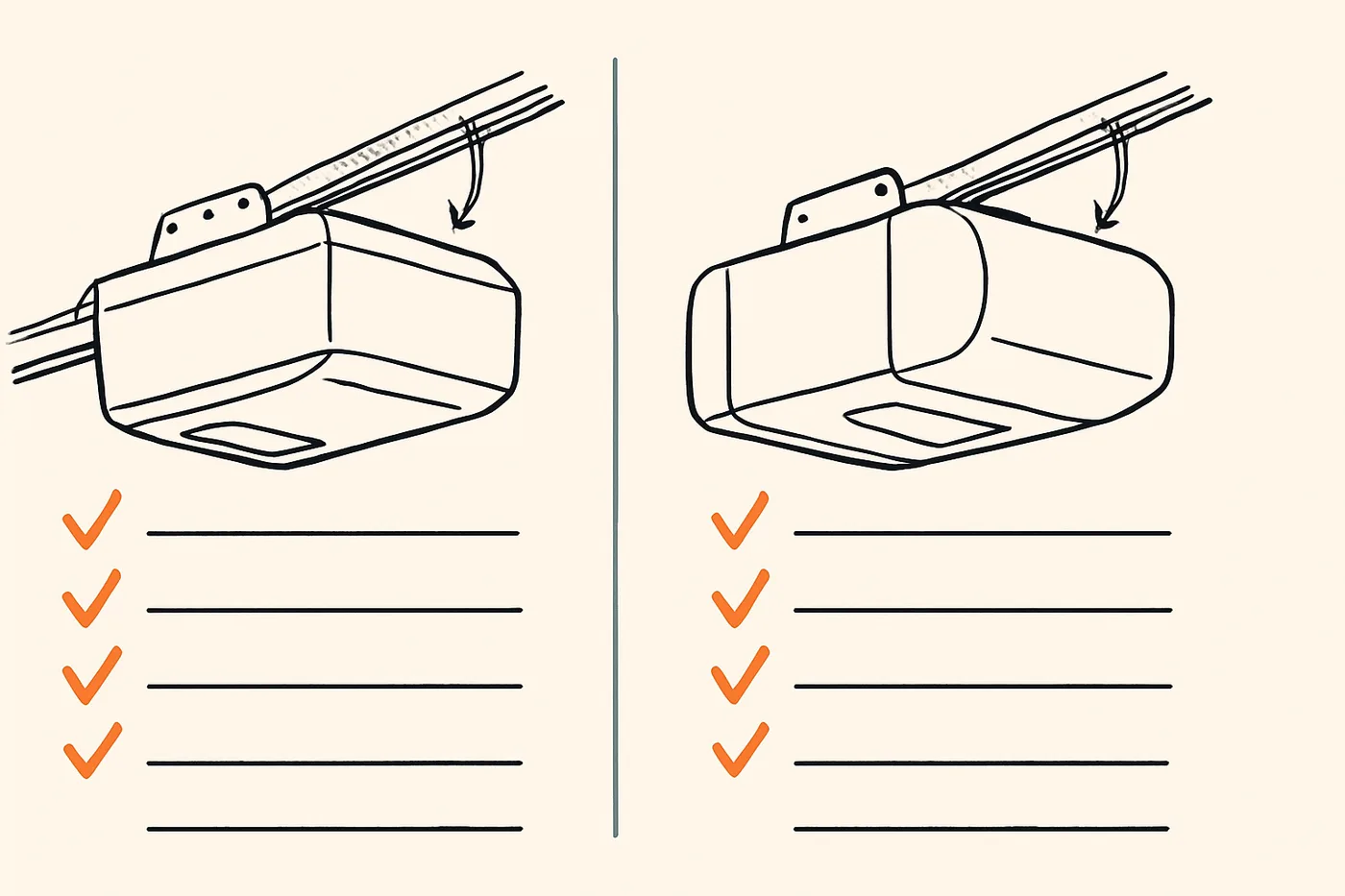
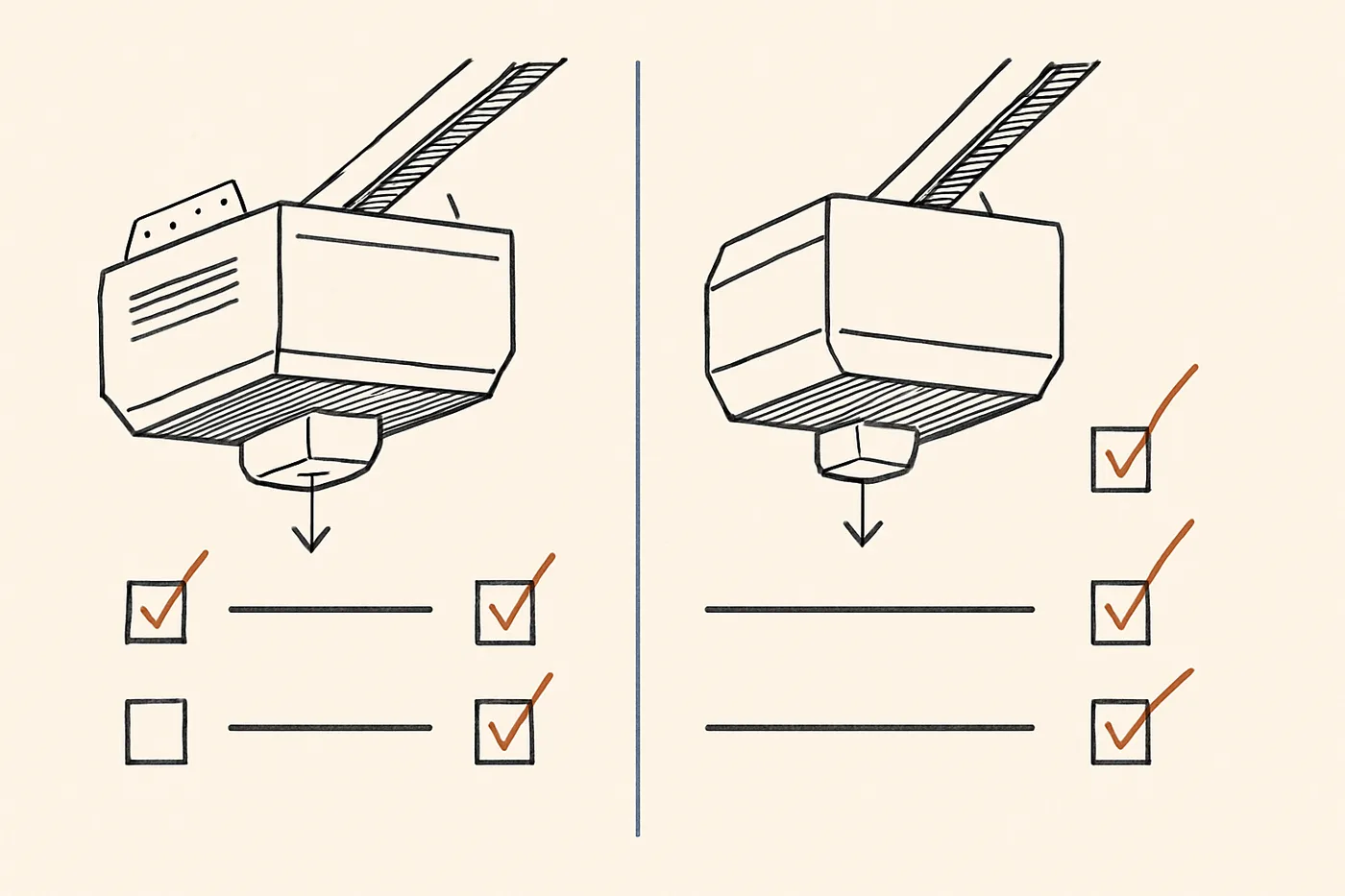
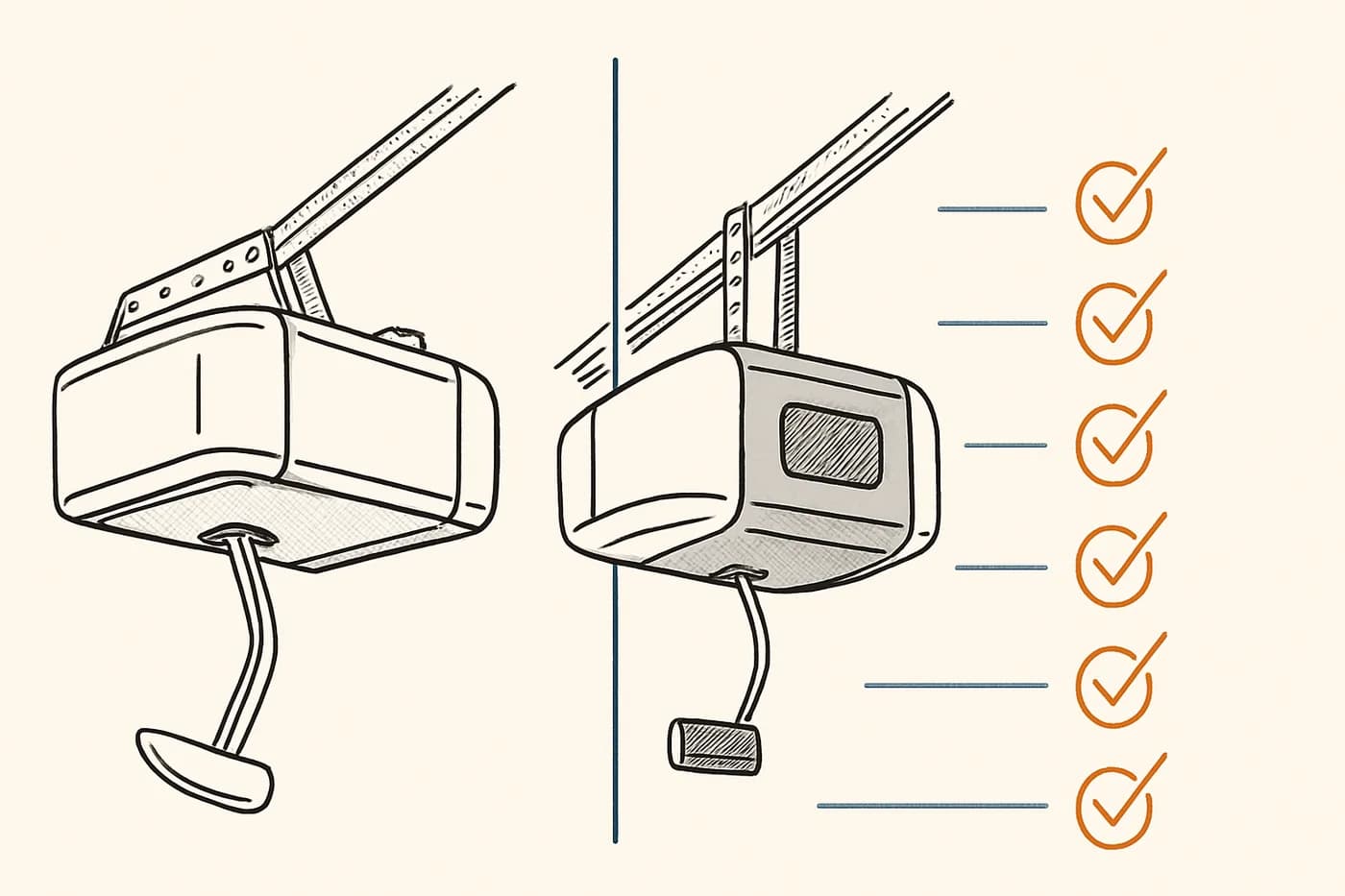
Chain-drive openers cost $350 to $500 installed and last 10 to 15 years. Belt-drive openers cost $450 to $650 installed and last 12 to 15 years. The price gap is $100 to $150. For that money you get a different acoustic experience: a belt drive operates at roughly 50 dB versus a chain drive's 70-plus dB, which is the difference between audible and nearly inaudible in an attached garage with bedrooms above. If the garage is attached, buy the belt. If detached, chain is fine and you can pocket the difference.
Screw drives used to be a third option. They aren't anymore. Screw drives are temperature-sensitive — the grease stiffens in cold and gets loud in heat — and parts are harder to source, which is why most professionals stopped recommending them. Don't buy one.
The edge case is direct drive. Direct-drive openers cost $650 to $900 or more installed, last 20 years or more with minimal maintenance, and most units carry a lifetime warranty on the motor. If you plan to stay in the house 15 years or more, the math works. If you don't, you're paying for warranty coverage you'll never use.
One product-level note that matters at the point of purchase: the Genie StealthDrive Connect 7155 ships on a one-piece rail specifically to eliminate the most common cause of belt drift in the first year, whereas most openers in its price range ship a three-piece rail that must be assembled. If you're DIY-installing, that matters. If a pro is installing, it matters less.
Decision three: insulation and the extras that aren't optional
Insulation is not an option — it's a spec you should demand. Polystyrene insulation provides R-6 to R-10. Polyurethane injected foam, which bonds to both steel skins, provides R-12 to R-18 in the same panel thickness and adds structural rigidity beyond the thermal performance. Polyurethane is worth the upcharge in almost every case. The rigidity alone reduces opener strain and cuts operational noise, which matters even if you don't heat the garage. Maya covers the acoustic side of this in the why is my garage door so noisy video.
Battery backup is the other spec that's non-negotiable in some places and worth buying everywhere. Battery backup adds $75 to $150 to the opener cost and is legally required on all new residential opener installations in California under SB-969. If you live in California, it's not a choice. If you live anywhere that loses power in storms, it should still not be a choice.
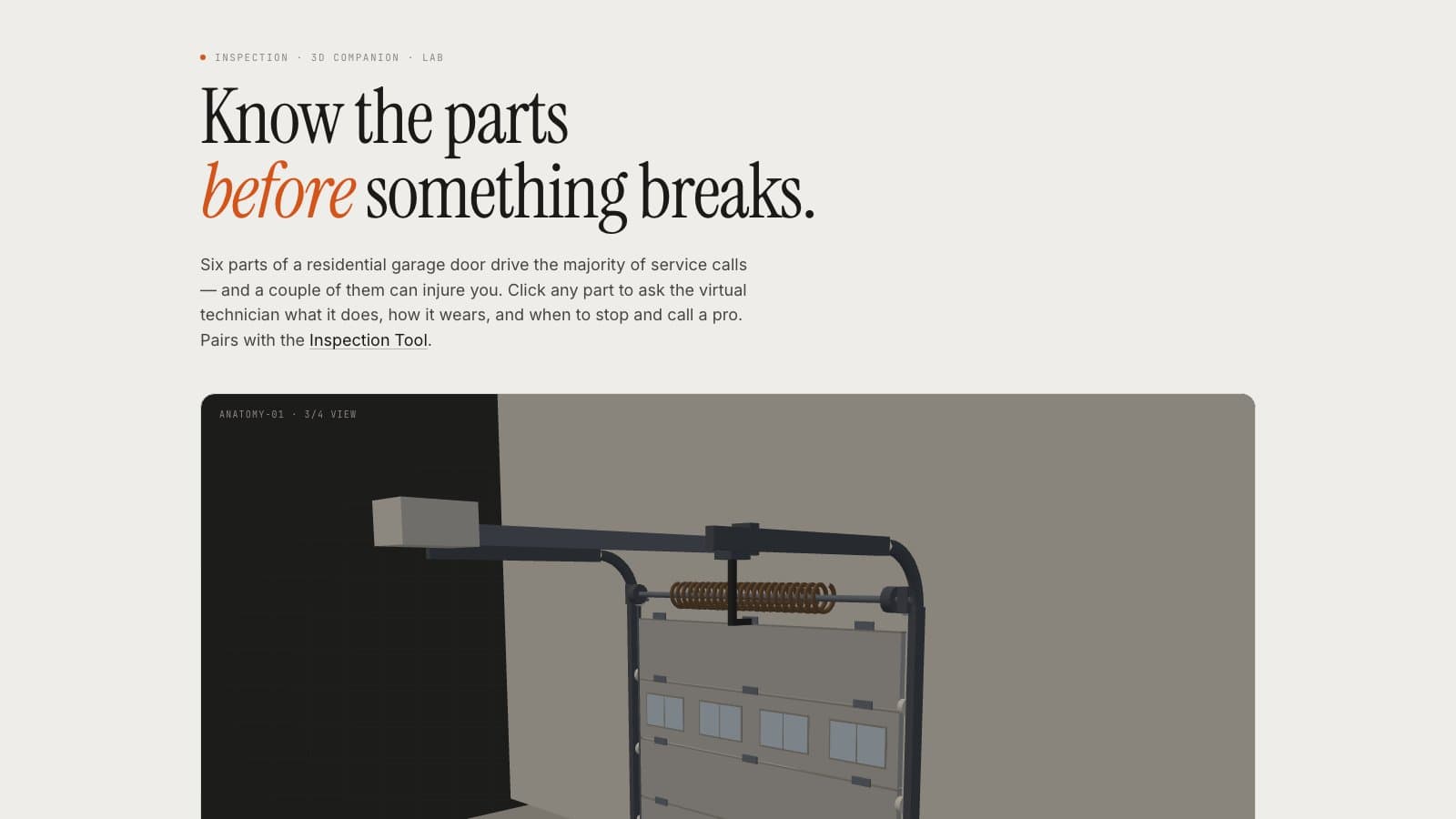
Then there are springs. Most quotes don't itemize them, but they should. Standard torsion springs are rated to 10,000 cycles — roughly 7 to 10 years of daily use. High-cycle springs rated to 25,000 to 100,000 cycles cost $75 to $150 more upfront and last proportionally longer. If you cycle the door more than four times a day — common in two-worker households — pay for the high-cycle upgrade. It's the single best dollar-per-year investment in the whole system. The garage door anatomy lab shows exactly what these components look like and where they fail.
For the installation itself, the difference between a good result and a bad one is the installer, not the brand on the box. If you're in Las Vegas, A+ Garage Doors handles both new installs and garage door repair in Las Vegas; outside that market, look for local shops like Garage Door Pro Services that will do a free garage door safety inspection before quoting, because that's how you know they're pricing the actual job. The science of garage doors lab walks through the physics of what a good install has to solve for.
The three questions that get you to an answer
One: is the garage attached or detached? Attached: insulated steel with polyurethane foam, belt-drive opener. Detached and unheated: single-skin or basic insulated steel, chain-drive opener, done. This one question eliminates half the catalog.
Two: how long do you plan to stay in the house? Under seven years: mid-grade insulated steel, belt drive, standard springs, total in the $1,950 to $3,000 range. Seven to fifteen years: same door, belt drive, high-cycle springs, battery backup, $2,400 to $3,500. Fifteen years or more: consider direct drive and the R-18 door, budget $3,000 to $4,000.
Three: do you have an edge case? Design-driven house that needs wood, or a garage used as a workshop that needs R-18 minimum — those are the two reasons to leave the framework above. Everything else fits.
For most homeowners with an attached garage and a five-to-fifteen-year horizon: mid-grade insulated steel with polyurethane foam, belt-drive opener with battery backup, high-cycle springs. Installed cost around $2,600 to $3,200. That's the answer. Maya walks through the same tech stack from a different angle in the garage door tech decoded video, and the pop art physics piece covers why the spring choice matters more than the door choice for how the whole system feels day to day.