Opener horsepower: does your heavy door need more than 1/2 HP?
Chamberlain matches a 1/2 HP-equivalent motor to sectional aluminum doors and its strongest tier to heavier or one-piece doors. How to read the rating and what to ask for.

You are buying an opener, your door feels heavy, and the quote says 1/2 HP. Horsepower is the motor's lifting power, and the makers do tie a bigger motor to a heavier door: Chamberlain's buyer's guide puts its strongest tier, "Equivalent to 1 1/4 HPS*", against "Heavier or one-piece doors," and its 1/2 HP-equivalent tier against "Sectional aluminum doors." The same Chamberlain guide says "Higher lifting power, or horsepower equivalent, means the motor doesn't have to work as hard and will typically last longer."
So a heavy or one-piece door is the maker's reason to step up. A standard aluminum sectional door is the maker's case for 1/2 HP. Neither maker we read gives a door weight for each rating, so this page does not either.
What a DC opener's rating means
Some openers use a DC motor, and those are not rated in true horsepower. Chamberlain's buyer's guide says "Lift capacity of DC motors is typically not measured in horsepower," and its footnote reads "For comparison purposes only; lift capacity similar to 1-1/4 or 3/4 horsepower AC motor."
LiftMaster's 6580L page says the same thing in its own words: "For comparison only. DC motor lift capacity is not measured in HP." So when a box shows "HPS" or "HP", read the number as the maker's comparison to an AC motor, not as a measured horsepower.
Which models list which motor
These are the models whose maker pages we read, with the maker's own wording:
- LiftMaster 81550: 1/2 HP AC. LiftMaster's 81550 page says "Support standard aluminum doors day after day with the 1/2 HP AC motor."
- LiftMaster 8365W-267: 1/2 HP, per LiftMaster's 8365W-267 product page. LiftMaster lists it as discontinued.
- LiftMaster 85870MC: 3/4 HP AC. LiftMaster's 85870MC page says "Lift heavy and reinforced doors in high-wind areas with the 3/4 HP AC motor."
- LiftMaster 6580L: "1 HPs" DC. LiftMaster's 6580L page gives it a "lift capacity similar to a 1 HP AC motor."
- LiftMaster 6690L: "1-1/4 HPs" DC. LiftMaster's 6690L page says its "1¼ HP* equivalent motor is designed for high-use garages and harsh conditions."
- LiftMaster 8360W and 8500W: the maker gives no figure on the LiftMaster pages we read.
- Genie 3035: the maker gives no figure in the Genie manual we read.
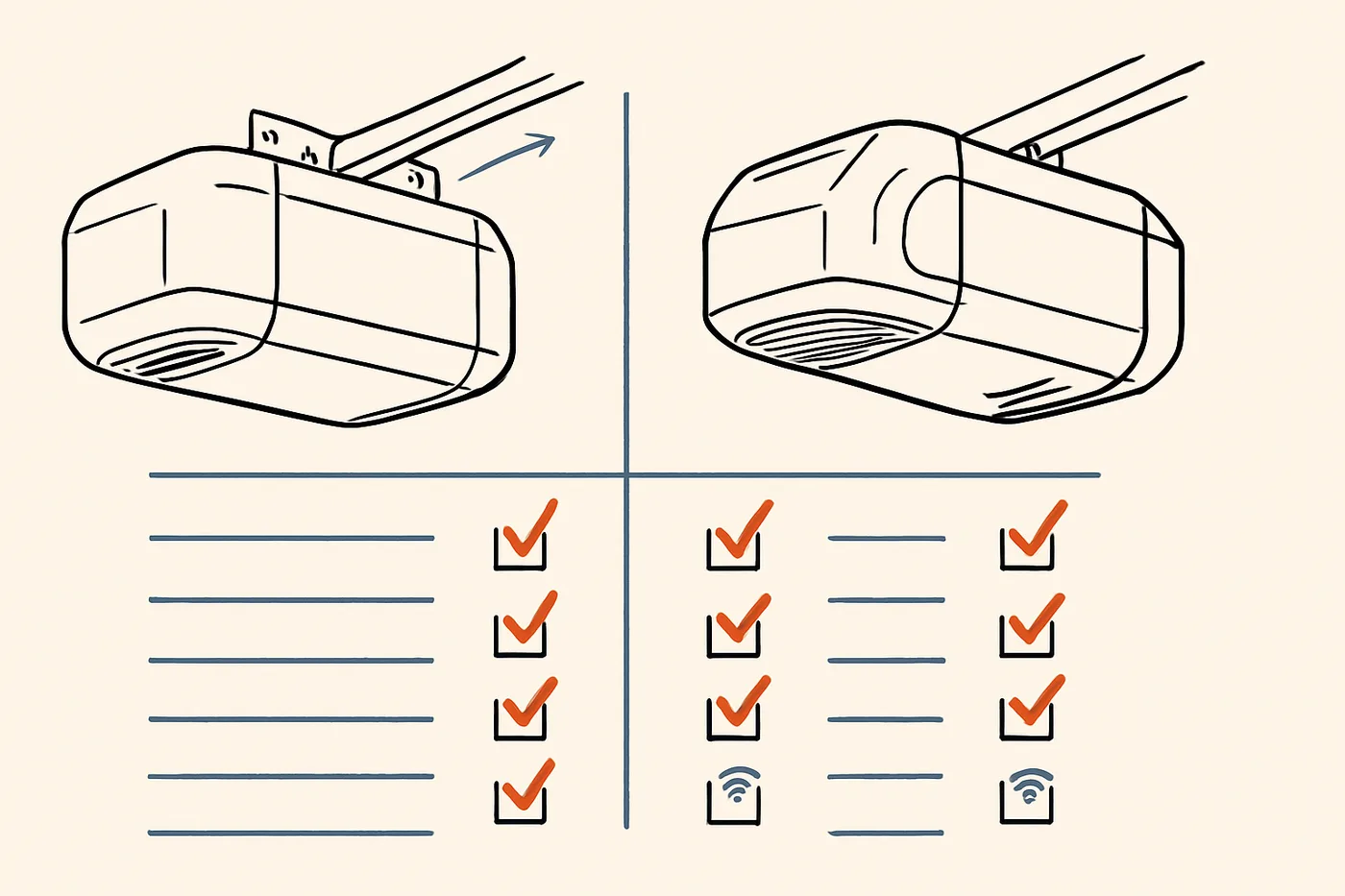
More openers, with their drive type and features side by side, are on our brand comparison. How chain, belt and screw drives differ is in our drive type comparison, and openers by budget are in our guide to openers under $500.
When 1/2 HP is the right call
A 1/2 HP opener is not a cheap mistake on the right door. Chamberlain's buyer's guide says its 1/2 HP-equivalent tier is for "Sectional aluminum doors," and LiftMaster's 81550 page says its 1/2 HP AC model will "Support standard aluminum doors day after day."
If your door is a standard aluminum sectional door, those are the makers saying 1/2 HP fits. If it is heavier, one piece, or reinforced for wind, the makers point to the higher tiers above.
LiftMaster gives a second reason to step up. Its buyer's guide says "More horsepower puts less stress on the opener over time," and it lists "Do you have an oversized or a heavy garage door?" as a question to discuss with your installer.
What a bigger motor does not do
The opener is not what holds your door up. Chamberlain's balance support article says a balanced door "should stay in place, supported entirely by its springs," and that "If the door slams shut or shoot upward with force, the door is out of balance."
The same Chamberlain article says "An unbalanced garage door may not reverse when required." That is a safety problem, and it is about the door and its springs, not the motor's rating. If your door feels heavy, have a technician check its balance before you choose a motor. What the balance check looks like is on our balance page.
What to put on the quote
- The opener's model number, in writing.
- The maker's lift-capacity wording for that model: the horsepower for an AC motor, or the "HP equivalent" or "HPS" figure for a DC motor.
- Why the installer picked that rating for your door, especially if your door is heavy, one piece or oversized.
With the model number you can read the maker's own page, the same way we did above.
What not to do
Do not try to adjust, wind, loosen or replace a spring or cable yourself, and do not touch the bottom bracket. Those parts are under tension and belong to a trained technician. If the door feels very heavy, drops fast or will not stay put, do not lift it, and call a professional.
What to do today
- Note what kind of door you have: a standard aluminum sectional, or a heavier, one-piece or reinforced door.
- Ask each installer for the model number and the maker's lift-capacity wording in writing.
- If the door feels heavy, ask for a balance check by a technician before you decide on a bigger motor.