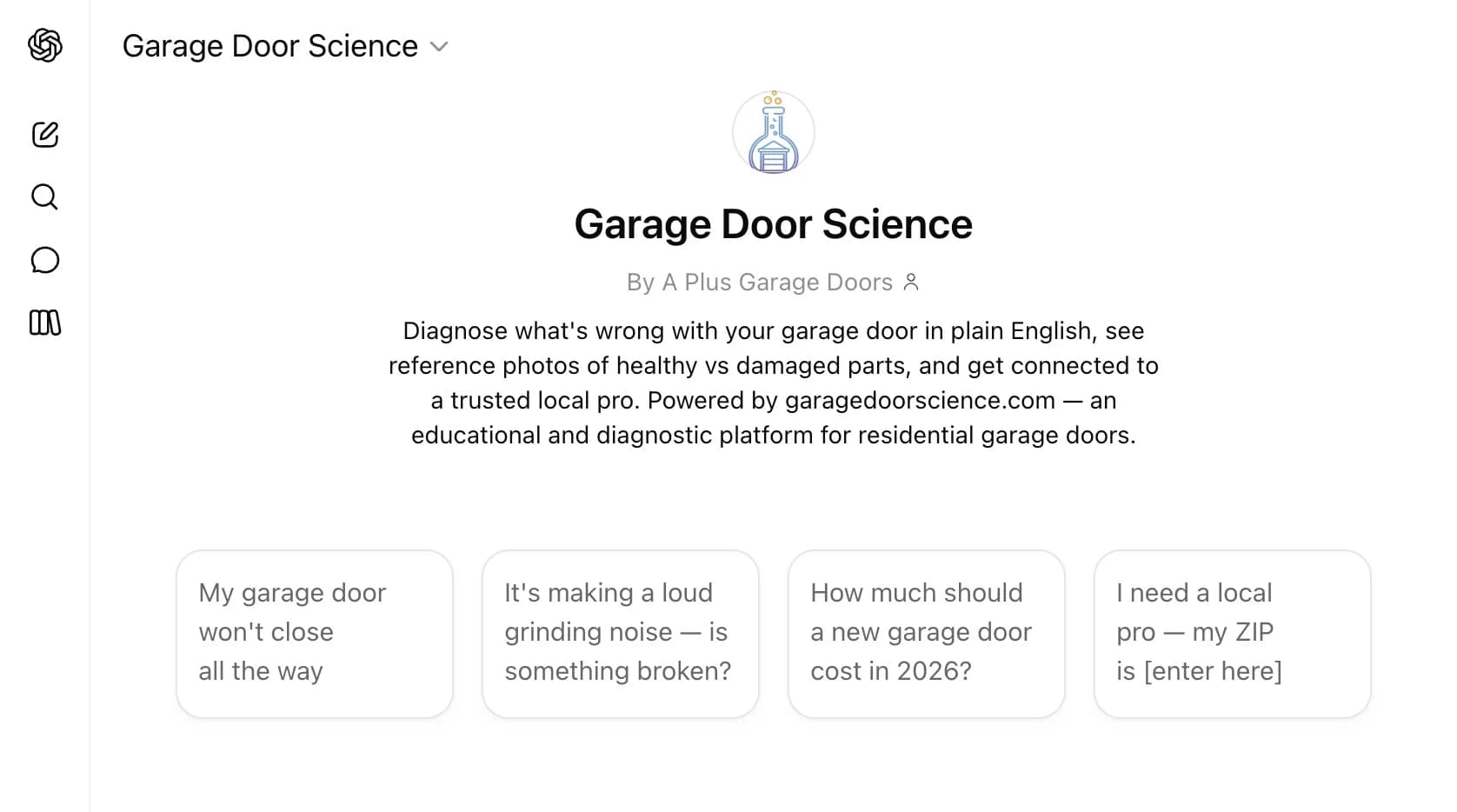
Garage Door Science is Now in ChatGPT
We published the Garage Door Science Custom GPT — a conversational front door to our diagnostics, lab corpus, partner routing, and 24-point inspection. Free, no signup, works directly inside ChatGPT.

Garage Door Science is now available as a Custom GPT inside ChatGPT. If you already live in ChatGPT, you no longer have to leave it to get a real diagnosis, a partner referral in your ZIP, or the right reference photo for whatever is squeaking, dragging, or refusing to close. It is free, requires no signup, and uses the same diagnostic engine that powers the chat on this site.
Open Garage Door Science in ChatGPT →
What it does
Ask it the same way you would ask a friend who happens to fix garage doors for a living. Describe the symptom — "my opener hums for a second then stops," "one side of the door is lower than the other," "remote works from the driveway but not the street" — and the GPT walks the same decision tree the site uses, returns the likely cause, the safety rating (DIY vs. call-someone), the typical cost range for your region, and a partner in your ZIP if you want a hand.
It can also pull a reference photo for any of the 24 inspection items, surface the right lab to actually understand what is going on inside the system, and answer follow-up questions grounded in our published articles. The same eight tools chat on this site uses — diagnose, routeByZip, getDoorStyles, getActivePromotions, getInspectionReferencePhotos, retrieveLabContext, costEstimate, submitInspection — are wired up as ChatGPT Actions.
Why we shipped it as a Custom GPT
Two reasons. One: a meaningful share of homeowners who have an AI question about their door already start in ChatGPT, not in a search engine. We would rather meet them there than hope they find their way back to the site. Two: every tool on Garage Door Science is built MCP-first. Exposing those same tools through a Custom GPT was a single OpenAPI export — no new backend, no parallel content pipeline, no separate models. One source of truth for the diagnostics, multiple front doors.
If you build agents and want the raw tools instead of the conversational wrapper, the public MCP endpoint and REST API are documented and free with attribution.
The honest limits
ChatGPT Custom GPT Actions cannot render images inline. That is a platform decision, not a bug in our integration. So when the GPT shows you a reference photo for a broken extension spring, you get a clickable markdown link to the photo on this site rather than the photo itself. Click through and you land on a clean page with the photo, the severity badge, and what to do next. We built a forgiving slug resolver specifically for this — if the GPT confabulates a reasonable URL like /reference/springs/healthy-torsion-spring, it still resolves to the right photo.
For inline images, video, and the full interactive labs, the website remains the richer surface. The GPT is for the conversation; the site is for the picture.
What is next
The same eight tools, an upcoming visualDiagnose tool that takes a photo of your symptom directly, and a planned ChatGPT App (via the new Apps SDK) that will let us render images and the inspection widget natively inside ChatGPT once the platform is ready. If you have ideas for what the GPT should do better, the easiest way to tell us is to use it and break it — feedback comes back to us through the conversation logs, and we read every one.