How a garage door actually works: types, parts, and the physics behind them
Learn how garage doors work with our complete guide to door types, essential components, and mechanics. Perfect for homeowners new to garage door systems.

You lift it with one finger on a wall button because a spring above the header is doing the actual work. When the spring stops doing its work correctly, the door reveals its true weight in the least forgiving way possible.
This article walks through what is above your garage: the door itself, the counterbalance system that makes it feel weightless, the opener that automates the motion, and the safety systems that decide whether the door reverses when something is under it. Every number here is real. Read them once.
The door: sectional versus rolling steel
Most residential garage doors in North America are sectional. Four or five horizontal panels are hinged together and travel on rollers up a curved track that carries the door from vertical (closed) to horizontal (open, tucked against the ceiling). Sectional doors are rated for 10,000 to 50,000 cycles of service life and can reach R-18 insulation values when the panels are injected with polyurethane foam.
Rolling steel doors are the other common architecture. Instead of hinged panels on a track, they use narrow interlocking slats that coil around a drum above the opening. Because the slats slide against each other rather than hinging, the same door can be rated for 25,000 to 500,000-plus cycles. The trade-off is thermal performance: rolling steel tops out around R-10, even with foam-filled slats. Sectional doors dominate residential garages. Rolling steel dominates commercial bays and detached shops where cycle count matters more than heat loss.
The counterbalance system
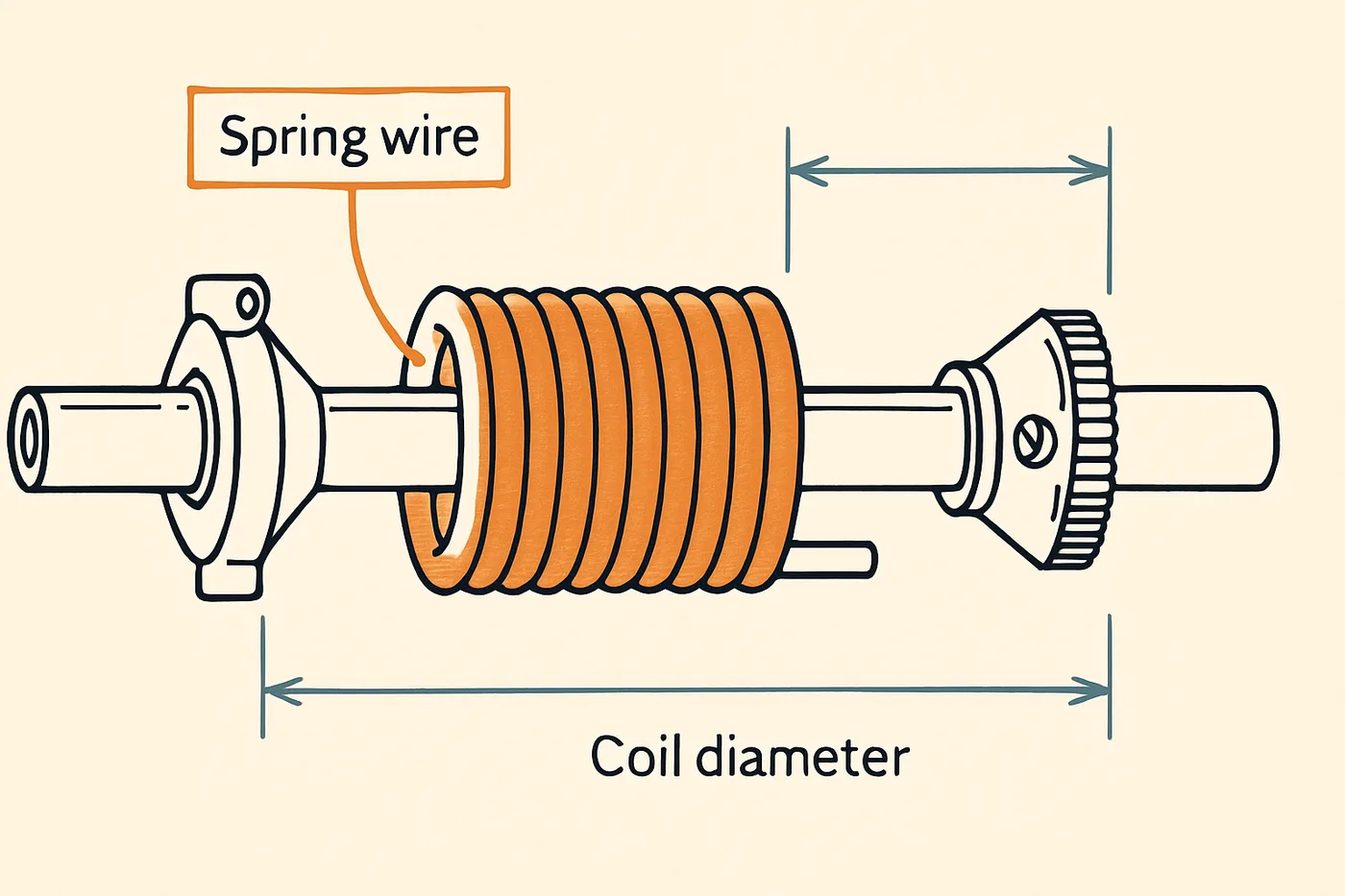
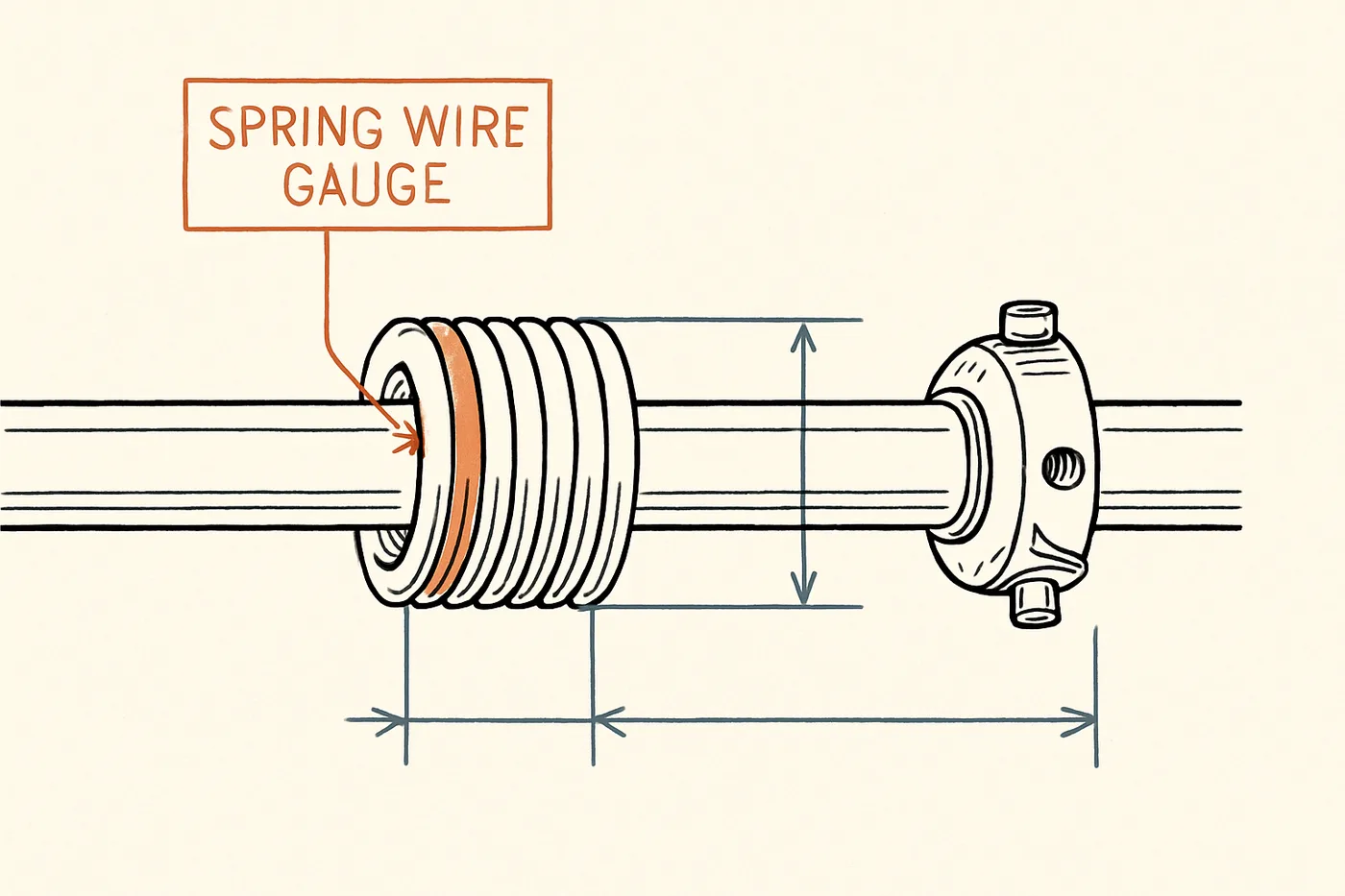
The panel on your garage is heavy. The reason it feels light is a torsion spring wound tightly across a shaft above the door opening, storing energy that the door releases as it opens and reabsorbs as it closes.
The wound spring is why the door feels weightless in normal operation, and why a broken cable can turn the same door into a falling weight. A torsion spring holds a lot of force. Clopay says torsion springs are under extreme tension, and even a small mistake can cause serious injury, and it calls spring replacement "not your typical DIY project" and hiring a qualified professional "the safest route".
A standard residential spring is rated for roughly 10,000 cycles, about seven years at four cycles a day. High-cycle oil-tempered upgrades are rated for 25,000 to 100,000 cycles. The cost-benefit calculation favors an upgrade once you exceed roughly four cycles per day — easy to hit in a household where the garage is the primary entrance.
The spring transfers its torque to cables wound around drums at each end of the shaft. As the shaft rotates, the drums pay out cable, and the cables lift the door up its tracks. Every component in that chain — the spring, the shaft, the drum, the cable, the bottom bracket where the cable terminates on the door — is under continuous tension whenever the door is closed. None of these parts can be safely serviced by hand without releasing that tension first, and releasing it correctly requires winding bars and training.
An improperly tensioned spring that releases can fracture a wrist. A winding bar that slips out of a spring cone can crack a skull. Field reports document both.
Rollers, tracks, hinges, and seals
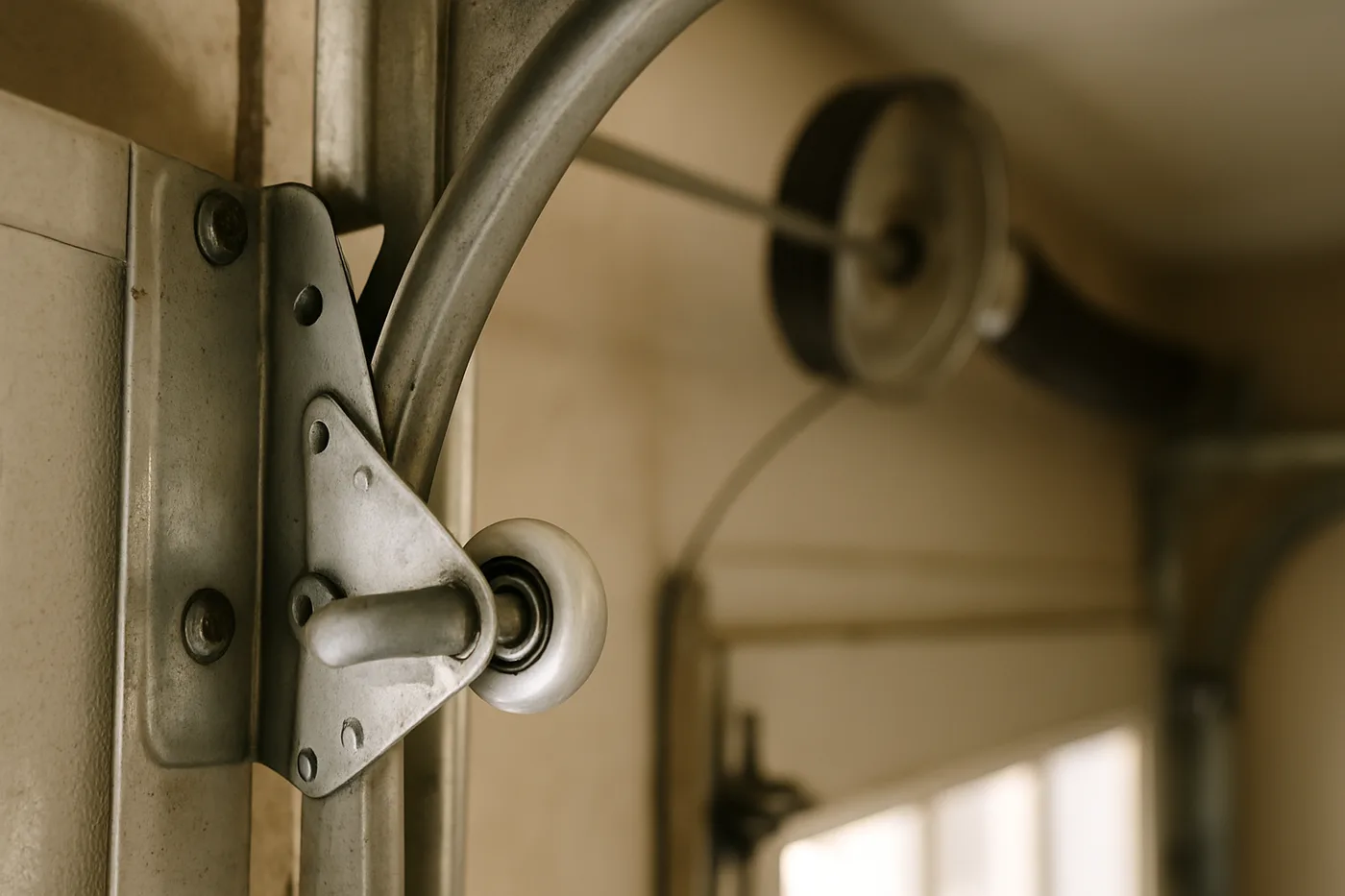
The parts that do not store energy are the ones you can meaningfully inspect. Rollers ride in the vertical and horizontal tracks and carry the panel weight. Hinges connect the panels and allow them to pivot as the door bends through the curve. Bearings support the torsion shaft at each end.
The bottom U-seal along the base of the door — the flexible rubber strip that presses against the concrete floor — wears out: Clopay says most seals need replacing every two to three years, depending on climate and use, and Amarr says around two years or more with proper maintenance. A worn seal either goes chalky or stays permanently flattened. Replacing it requires sliding a new profile into the retainer along the bottom panel. There is no tension involved. It is one of the few genuinely homeowner-serviceable repairs on the entire assembly.
The opener
The opener does not lift the door. The spring does. The opener supplies the small force needed to overcome friction and initiate motion, plus the intelligence to know when to stop, reverse, or lock out.
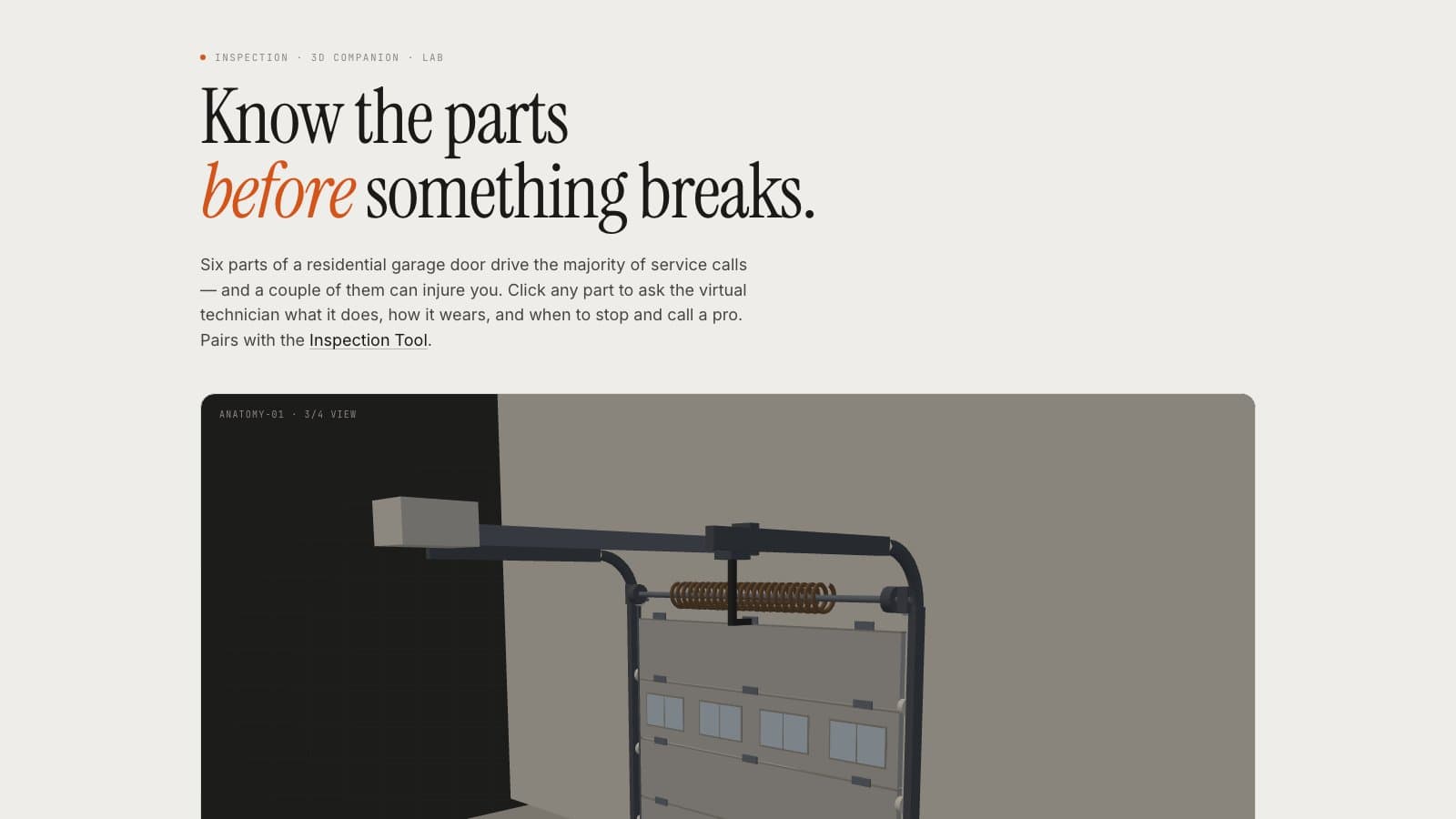
Chain, belt and direct drive are three common opener types. A chain-drive opener is usually the loudest, while belt-drive and direct-drive units are quieter. The garage door anatomy lab walks the mechanical geometry of each drive type, and the why is my garage door so noisy segment breaks down which noises come from the drive versus the door itself.
Cost, life expectancy and warranty vary by model, so get a written quote and read the model's own warranty page. Genie's page for the 7155 is an example of what a manufacturer lists for a belt-drive opener.
If you live in California, the opener question is partially decided for you: SB 969 has required battery backup on residential openers made, sold or installed in the state on or after July 1, 2019. Battery backup adds $75 to $150 when purchased as an accessory to a non-equipped unit.
Safety systems: photo-eye and auto-reverse
Every residential opener sold in the United States is required by the federal rule to carry two independent entrapment protection systems.
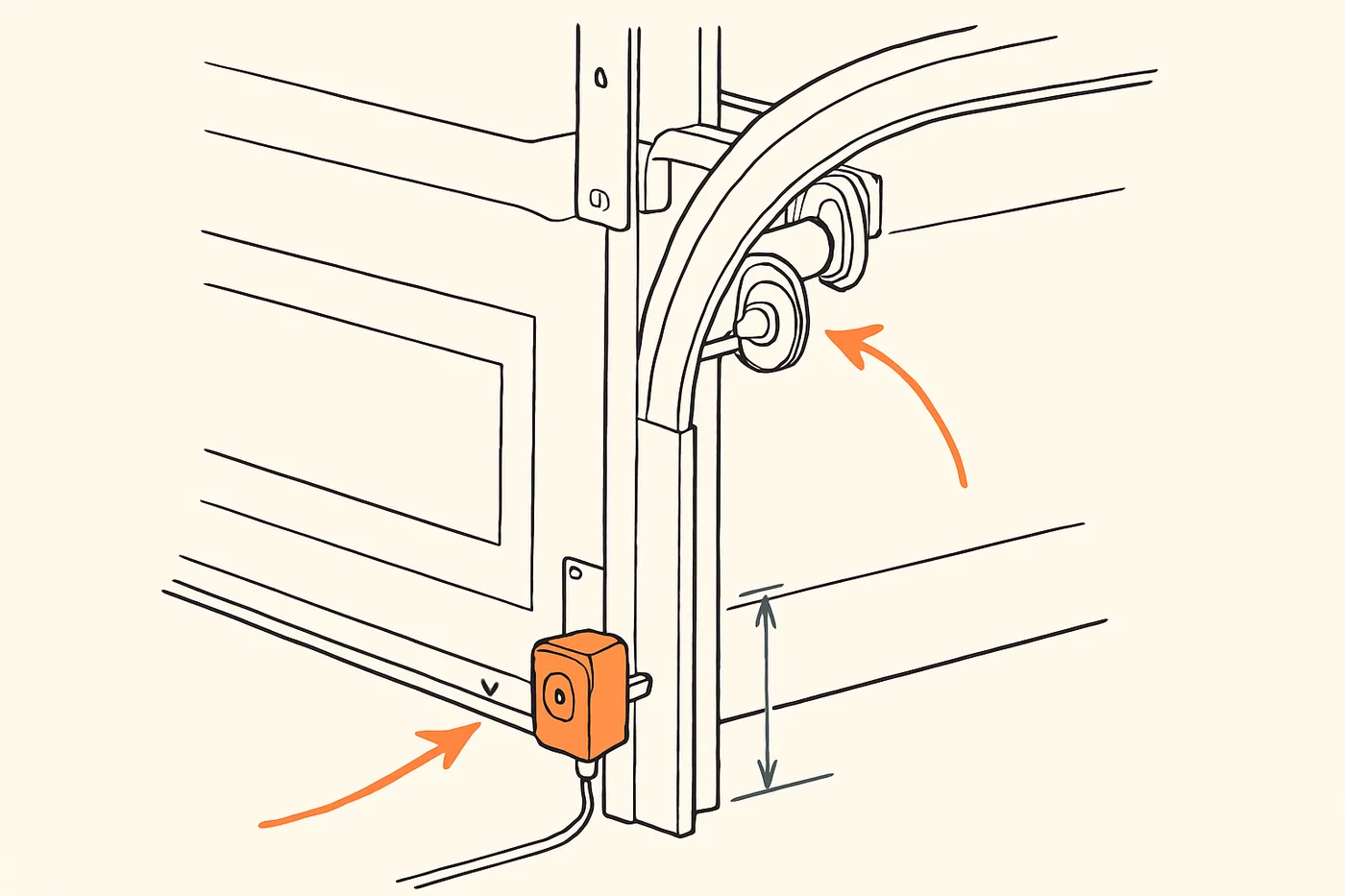
The first system is a secondary sensor. On most openers that is the pair of photo-eye sensors mounted low at the base of the door tracks, so the beam crosses where something would pass under the door. The federal rule also allows an edge sensor on the door instead.
The second system is the motor-current auto-reverse. The opener continuously monitors the current draw of its own motor; when the door meets an obstruction, the motor begins to stall, current rises sharply, and the controller commands a reversal when the draw exceeds a calibrated threshold. 16 CFR 1211.7 requires the opener to initiate reversal within 2 seconds of contact with an obstruction. Both protections must work. If one fails, the door is out of compliance and a child is unprotected.
The Maya tech-decoded segment shows both systems triggering in slow motion, and the science of garage doors lab has an interactive walk-through of the current-sensing logic.
What you can inspect, what you cannot
You can visually inspect the torsion spring for coil gaps, rust, or thinning near the center. You can watch the door travel through a full cycle and listen for grinding at the rollers or hinges. You can test the photo-eyes by breaking the beam with a broom handle during a close cycle and confirming the door reverses. You can test auto-reverse the way your opener's manual describes; Chamberlain's version uses a one-inch board or a 2x4 laid flat in the door's path, and the door must reverse when it hits it. If it does not, stop using the opener and call a technician. You can replace the bottom U-seal.
You cannot safely adjust spring tension. You cannot safely replace a cable. You cannot safely service the bottom bracket where the cable terminates. Every one of those components is under stored tension whenever the door is closed, and every one has fractured someone who assumed otherwise. For Las Vegas homeowners, A+ Garage Doors (our affiliated installer) handles same-day spring and cable work; nationally, Garage Door Pro Services (our affiliated installer) offers a free garage door safety inspection that covers spring balance, cable condition, and the sensor and reversal checks in a single visit.
The inspection work is yours. The tension work is not. That line exists because the physics does not care about your confidence level. Call a licensed technician for any spring, cable, or drum service.