Garage Doors: Types, Styles, and How to Choose
Learn about garage door types and styles—from sectional to rolling models. Compare features, materials, and design options to choose the right door for your home.

You're replacing a garage door for the first time in fifteen or twenty years, and the last time you did this, there were maybe three choices. Now there are dozens. Sectional, carriage house, full-view, side-hinged, rolling steel — before you get to insulation levels, panel styles, and window inserts. Most of what you'll read online is written to sell you something specific.
Here's the honest landscape. Most of the choices don't matter as much as the marketing suggests. A few of them matter a lot. This article gets you to the decision.
The one door most people should buy
Roughly 80% of replacement garage doors installed in North America are insulated steel sectional doors. That's not a coincidence. It's the answer the market has converged on because it works.
A sectional door is the horizontal-panel door on tracks that curves up along the ceiling when it opens. The mid-grade version uses polyurethane foam sandwiched between two steel skins, achieving R-12 to R-18, the sweet spot for most attached garages. A full replacement runs $1,500 to $3,200 installed in 2026 for a mid-grade insulated steel sectional, and that's where most projects land.
If your garage is attached to the house and you want a door that will last twenty years without asking anything of you, this is the answer. Everything else in this article is context for whether you're one of the buyers who should choose something different.
The material choice hidden inside the sectional decision
When you buy a steel sectional door, you're choosing between two insulation types, and this is where most buyers get quietly upsold or quietly underinsulated.
Polystyrene insulation provides R-6 to R-10, whereas polyurethane injected foam bonded to both steel skins provides R-12 to R-18 in the same panel thickness and adds structural rigidity beyond the thermal performance. The polystyrene version is a foam board slid into the panel cavity. The polyurethane is injected as a liquid and expands to bond with both skins. Structurally, they're not the same product.
For an attached garage in a climate with real winters or real summers, polyurethane is the right answer. For a detached, unheated garage where the door is mostly a security and weather barrier, polystyrene is fine and you should save the money.
The high-end version of this same architecture is the three-layer polyurethane door. The Amarr Olympus is a three-layer polyurethane sandwich door that reaches up to R-18, putting it in the same thermal class as an insulated exterior wall, and costs $1,700 to $2,900 installed. If you have living space above the garage, this tier is worth the money.
Panel style: long vs short
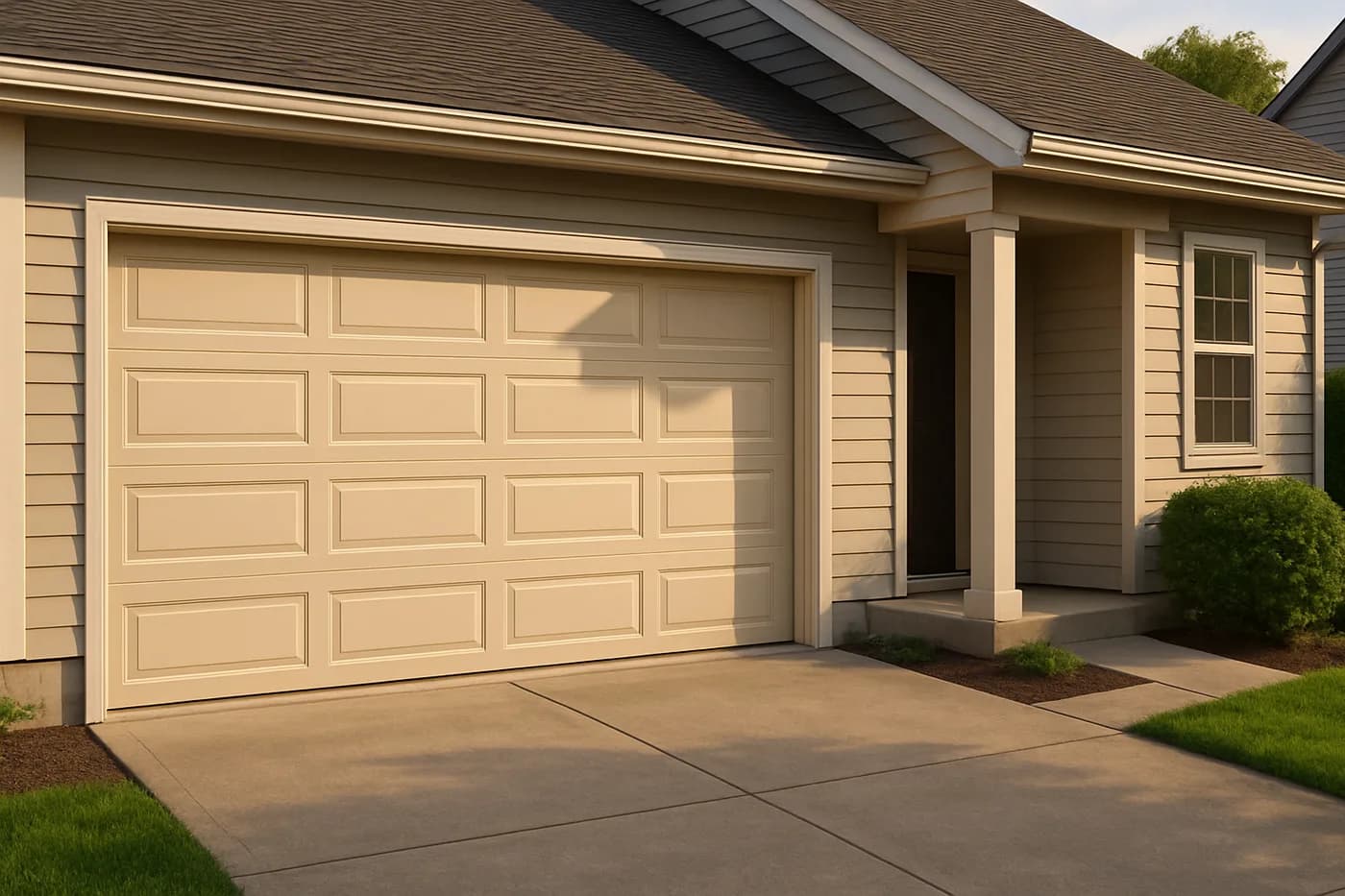
Once you've picked steel sectional, the next choice is panel style. Long-panel doors have wide, uninterrupted horizontal panels. Short-panel doors have the same panels subdivided into squares — the traditional look most people picture when they think "garage door."
The price is the same at the entry level. A long-panel door on an entry-level line such as the Amarr Lincoln costs $1,100 to $1,700 installed for a standard 16x7 double-car opening regardless of whether long or short panels are chosen, because the stamping does not change the price at that tier.
The failure mode is not the same. Long panels dent more visibly than short panels because a dimple lands in the middle of a wide, flat, unbroken surface, while the same dent on a short-panel door is partially camouflaged by the surrounding subdivided pattern. If you have kids with bikes, a basketball hoop above the door, or a driveway that gets hail, this matters.
Carriage house and full-view doors
These are the two style upgrades most buyers consider once they've decided a plain sectional is too plain.
Carriage house doors are still sectional doors underneath — same tracks, same springs, same opener. What changes is the exterior styling: overlay hardware, decorative hinges and handles, sometimes a plank pattern stamped or applied to the panels. The Amarr Carriage Court and Hillcrest premium lines run $3,500 to $7,500 installed once window sections and overlay hardware are added. They're the right choice for a house with real architectural intent — a Craftsman, a Tudor, a farmhouse — where a plain long-panel door would look wrong.
Full-view aluminum doors are the glass-and-aluminum-frame doors you see on modern homes and the front of car dealerships. The full-view aluminum Hillcrest is capable of climbing past $10,000 for wider openings. They're beautiful and they're specific — the wrong house makes them look like a commercial mistake, and the insulation value is low because the panels are mostly glass.
Wood doors, and why almost no one should buy one
Wood is the category people romanticize and then regret. Custom wood garage doors run $4,000 to $15,000 installed depending on species and hardware, and require refinishing every three to five years. The refinishing is not optional. A neglected wood door swells, cracks, and eventually delaminates.
Wood is right for one buyer: someone with a specific architectural home where a steel carriage-house replica would be visibly wrong, who has the budget for the door and the discipline to maintain it. For everyone else, a good carriage-house steel door delivers the look at a third of the cost and none of the refinishing.
Rolling steel doors
These are the coiling doors you see on storage units, warehouses, and some commercial applications. They roll up into a coil above the opening instead of running horizontally along tracks. For residential use, they're almost always the wrong answer — the aesthetics are industrial, the insulation options are limited, and the operating hardware is more expensive to service.
The exception: a detached workshop, a barn conversion, or a garage where ceiling space is too limited for sectional tracks. In those cases, rolling steel is a legitimate choice. Otherwise, skip it.
The opener is part of the decision
You cannot separate the door from the opener, because door weight determines opener size. For a double-car door, a solid wood door, or an insulated steel door over 16 feet wide, three-quarter horsepower is the minimum opener size to avoid premature motor burnout.
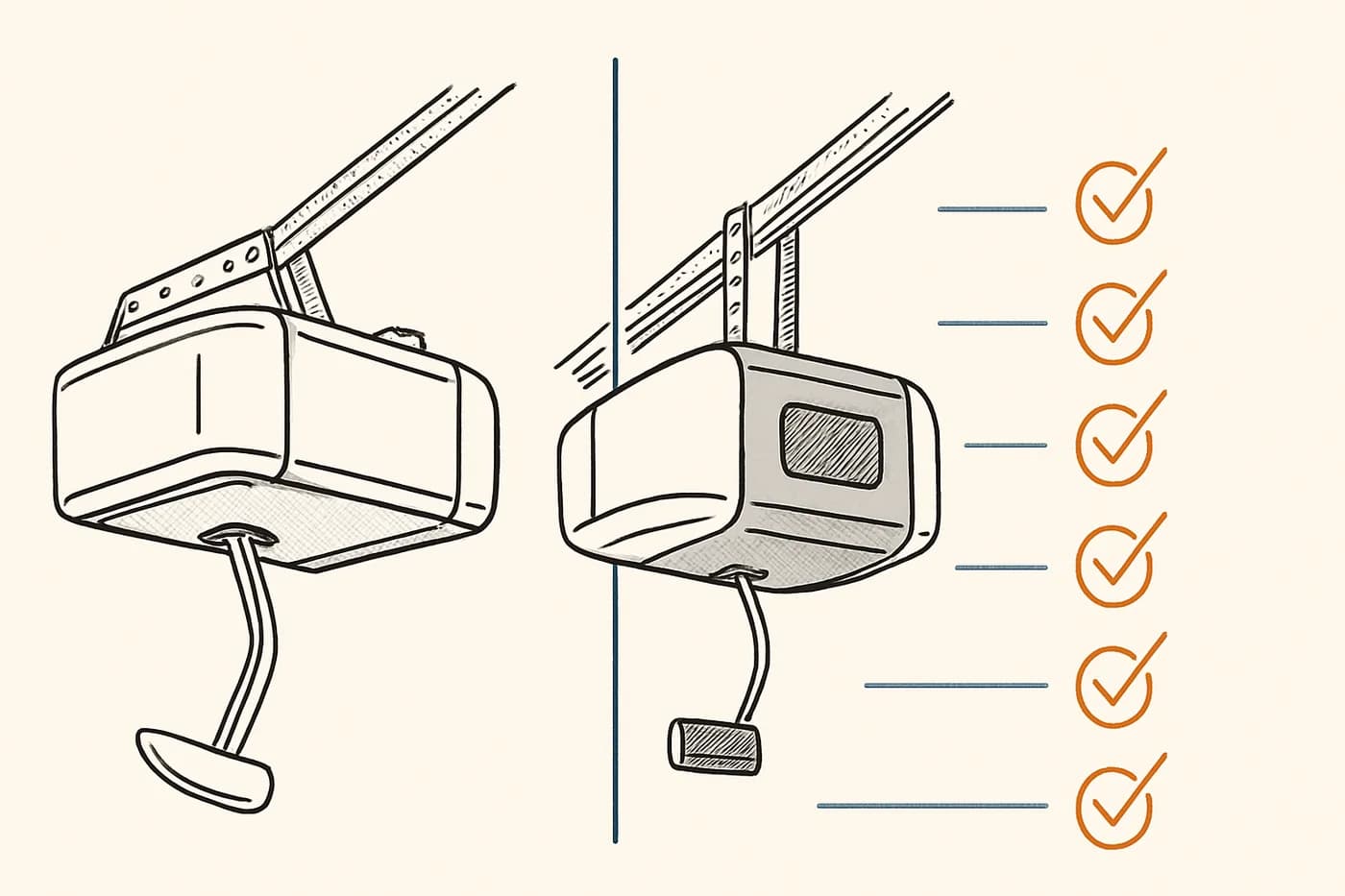
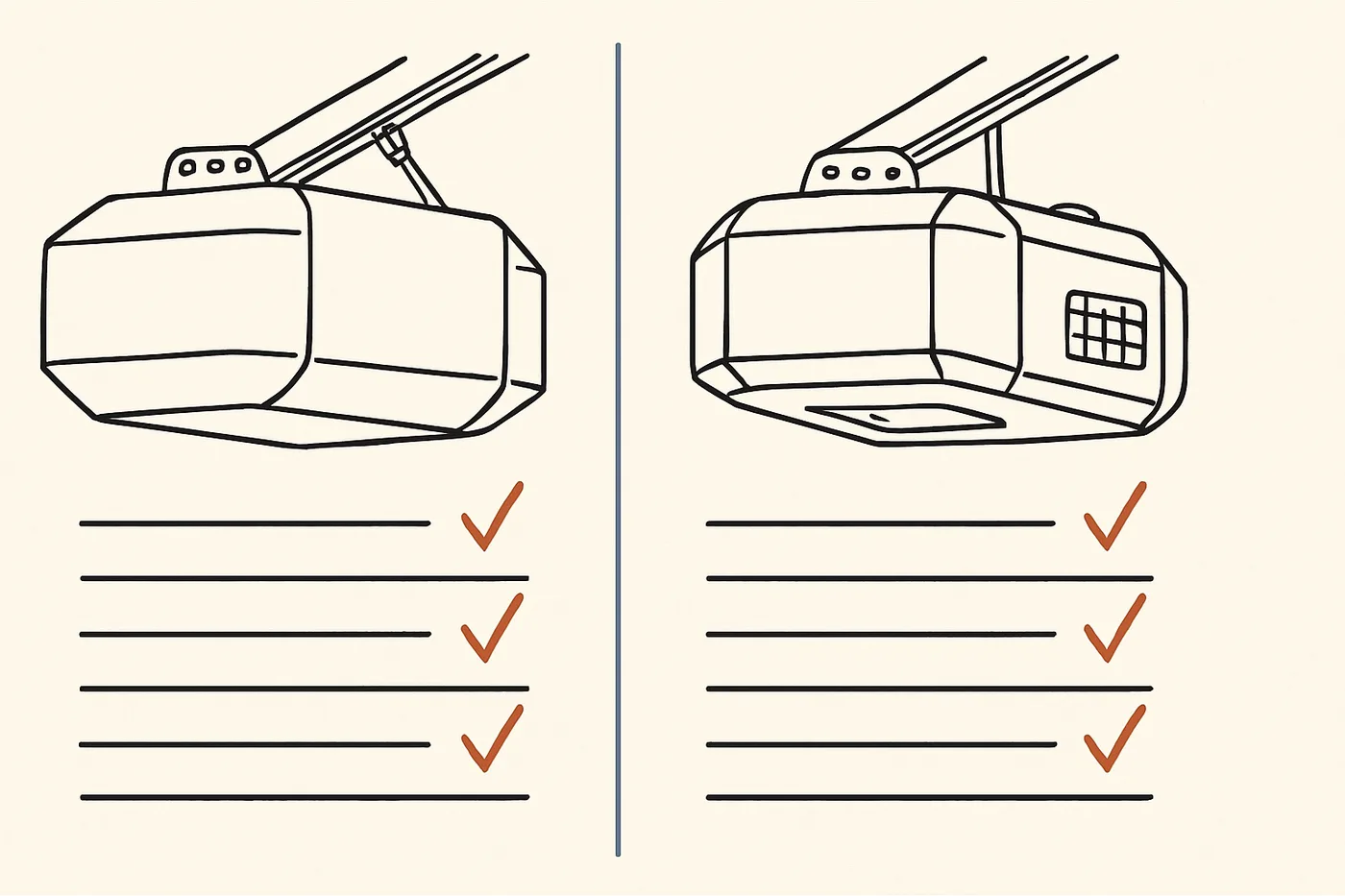
Drive type matters if the garage is attached. A chain-drive opener costs $350 to $500 installed and lasts 10 to 15 years, while a belt-drive opener costs $450 to $650 installed and lasts 12 to 15 years, with the belt drive operating at roughly 50 dB versus the chain drive's 70-plus dB. A direct-drive opener costs $650 to $900 or more installed, lasts 20 years or more with minimal maintenance, and most units carry a lifetime warranty on the motor — the motor unit itself travels along the stationary rail, producing the quietest operation of any opener type. Skip screw drives entirely: the grease on the threads becomes stiff in cold weather and loud in heat, and parts are harder to source.
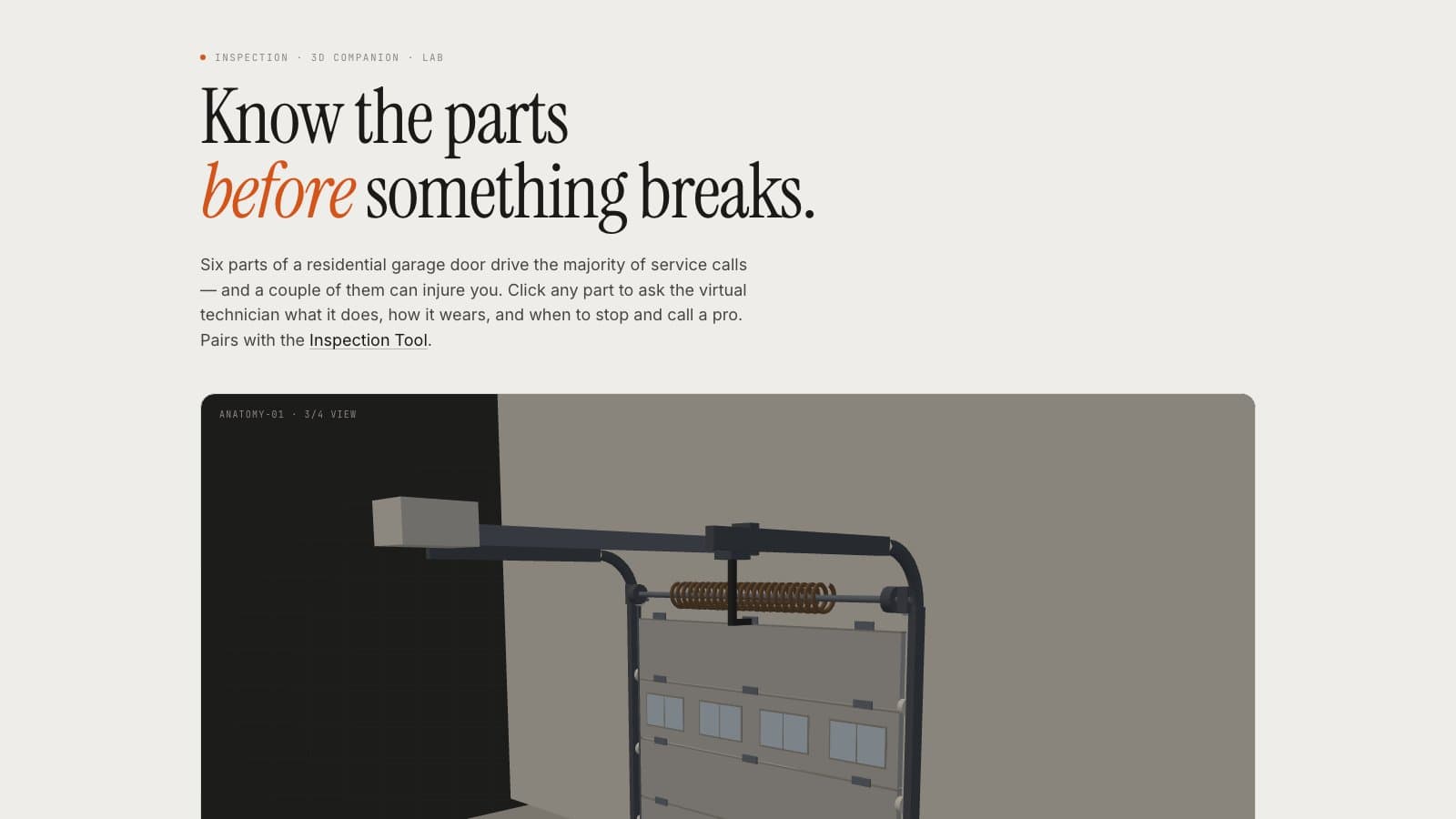
On the mechanical side: standard torsion springs are rated to 10,000 cycles — roughly 7 to 10 years of daily use — while high-cycle springs rated to 25,000 to 100,000 cycles cost $75 to $150 more upfront and last proportionally longer. If you're paying for a twenty-year door, pay the extra $100 for springs that will last as long. If you want to see how all these parts fit together before you shop, the garage door anatomy lab and the science of garage doors lab both walk through the assembly, and Maya's tech-decoded video covers the mechanical vocabulary in about six minutes.
One more consideration before you buy new: if your existing door still functions but has cosmetic damage or a broken component, get a repair quote first. The rule of thumb is that if a single repair quote exceeds 50 percent of the cost of replacing the door with the same tier, replacement is the better financial decision. For Las Vegas homeowners, A+ Garage Doors handles both the diagnostic call and the replacement if it comes to that; nationally, Garage Door Pro Services includes a free garage door safety inspection as part of a standard visit, which is worth having done regardless of whether you replace. If a new opener is on the list, that inspection also tells you whether the existing door is heavy enough to demand three-quarter horsepower or louder than it should be.
The decision
One: is the garage attached to the house? If detached, buy a polystyrene-insulated steel sectional in the $1,100 to $1,700 range and be done. If attached, keep reading.
Two: does your house have specific architectural character — Craftsman, Tudor, farmhouse, mid-century modern? If yes, spend the extra $1,500 to $3,000 on a carriage house or full-view door that matches the architecture. If no, a long-panel or short-panel polyurethane steel door in the $1,700 to $2,900 range is the right answer. Choose short panels if the door faces heavy use or a driveway where damage is likely.
Three: is there living space above or immediately adjacent to the garage? If yes, pay for the three-layer polyurethane door at R-16 to R-18 and pair it with a belt or direct-drive opener. If no, a two-layer polyurethane door and a chain-drive opener is fine and you should keep the $500 in your pocket.
For most buyers reading this, the answer is an insulated steel sectional, polyurethane core, short-panel or long-panel depending on the driveway, paired with a belt-drive opener and high-cycle springs. Total installed cost lands between $2,000 and $3,500. That's the middle of the market, and the middle of the market is where it should be.