Want an insulated roll-up door on your garage? What is made, and what the numbers mean
Insulated roll-up (coiling) doors exist, but the ones with published insulation numbers are sold for commercial buildings. Here is what the makers list, how it compares with a sectional door, and what to ask a dealer.

You are looking at a roll-up door for your garage because you want something that coils out of the way, or that holds up. Then you added the word "insulated" and the search results got thin. That is not you. Insulated roll-up doors exist, but the makers publish their insulation numbers for commercial buildings, and a home garage is a different job. Here is what the makers actually say, so you can decide whether to ask a dealer about one.
The short answer
- They exist. Raynor lists insulated flat slats for its DuraCoil rolling door. Cornell lists a foam-filled insulated rolling door.
- They are sold for commercial and industrial buildings. Raynor calls DuraCoil "an ideal choice for commercial and industrial applications." Cornell's page names hotels, convention centers, condominiums and parking garages, and never mentions houses.
- We did not find a manufacturer page that sells an insulated roll-up door to a homeowner. If one is in your plan, a dealer has to tell you whether they will supply and service it for a house.
What the insulation numbers are
R-value is how well the insulation resists heat flow, and a higher number means the door keeps more of the heat in or out (Clopay). Here is what is published:
| Door | What the maker lists |
|---|---|
| Raynor DuraCoil, insulated flat slat | "R-Value of 6.24" for the slats; in its energy-code option, which adds side, hood and header seals, a U-factor of 0.90 |
| Cornell Thermiser | "R-value of 8 as calculated using the ASHRAE Handbook of Fundamentals"; slats filled with 7/8 inch of closed-cell urethane |
| Clopay doors, for comparison | From 6.3 up to 20.4 across the doors on its insulation page (the 20.4 doors are polyurethane) |
Two cautions. First, the makers each measure their own door in their own way, so these are not a head-to-head test. Second, the slat is not the whole door. Raynor lists the slat's R-value and, separately, a U-factor of 0.90 in its energy-code option, and a lower U-factor means less heat flow. When you compare quotes, ask for the whole-door number.
How that compares with a typical insulated garage door
Clopay's guide says an R-value between 10 and 13 is best for an attached garage or a cold climate, 15 or higher in more extreme climates, and 6 to 10 for a detached garage or a temperate zone. By that guidance, the two roll-up figures above sit in the range Clopay suggests for a detached garage or mild weather, and below what it suggests for an attached garage in the cold. That is our reading of Clopay's guidance, not a statement from either roll-up maker.
If your garage is attached to the house, or you heat it, the insulation is a big part of the choice. Our R-value guide explains what the number does.
What else Raynor says about these doors
- Sound: Raynor lists a sound rating of STC 22 without a header seal and STC 23 with one, for the insulated flat slat only.
- Air leaks: in that same energy-code option (side, hood and header seals added), it lists air infiltration of .47 CFM per square foot, against a maximum of 1.0 in the 2018 energy code.
- How it works: the door opens by hand, chain, crank or motor, depending on the model.
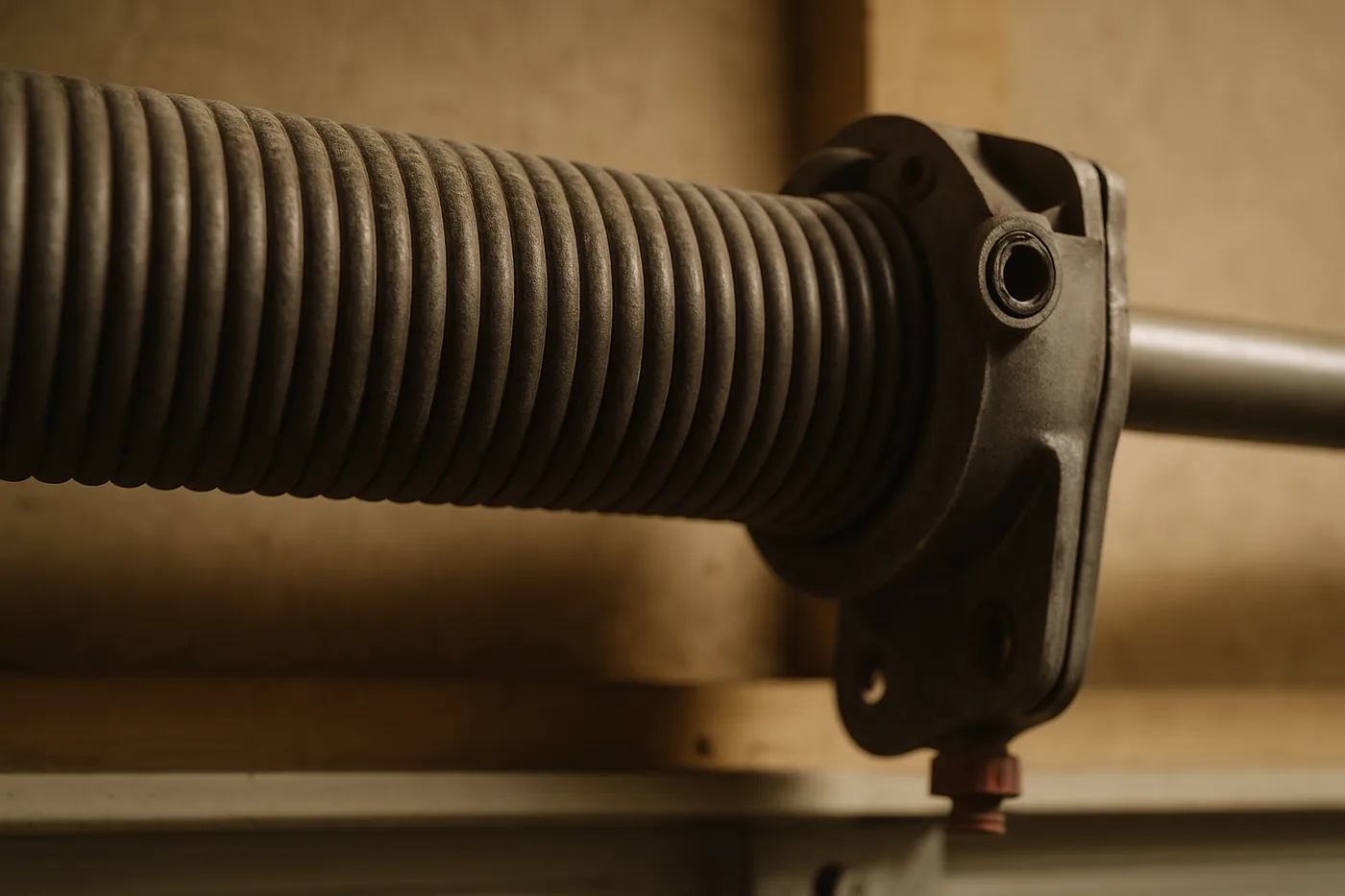
- Springs: the door has a torsion spring in the barrel above the opening. Springs under tension are a technician's job. If a roll-up door gets hard to lift, drops, or will not stay up, stop and call a pro.
What to ask a dealer
- Is this door sold and serviced for a house, and who services the spring?
- What is the whole-door R-value or U-factor, and how was it calculated?
- What is in the slats: foam, a thin layer, or nothing?
- Does the quote include seals at the sides and the top?
- How is it operated, and what happens in a power outage?
Where to go next
Our post on roll-up versus sectional doors covers what each door is and how they differ. The rolling steel lab shows how a coiling door is built, and our rolling steel maintenance guide covers care for one you already have.