Your garage door won't close at night: what to check before you call
A practical troubleshooting guide for when your garage door refuses to close after dark: photo-eye alignment, force settings, manual lock, and when to call for 24-hour service.

It's 10:47 PM. You pulled in, grabbed the groceries, hit the button on your way inside. The door started down, then stopped and went back up. You tried again. Same thing. Now you're standing in the kitchen doorway in socks, looking at a wide-open garage, wondering whether this is a five-minute fix or a five-hundred-dollar one.
Not sure which problem this is? Start with our page on a garage door that reverses or won't close.
Most nighttime close failures are fixable by you, right now, with a flashlight and a little patience. A few are not. This article will help you tell the difference before you decide whether you need someone at your house before morning.
Start with the photo-eyes, because it's almost always the photo-eyes
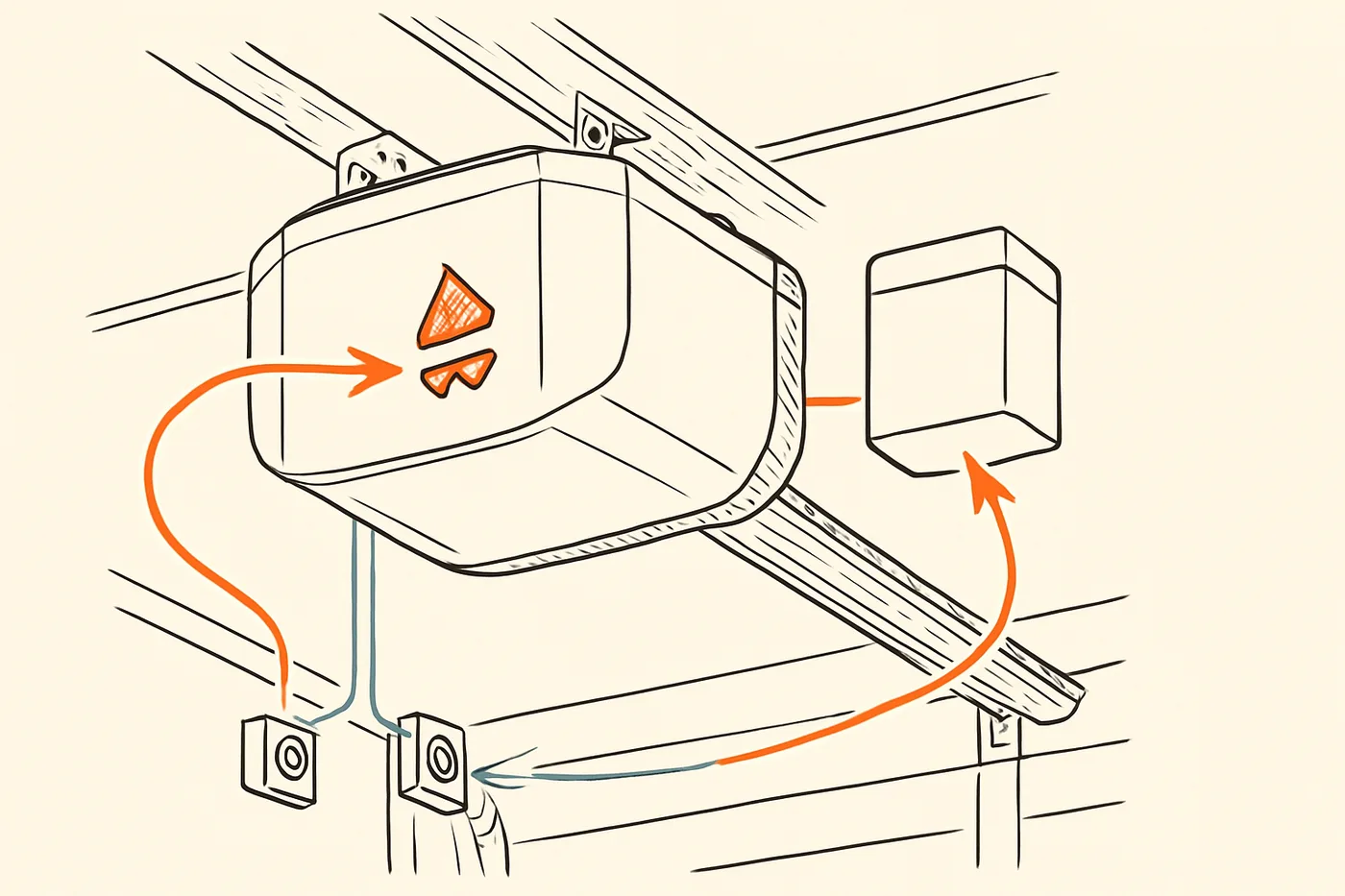
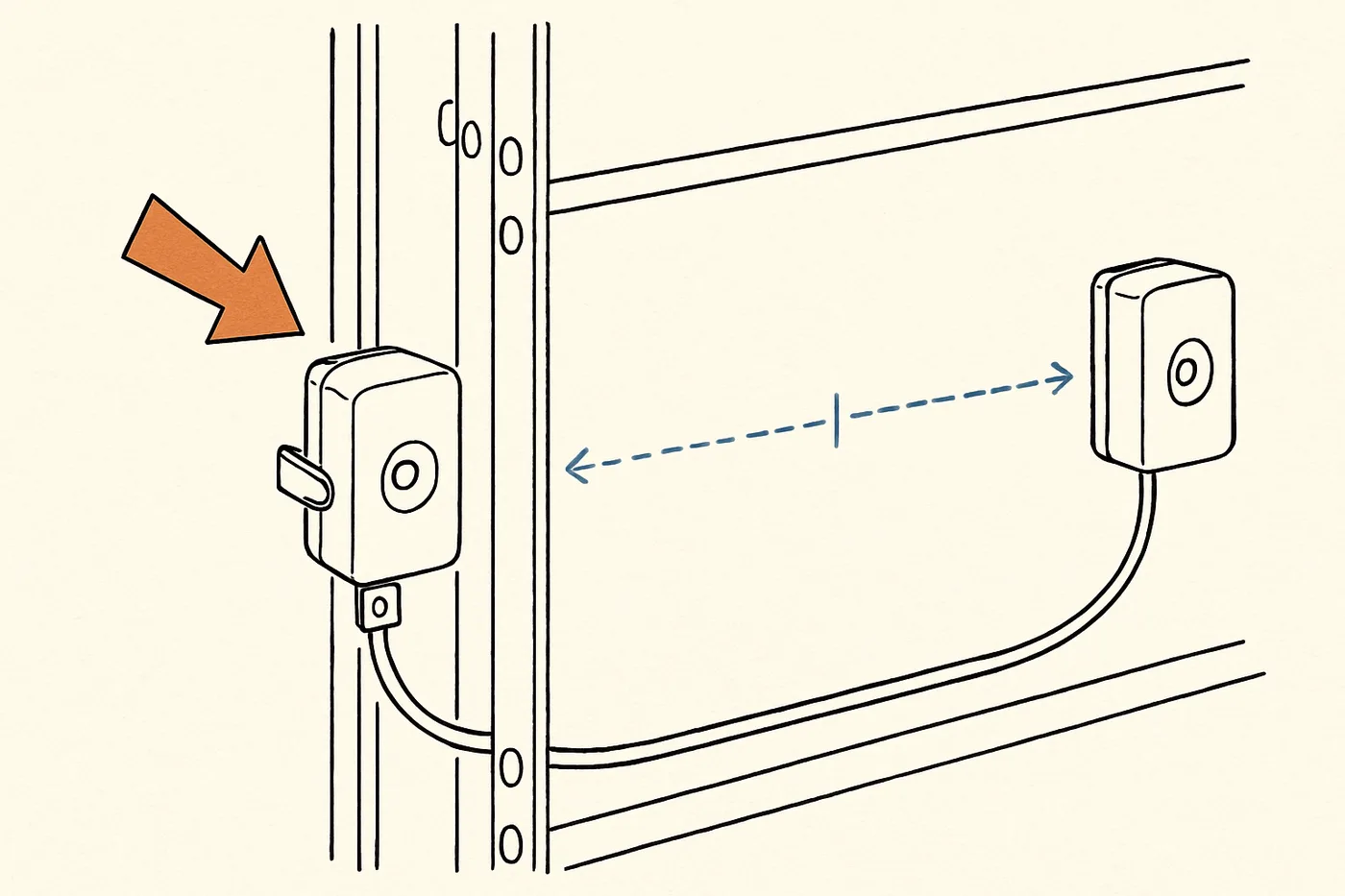
Near the bottom of each track, low near the floor, there are two small sensors that face each other across the opening. One sends an invisible beam. The other receives it. If anything breaks that beam, or if the sensors have drifted out of alignment, the opener will refuse to close. It will start, then reverse. Exactly what you just watched it do.
This is, by a wide margin, the most common reason a garage door won't close. Each sensor has a small LED. One is typically green (the sender), one red (the receiver), though colors vary by brand. Both should be steady. If one is off, or blinking, the beam isn't making it across.
Walk out with your flashlight and look at each sensor. In order:
- Is there anything in the beam path? A rake handle, a recycling bin, a cat, a leaf that blew in. Sweep the opening clear.
- Is either lens dirty? Garage-door sensors sit at shin height and collect dust, cobwebs, and road salt. Wipe each lens gently with a soft cloth.
- Is either sensor knocked sideways? A bumped bike, a kicked storage bin, a snow shovel leaned against the track: any of these can nudge a sensor a few degrees. The beam is narrow. A few degrees is enough.
If a sensor is out of alignment, loosen the wingnut holding its bracket, point it at its partner, and tighten it back down when the LED goes steady. You're aiming, not adjusting anything structural.
The wall-button test that tells you what you're dealing with
Here's a quick check that can save a service call. Go to the wall-mounted button inside the garage, not the remote and not the keypad, and press it once. Watch the door the whole way.
Try the wired wall button. If it closes the door normally but the remote or keypad won't, the sensors are probably fine and the remote or keypad is the problem. If nothing will close the door, something is still interrupting that beam, even if you can't see what. A spider web strung between the lenses at night. A sensor that's close to aligned but not quite. The bracket drooping half a degree because the screw is loose. Do not try to get around the sensors.
If the door still reverses on the wall button, the opener is finding something in the way, and the next steps are the sensors and the opener's own settings. If you can't tell, a technician can.
Check whether the manual lock got flipped
Most garage doors have a manual lock: a bar or slide mechanism on the door itself, often engaged by a key or a handle on the inside. If you had a power outage earlier, or if someone in the house was buttoning up for a trip, that lock may have been thrown without anyone thinking to mention it.
An engaged manual lock prevents the opener from moving the door and can damage the opener if you keep triggering it. If the opener is straining, clicking, or the motor hums without the door moving, stop pressing the button. Walk to the door. Look at the lock mechanism. Disengage it. Try again.
This is the check that saves people from replacing an opener they didn't actually break.
Cold night, stiff door: the force setting question
If it's cold out (say, below freezing) and the door closes fine when you pull the red release cord and guide it down by hand, but reverses when the opener does it, you may be looking at a force-setting issue. Cold stiffens lubricant and increases the force an opener needs to move the door. The opener feels that extra resistance, interprets it as an obstruction, and reverses. It's doing exactly what it's designed to do.
Do not turn the force settings up to make the door close. The reversal feature exists to keep the door from crushing a person, a pet, or a car bumper, and a higher setting defeats it. A door that reverses only in the cold is telling you something is binding or stiff. Leave the settings alone and have a technician find out why. If you're not sure, leave it and call in the morning.
When the opener light flashes and the door reverses
Most openers have a diagnostic behavior you may not have noticed: when the door reverses mid-close, the light on the opener head flashes a pattern. That pattern is the opener telling you it sensed an obstruction. Check the track for debris, a broken spring, or a shifted door panel.
Look at the door itself. Stand inside and shine your light up at the springs above the door. If you see a spring that has a visible gap in it (a break where the coils have separated by an inch or two), stop.
Do not try to close the door.
Do not pull the release and lower it by hand.
A broken spring means the door's full weight is no longer counterbalanced. That weight wants to come down. The cables, the brackets, and the opener are now holding far more load than they were designed to hold continuously. This is the part of the article where the line is. You can check photo-eyes. You can disengage a manual lock. You do not work around a broken spring. A technician does that, with the right tools, in the right sequence. If you want to understand what all these parts do and why the spring is the one you don't touch, the anatomy lab walks through it.
When to call tonight versus call in the morning
Open garage, broken spring, car inside, valuables inside: that's a tonight call. Most 24-hour garage door services charge a premium for after-hours work, but an open garage overnight in a neighborhood you're not sure about is not a saving you want to chase.
Open garage, everything checks out on the photo-eyes and the lock, nothing visibly broken, but the door still won't close: also a tonight call. Something is wrong that you've ruled out the easy causes of, and leaving the door up until 8 AM is a security decision, not a diagnostic one. A+ Garage Doors (our affiliated installer) offers same-day emergency service in the Las Vegas valley, and Garage Door Pro Services (our affiliated installer) provides the same across Southern Utah.
Photo-eyes cleaned and aligned and the door now closes, with only an occasional cold-weather reversal left: that's a morning call, scheduled at normal rates, with time to think.
The door being open is the problem. Everything else is a question of when you solve it and how much it costs.