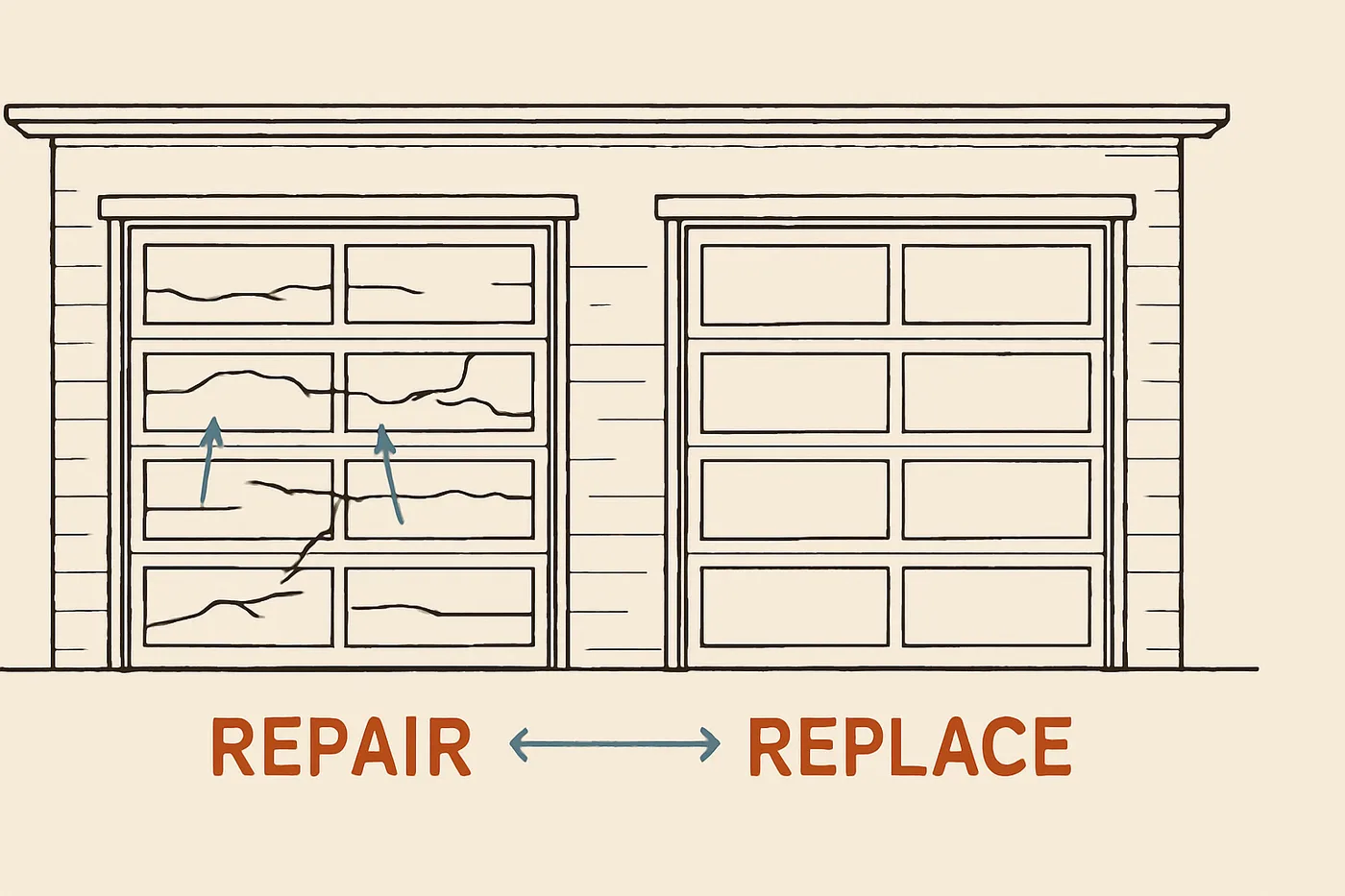
Repair or replace your garage door? How to decide when you have a quote in hand
You have a repair quote and a nagging feeling the door is on its way out. Here is how to compare the quote to a replacement, what to ask the technician, and which conditions mean stop using the door.

Repair or replace? Start with the quote
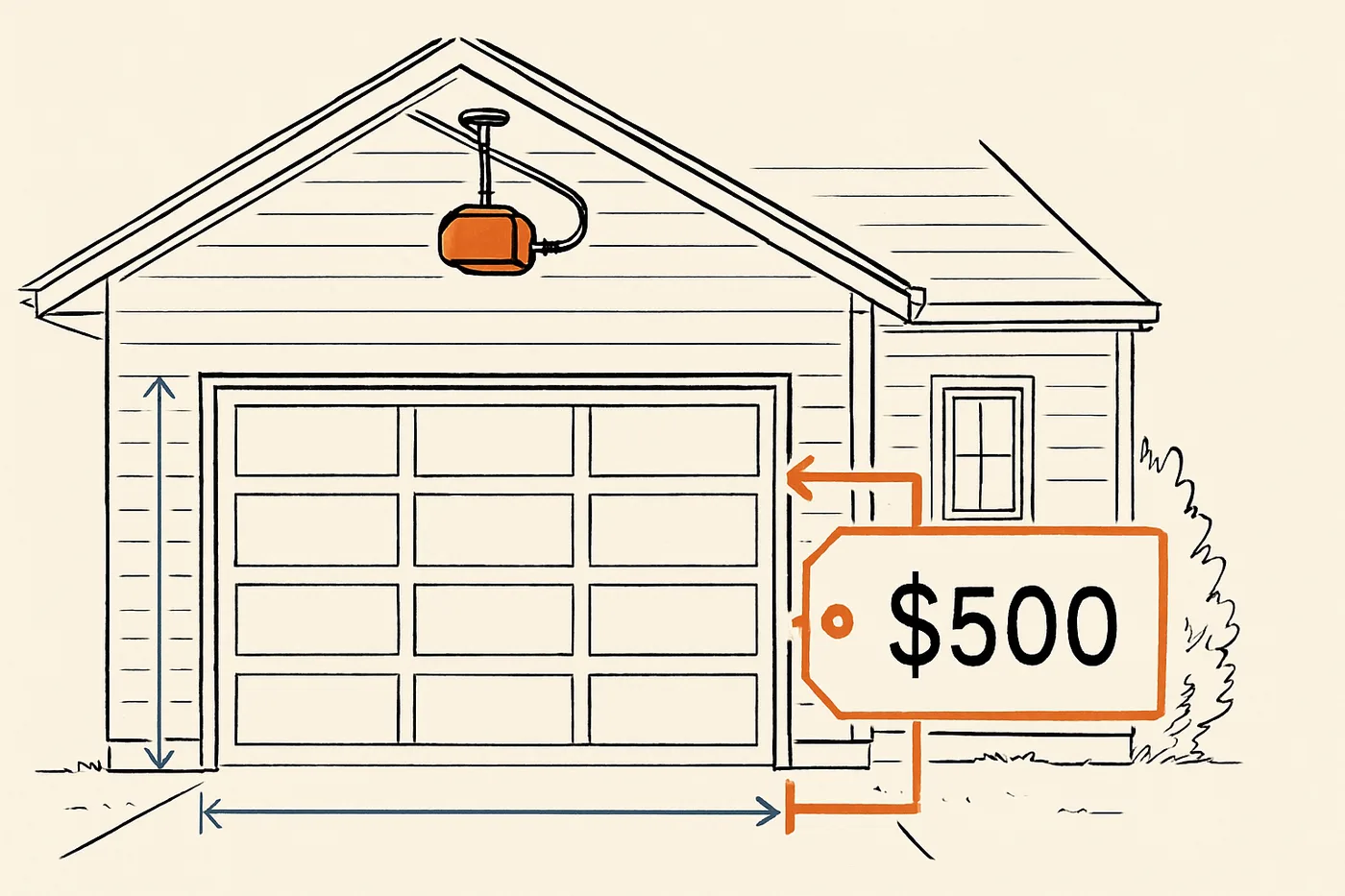
There is no standard that says when a garage door should be replaced, so treat the rules below as ours, not a manufacturer's or an industry body's. What you can anchor on is what the work typically costs. HomeAdvisor's repair-cost page (updated Jun 20, 2026) puts a typical repair at $155 to $379 with an average of $265, with springs at $180 to $350, cables at $100 to $400, a single panel at $250 to $1,000 and an opener at $100 to $500. HomeAdvisor's installation page (updated Jun 17, 2026) puts a replacement at $754 to $1,707, with an average of about $1,231.
Those are one aggregator's ranges, not a price list for your door. Your own written quotes beat both.
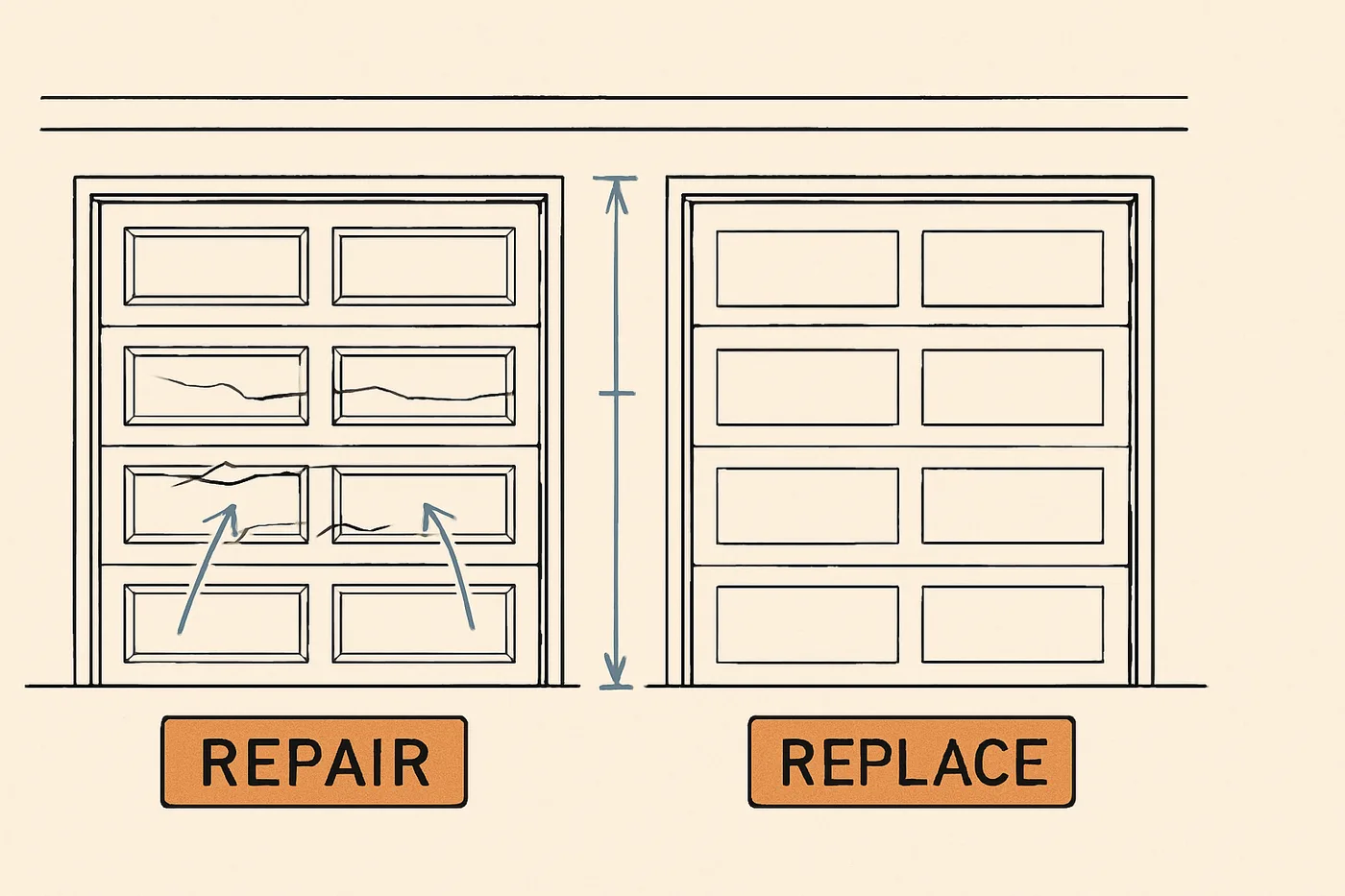
Replace vs. repair decision table
Use this as a first triage before the technician arrives. It is our rule of thumb, not a standard.
| Situation | Leans repair | Leans replace |
|---|---|---|
| One broken spring, door otherwise sound | Yes | No |
| Cable frayed or kinked | Stop using the door and call a pro first, then decide | Consider if the tech finds other wear |
| One dented panel, surrounding panels intact | Yes | No |
| Several panels buckled or dented | No | Yes |
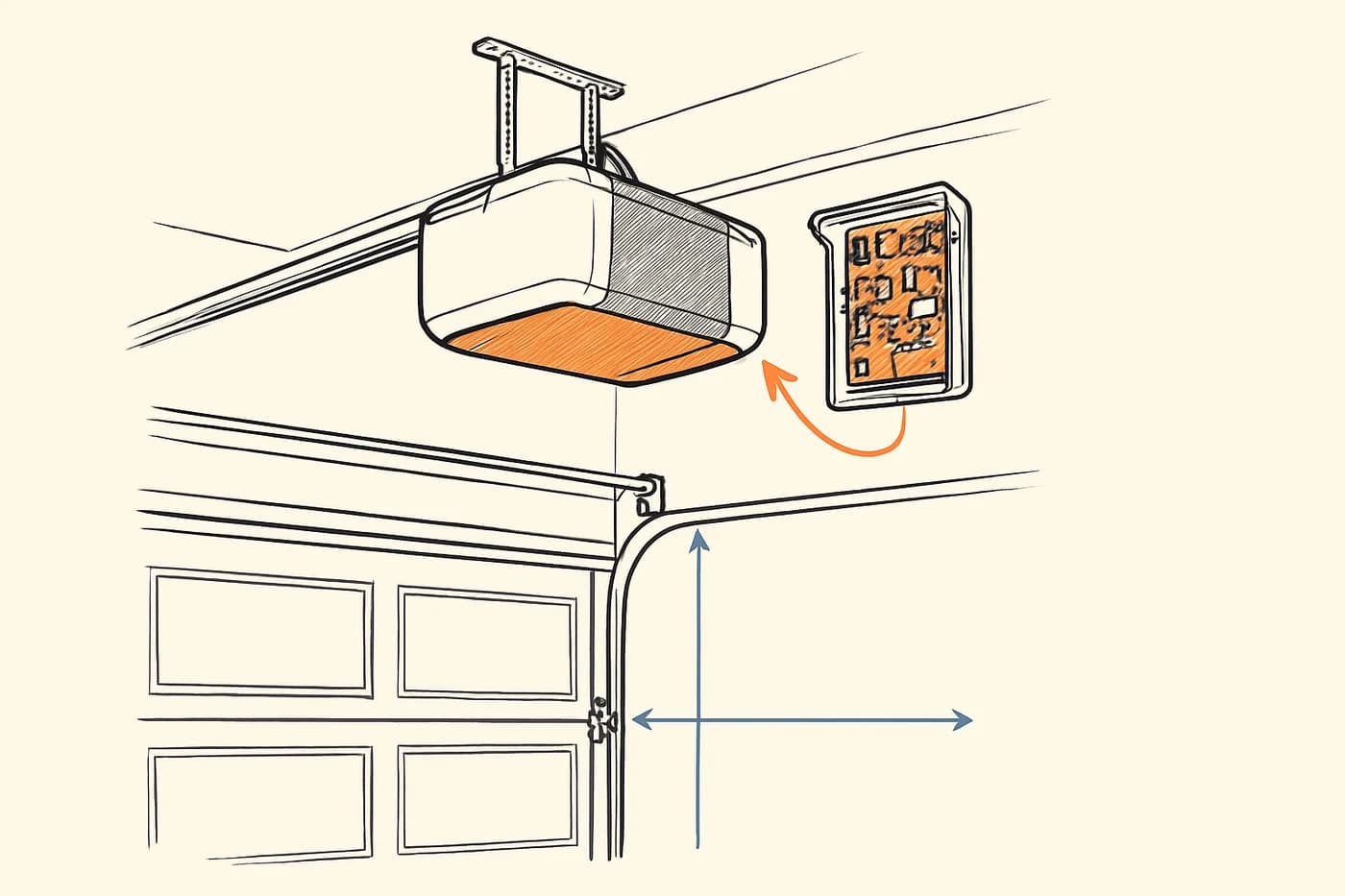
| Bad opener, door structure sound | Yes (replace the opener only) | No |
| The repair quote is a large share of a replacement quote | No | Yes |
| The tech flags several worn parts on an old door | No | Yes |
| Single-pane door on a heated attached garage | No | Yes |
| The door keeps failing | No | Yes |
For the opener, which wears out separately from the door, see how long garage door openers last. For what a new door runs, see how much a new garage door costs.
Test 1: Is the repair a big share of a replacement?
Compare the quote with a written replacement quote for the same kind of door you have now, not the cheapest one on the internet. If the repair is a large share of it, replacing starts to make sense, particularly if the technician also found other worn parts. We use "more than about half" as our own rule of thumb; it is a judgment call, not a rule from HomeAdvisor or a manufacturer. A single spring on a door that is otherwise sound is a repair, not a reason to replace.
Test 2: How much life is left, and what else is close to failing?
Springs, cables, rollers and hinges all wear with use, so when one fails the others may not be far behind. On the same visit, ask the technician what else is close to failing: the cables, the rollers, the opener, the bottom seal, the second spring. Price the whole list, then apply Test 1 to the total, not to the one item that brought them out. If the door is old and the quote is for more than one part, ask for a replacement quote beside it.
For the spring: a standard spring is rated for about 10,000 cycles, one cycle is one full open and close, and at four cycles a day that is about seven years (IDC Spring, a spring manufacturer). A door whose springs have not been replaced in that time has used most of that rating.
Test 3: The safety line
Some conditions move the decision out of the spreadsheet. If you see frayed, kinked or uneven cables, a spring that has visibly separated, a bottom bracket pulling away from the panel, or a door that has come off its tracks, do not use the door and call a professional. Cables and springs are under tension, and none of these is a homeowner repair.
When you are across the safety line, the question is not "repair or replace" yet. It is "make the door safe today, then decide." Pay for the safety fix, then use the two tests above for the rest of the system.
What a repair quote often leaves out
Before you compare a repair quote with a replacement quote, make sure both are complete. Ask about:
- The springs. Ask whether the quote covers every spring on the door.
- The bottom seal. See the weather-seal guide.
- Removal and haul-away of anything being replaced. HomeAdvisor notes that removal is sometimes extra, at $50 to $200 for labor and disposal.
- A service call or trip fee. HomeAdvisor lists a quick service call at $50 to $75.
- The spring's cycle rating. Ask which spring the quote includes.
Every one of those is a line you can ask about before you sign.
The case for replacement that repair math misses
Repair-versus-replace arithmetic treats the door as a cost. A new insulated door with good seals also changes how much heat moves through the garage wall, which can matter on an attached, heated garage. Whether the savings are meaningful depends on your climate, your utility rates and how long you will stay. Model it yourself in the ROI lab with your own numbers, and see our insulated door guide for what the upgrade runs.
Before you call anyone
Run the 24-point inspection tool first. It walks you through what a technician checks and produces a scored report you can show an installer, so you know the state of the whole door, not just the part that failed.
The decision in three questions
- Is the repair quote a large share of a written replacement quote for the same kind of door? If yes, get a replacement quote before you authorize the repair.
- Is the door old, and did the technician flag anything else that is worn? If yes, price the whole list and apply question 1 to the total.
- Is there a safety-line condition (frayed cable, separated spring, off-track door)? If yes, do not use the door, have it made safe today, and decide repair or replace this week.
If all three answers are no, fix the door. If any is yes, put a replacement quote on the calendar before the repair crew leaves. If you need a professional assessment, A+ Garage Doors (our affiliated installer) repairs garage doors in Las Vegas, and Garage Door Pro Services (our affiliated installer) covers repair and replacement in their service areas.