Smart Garage Door Openers: Are They Worth It?
A decision framework for homeowners considering a smart garage door opener: what you actually get, what a smart opener adds to your home network, and whether the convenience justifies the premium.

The question you're actually asking is whether the extra money for a smart opener is going to pay for itself in convenience, or whether you're about to buy a feature you'll use twice and ignore forever. That's a fair question. The answer depends on how you actually use your garage, not how you imagine you'll use it once the app is installed.
Most of the confusion comes from people thinking they're buying something different from what's actually in the box.
What a smart opener actually does
A smart garage door opener is a normal garage door opener with a Wi-Fi radio and a companion app. The mechanical side (the motor, the rail, the trolley, the safety sensors) is identical to the non-smart version in the same product line. What you're paying extra for is the radio and the software.
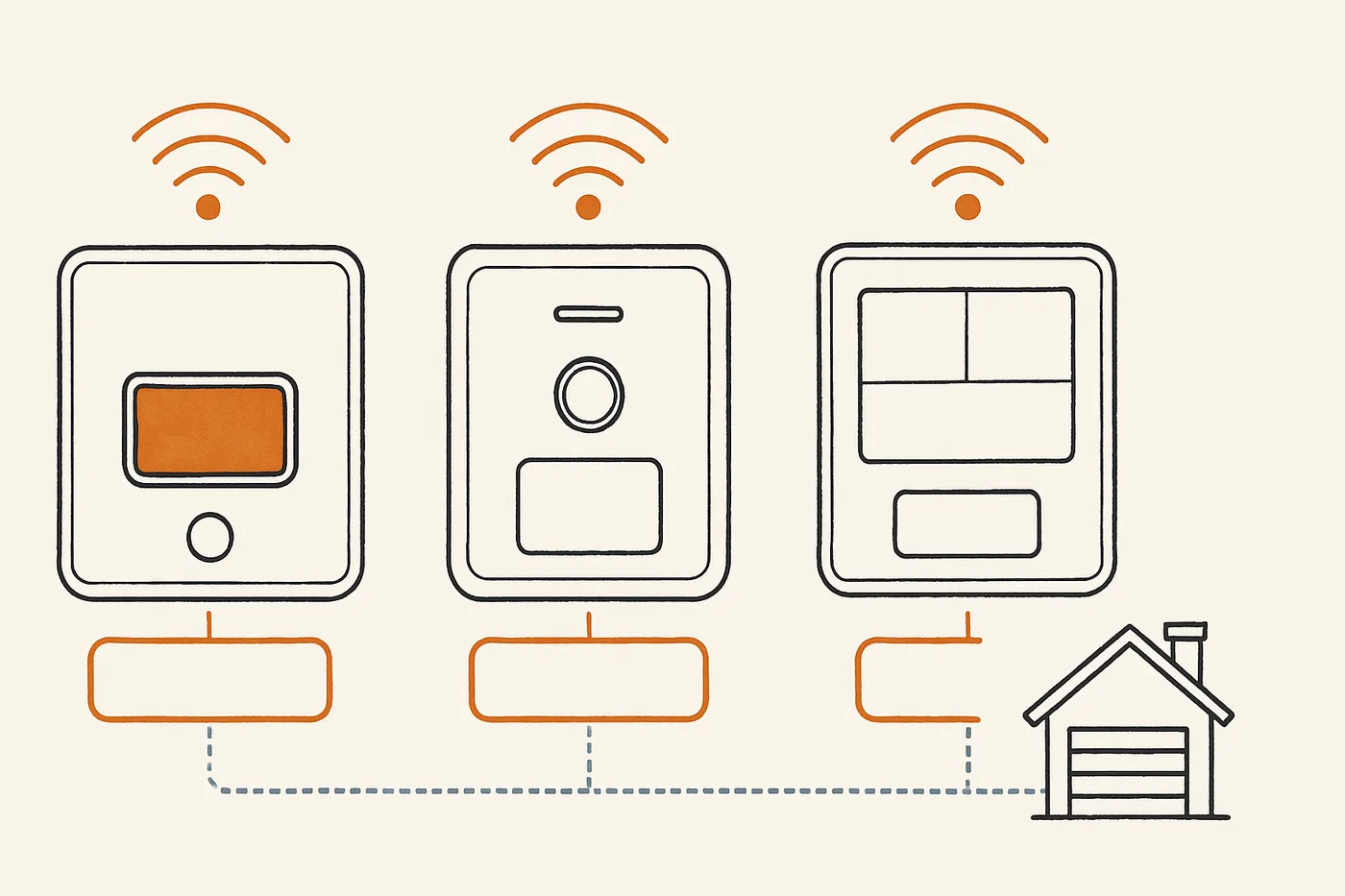
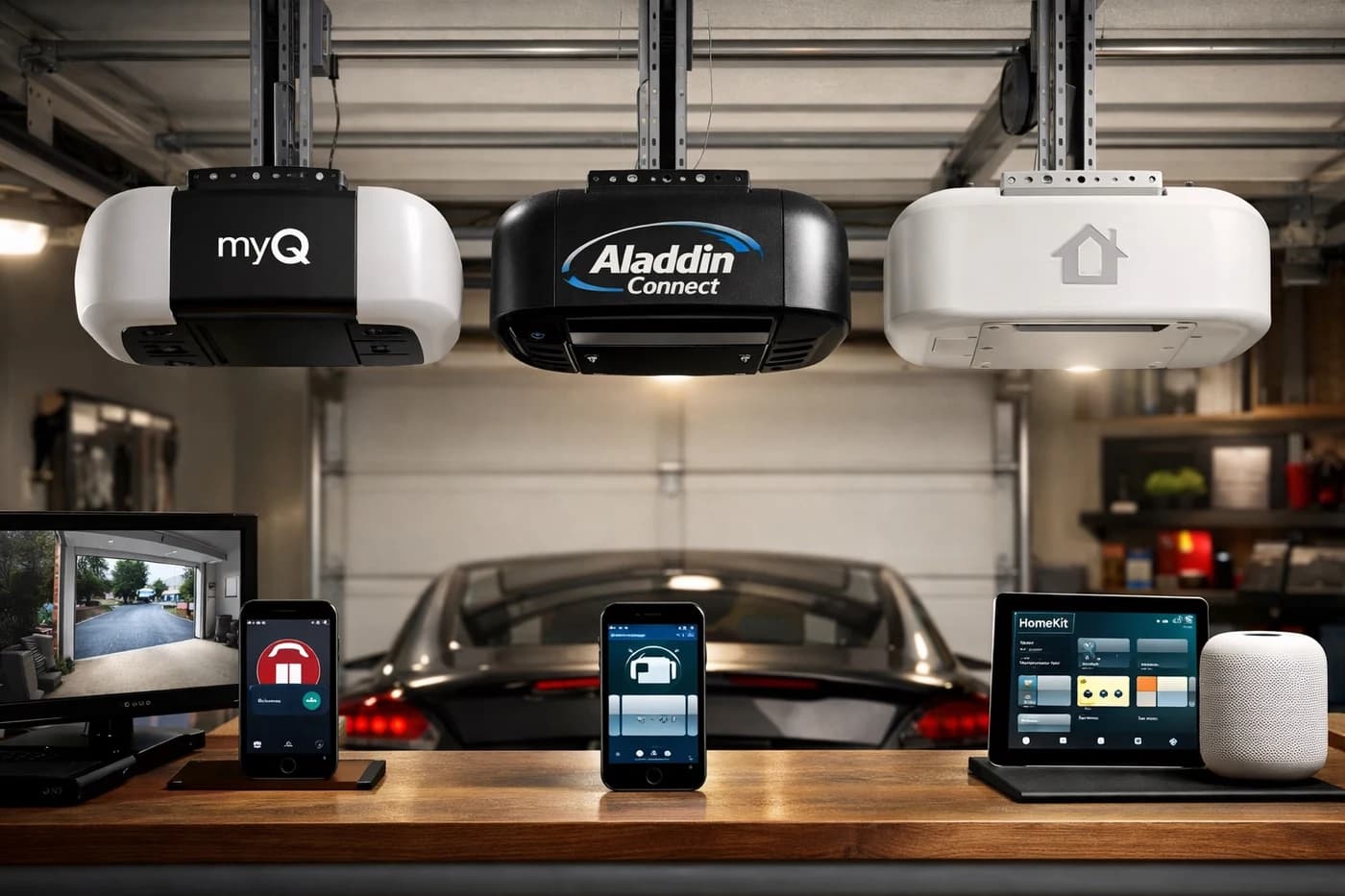
Consumer Reports' review of smart controllers lists MyQ (Chamberlain) and Aladdin Connect (Genie) among them, and which voice assistants each works with differs, so check that yours is supported before you buy.
Once connected, the app does four things. It tells you whether the door is open or closed. It sends a push notification when the state changes. It lets you open or close the door remotely from anywhere with an internet connection. And it logs a history of open/close events with timestamps.
That's the product. Everything else is an integration layered on top.
What the integrations actually get you
This is where smart openers start to earn the premium, or fail to. The useful integrations fall into three categories.
In-garage delivery. Chamberlain says Amazon Key in-garage delivery works with a myQ-connected opener: the driver can open and close the garage to place packages inside, and no access codes or keys are shared with the driver. If you live somewhere with porch theft, or you get multiple packages a week and none of them can sit outside, this can justify the opener by itself.
Home system handoff. Consumer Reports says the Ring integration with MyQ shows your door's open or closed status and sends you to the MyQ app to act on it. Whether that is worth anything depends on your setup.
Routine triggers. Door closes, lights turn off. Door opens in the morning, thermostat adjusts. If your house is currently dumb, this isn't going to be the thing that converts you.
Everything else (geofencing that closes the door when you leave the neighborhood, voice control through whichever assistants your opener supports, shared access for family members) works, but it's a nice-to-have, not a reason to buy.
One more thing to keep in mind: a smart opener is one more device on your home network, with an app account behind it. Keep the opener's software updated and use a password for the maker's app account that you do not use anywhere else. If you are not going to do that, a standard opener is the simpler choice.
What you don't get by going smart
A smart opener is not quieter. Smart features don't affect motor noise. If you have living space above the garage, the noise question is about belt versus chain drive, and you should read the chain vs belt vs screw drive comparison before you worry about smart features.
A smart opener is not more reliable. The motor and drive are the same as the non-smart version. The radio fails separately from the mechanics, and when it does, you still have a working opener. You just lose the app.
A smart opener does not satisfy California's battery backup requirement on its own. SB 969 requires battery backup on residential openers made, sold or installed in the state, and smart functionality is not part of that requirement. HomeAdvisor says chain drive openers often come without battery backups, while most other types include them, so don't assume yours has one. Check the spec sheet.
A smart opener does not fix a door with worn springs, misaligned tracks, or bad cables. If you don't know what those parts do, the garage door anatomy lab is worth a look before you spend anything on a new opener.
Who should buy smart, and who shouldn't
HomeAdvisor says Bluetooth-enabled smart belt-drive openers cost more but gives no figure, so compare the listings for the smart and standard versions of the unit you're looking at.
Buy smart if: you get packages delivered regularly and porch theft is a real concern where you live, you already use a smart home setup that the opener supports (check the supported list first), or you have more than one driver in the household and the "did I close the garage?" question comes up more than once a month. Any one of those is worth the premium.
Skip smart if: you live alone or with one other adult, you close the door reliably on your way in, you don't order much online, and you don't have a broader smart home. You will open the app a few times in the first weeks and then stop. The feature you're actually buying is peace of mind, and you already have it for free.
The three-question decision
One: do you get packages at your house that can't sit on the porch? If yes, and your carrier supports Amazon Key or equivalent, the smart opener pays for itself. Buy it.
Two: do you have an existing smart home setup that the opener would feed into? If yes, and you already keep the software and passwords up to date on those devices, the integration is worth the premium. Buy it.
Three: if neither of the above applies, do you, specifically you, forget to close the garage door often enough that knowing its state from your phone would meaningfully reduce your stress? If yes, buy the smart opener. If you had to think about it, the answer is no, and you should put the money toward a belt drive instead.
For the middle-of-the-road homeowner (attached garage, regular package delivery, one existing smart speaker in the kitchen), buy the smart opener. The Amazon Key integration alone justifies the premium, as long as you are willing to keep the software updated. For everyone else, save the money. Either way, if you'd rather have a professional handle the installation so the smart features are set up correctly from the start, A+ Garage Doors (our affiliated installer) offers same-day opener installation and repair in Las Vegas.