Garage Door Repair Cost in 2026: What Every Common Fix Actually Costs
Learn typical garage door repair costs for springs, cables, openers, and panels. Get pricing ranges and factors affecting your repair bill.

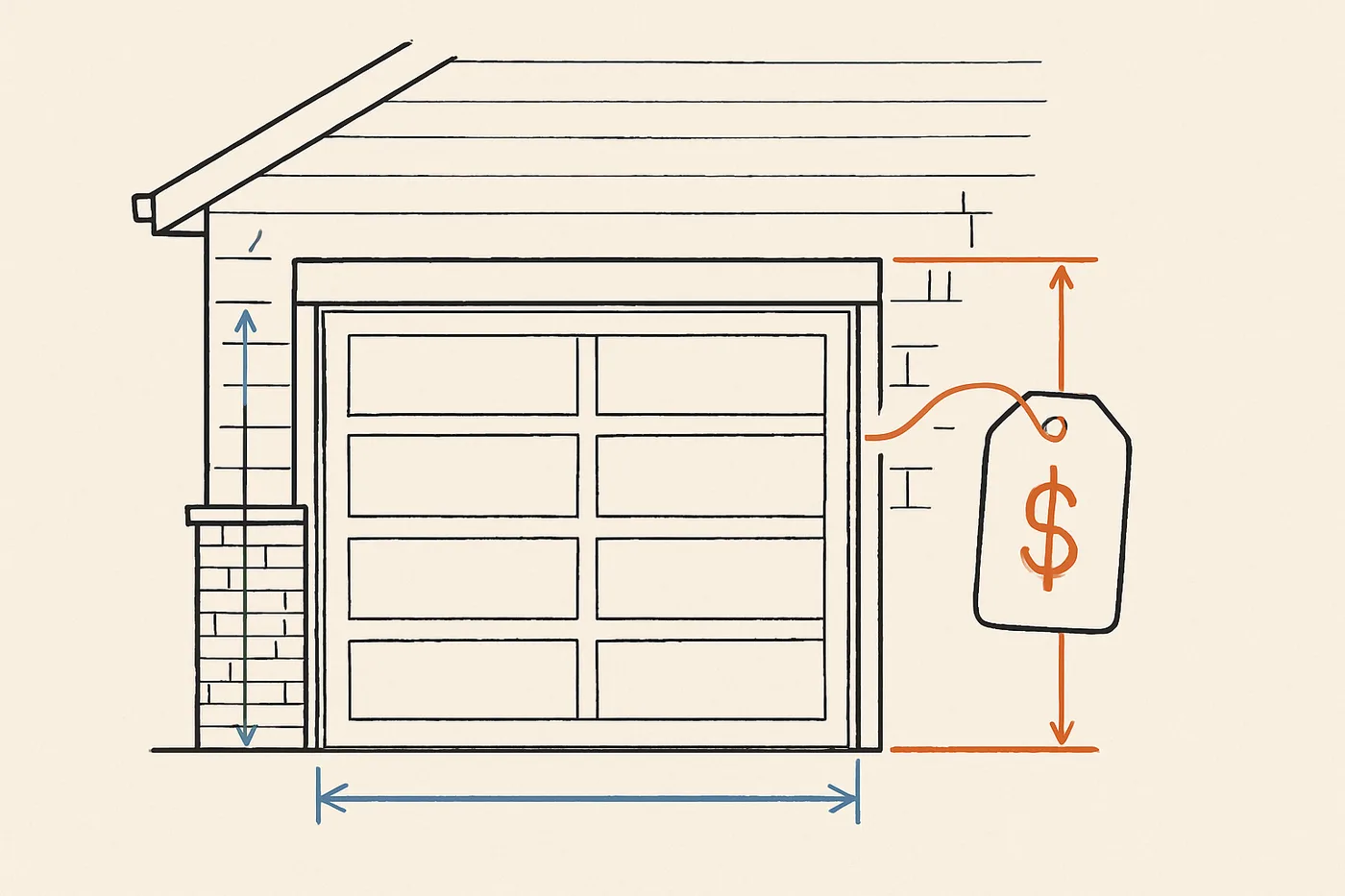
HomeAdvisor, a home-services cost guide, puts the average garage door repair at $265, with a normal range of $155 to $379 (updated June 2026). That is one source, and your quote depends on your door, your region and the installer, so get it in writing. HomeAdvisor says broken springs are one of the most common garage-door issues, and lists springs at $180 to $350. This piece walks through what each common fix should cost you, what quotes leave out, and the condition that turns a small repair into a large one if you ignore it.
Not sure which problem this is? Start with our page on a broken garage door spring.
The service call is its own line item
Before any repair happens, many companies charge to send a technician out and diagnose the problem; HomeAdvisor lists $50 to $75 for a quick visit on a simple fix, with labor on top. Some companies apply that fee toward the repair if you approve the work; some don't. Ask before you schedule. If the answer is "it depends," assume it doesn't apply.
A diagnostic fee is not a rip-off. It pays for the truck, the tech, and trained diagnosis on a system that stores serious mechanical energy. What is a rip-off is paying it twice: once at the visit and again inside the "repair price" the company quotes you. Ask for the fee to be itemized separately on the invoice.
Repair costs by component, 2026
| Repair | Typical installed cost | Notes |
|---|---|---|
| Torsion spring (single, standard) | $180 to $350 (HomeAdvisor) | Ask whether the second spring should be replaced at the same time |
| High-cycle spring upgrade | Ask for the price | Ask for the cycle rating in writing |
| Cables (pair) | $100 to $400 (HomeAdvisor) | Almost always replaced in pairs |
| Rollers (set) | Get a written quote | Nylon vs. steel, sealed vs. open bearing |
| Bottom seal / U-astragal | Get a written quote | Rubber gasket at the base of the door |
| Hinges / brackets | Get a written quote | Depends on how many, and location |
| Opener circuit board | Get a written quote | Ask for the part price and the installed price |
| Opener gear kit | Ask for the part price and the labor separately | Drive gear replacement |
| Opener replacement (full) | $218 to $540 normal range, $379 average (HomeAdvisor) | New unit installed, chain or belt |
| Single panel replacement | $250 to $1,000 (HomeAdvisor) | Highly dependent on door age and match |
| Track realignment | Get a written quote | Assumes track isn't bent beyond repair |
| Off-track door reset | Get a written quote | More if cables or rollers also failed |
These are 2026 ranges for standard residential double-car steel sectional doors in most U.S. markets. Custom wood, oversized, or specialty doors run higher across the board.
Why springs are one of the most common repairs
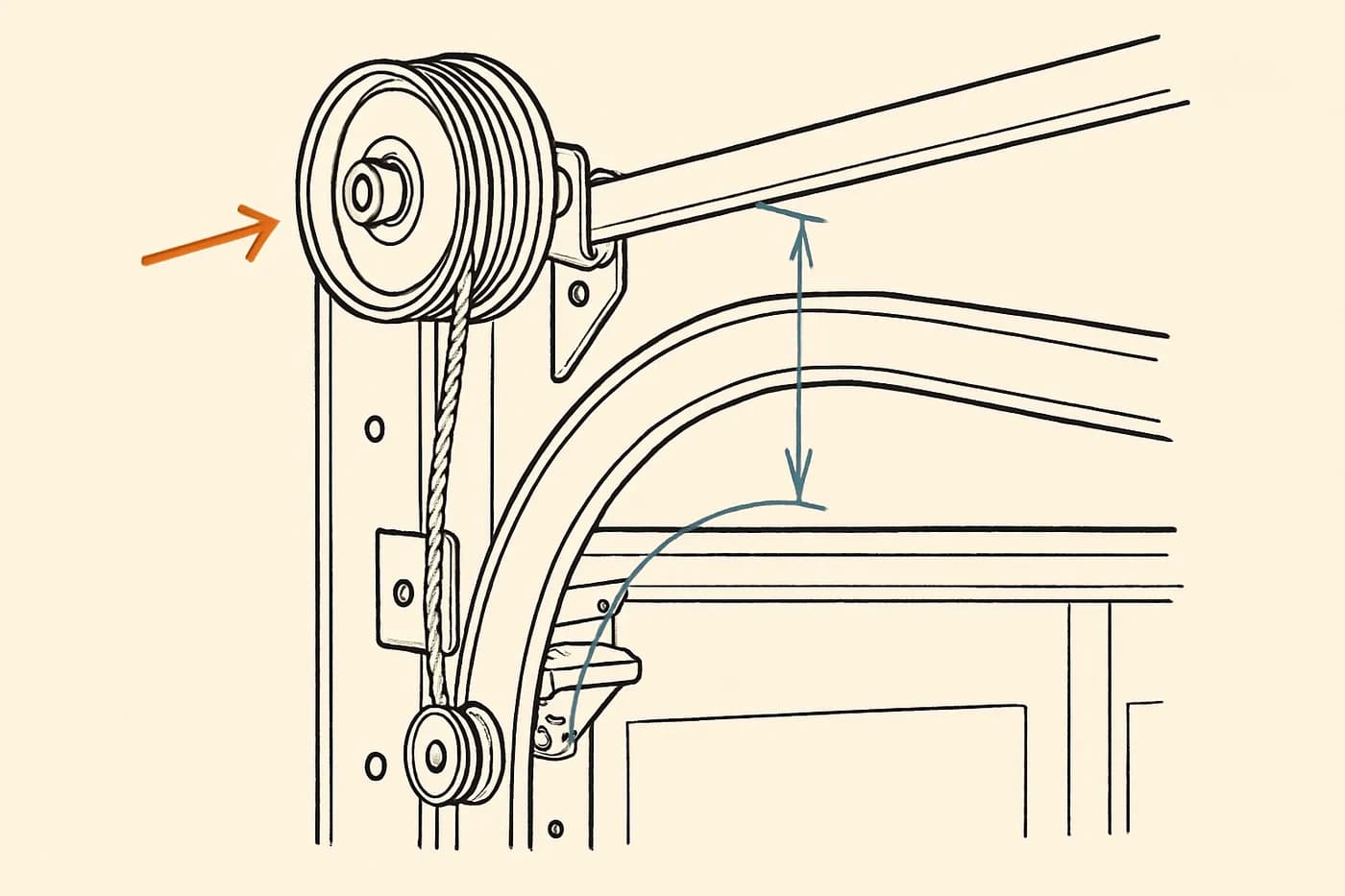
A standard spring is rated for about 10,000 cycles, one cycle is one full open and close, and at four cycles a day that is about seven years (IDC Spring, a spring manufacturer). The more often you use the door, the sooner you reach that rating.
This is why spring replacement is not a DIY line item to save money on. The tools cost money, the mistakes cost more, and the physics does not negotiate.
If you cycle the door more than four times a day, ask about a spring with a higher cycle rating and for the rating in writing.
For deeper reading on how springs store energy and why cycle ratings matter, the spring science lab covers the physics.
Cold weather changes the spring math
If your spring broke on the first cold morning of the season, that is not a coincidence. Clopay says winter breakage is more common because spring wire becomes more brittle and weaker in colder temperatures, so a worn spring tends to give out in the cold rather than on a mild day. The cold-weather spring fatigue lab is an illustrative model of that, not a measured figure.
Clopay's advice is to replace springs if you have lived in the home seven or more years, use the door daily and have never replaced them, so you are not locked in or out when one breaks. A standard spring is rated for about 10,000 cycles, one cycle is one full open and close, and at four cycles a day that is about seven years (IDC Spring, a spring manufacturer). If you are near that, budget for replacement before winter, not during it.
The condition that turns a small job into a big one
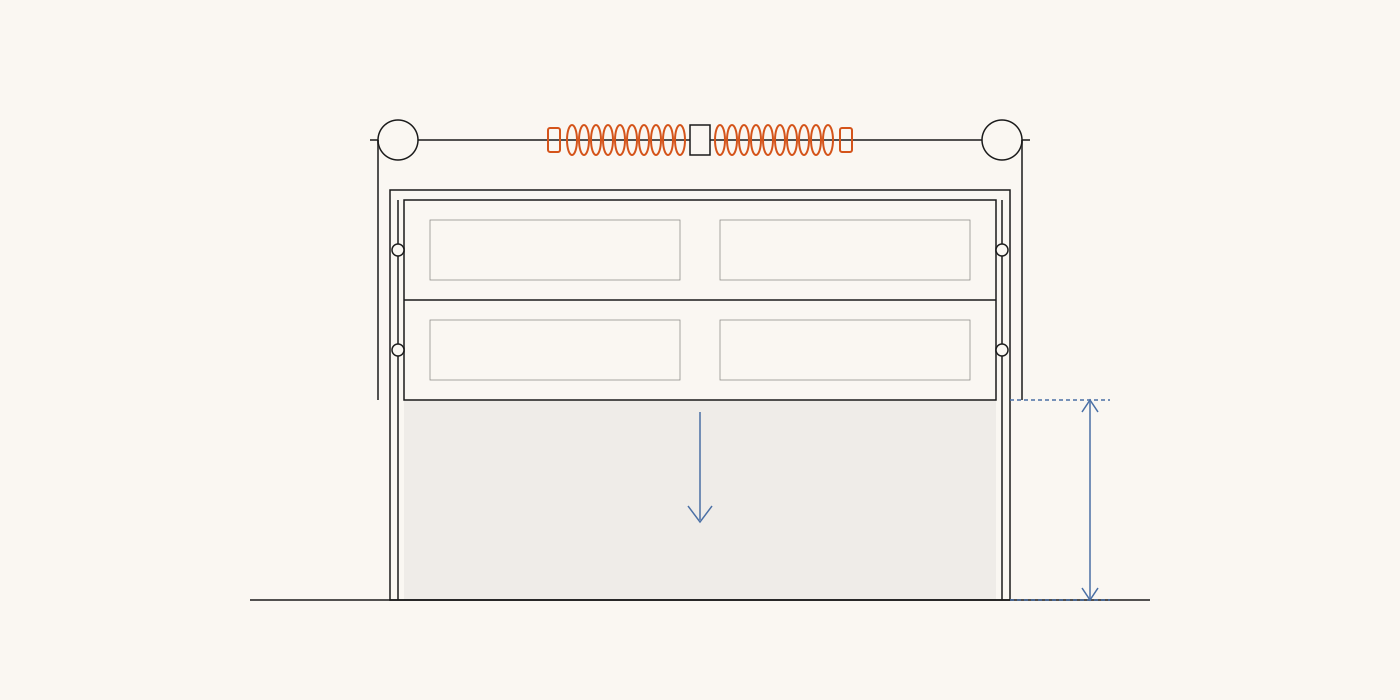
If your door is out of balance and you keep operating it, you are not just wearing out one part. The opener works harder than it was designed to, which is how a small spring job can become a much larger repair.
The fix is a balance check, which any competent tech will do as part of a standard service call. Ask for it explicitly. Providers like Garage Door Pro Services (our affiliated installer) include a multi-point balance and safety check as part of standard service, and their free garage door safety inspection is a reasonable starting point if you haven't had one in a few years. For Las Vegas homeowners, A+ Garage Doors (our affiliated installer) offers same-day spring and cable work, which matters when the door is stuck open in a monsoon or 110°F afternoon.
Opener repairs: fix or replace
Openers are where the "repair vs. replace" question gets sharper. A replacement circuit board costs less if you source the part yourself and more installed, so ask for both prices on the quote. HomeAdvisor lists opener repair at $100 to $500 and a normal range of $218 to $540 for installing a new opener, updated June 2026.
The rule: if the opener is old and the repair quote is a large share of a new installed opener, ask for both written quotes and compare them. Newer units are quieter, safer (rolling-code security, better photo-eye systems), and more efficient. A chain drive is the loudest of the three drive types, and a direct drive has fewer moving parts, which matters if the garage is under a bedroom.
Margaret's garage door safety video covers the auto-reverse and photo-eye tests you should run after any opener work.
Panel replacement is where quotes get slippery
Single-panel replacement runs $250 to $1,000, per HomeAdvisor, but the actual number depends heavily on whether your door model is still manufactured. If it is not, you are looking at either a color mismatch, a full door replacement, or a scavenged panel from a salvage supplier. Get this diagnosed before you commit to a repair path.
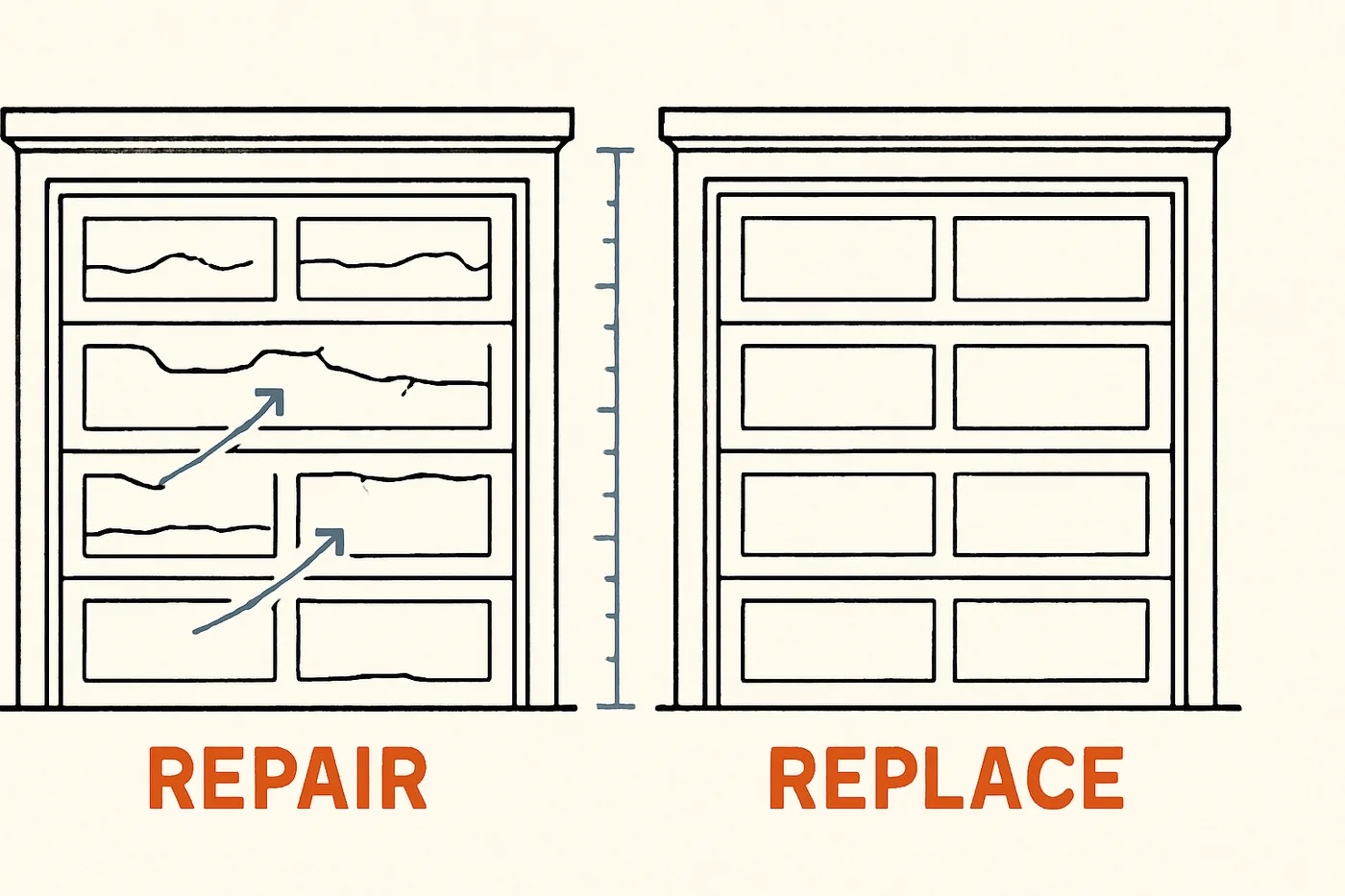
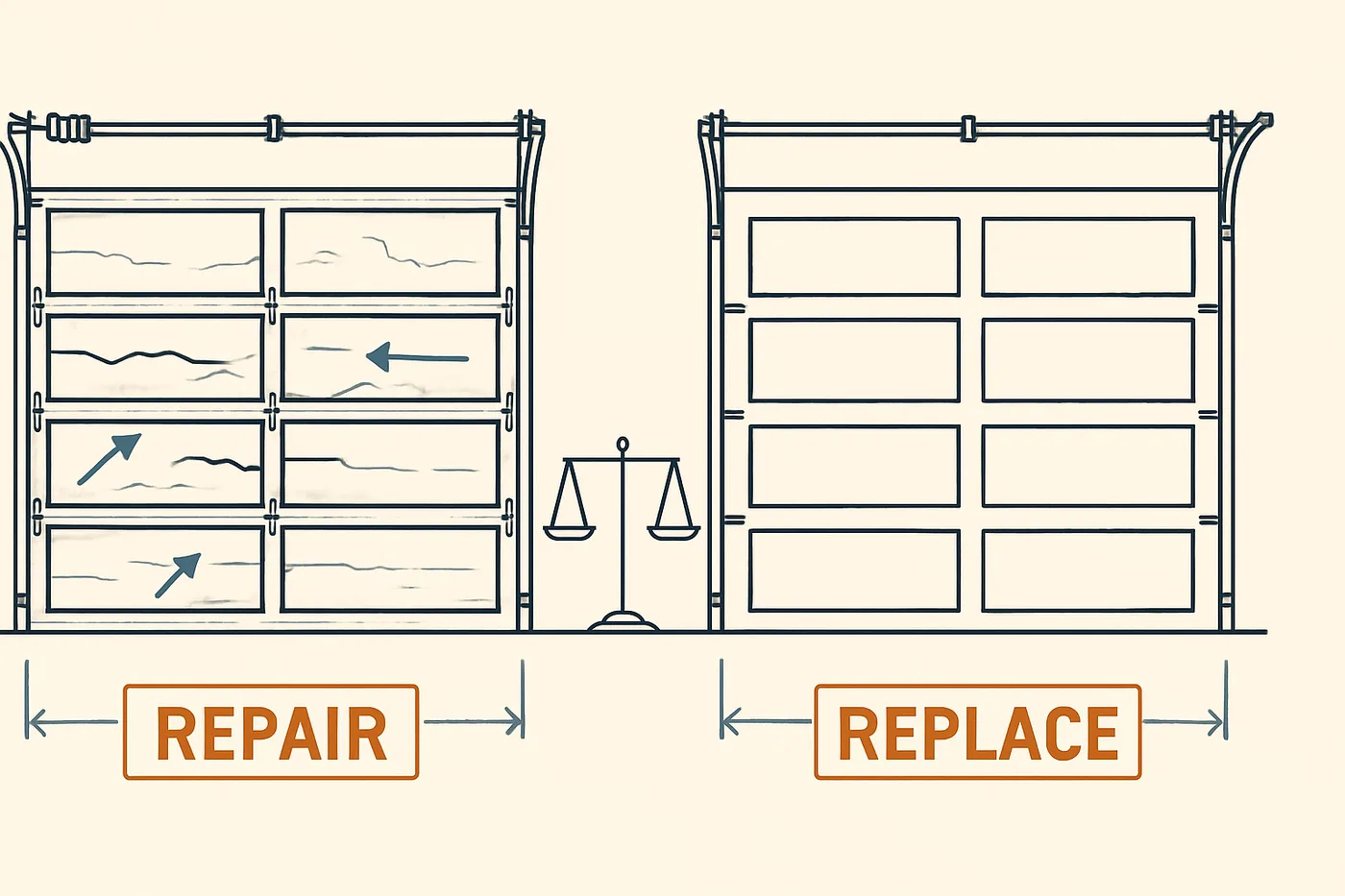
If a single repair quote is a large share of the cost of replacing the door with the same tier, replacement may be the better financial decision. Ask for both written quotes. Run the numbers on the ROI lab before you say yes to a panel repair on an old door.
What your repair quote probably does not include
- Balance check and adjustment. Should be standard, often isn't.
- New bottom seal. Clopay says most seals need replacing every two to three years, depending on climate and use, and Amarr says around two years or more with proper maintenance, so an original seal is probably worn.
- Lubrication of the full system. Hinges and rollers are lubricated every 3 to 6 months, or as needed, with the lubricant the maker names, not WD-40. A technician handles the spring.
- Haul-away of the old parts.
- Safety sensor alignment and auto-reverse test after any spring or opener work.
Add these together and your quote may be higher than the headline figure, because most quotes bury or omit them. Ask.
The WD-40 warning that costs you money later
If a tech "lubricates" your door with WD-40, ask why and what the door maker's manual says. Clopay says WD-40 and oil-based lubricants should be avoided because they draw dirt and dust, which causes premature wear. And do not let anyone lubricate the tracks themselves: Clopay says not to lubricate the tracks: wipe them with a damp cloth, because lubricant there makes the rollers work harder and strains the opener. Rollers get lubricated. Tracks stay dry.
Before you approve the quote
Three questions, every time:
- Does the price include a full balance check and adjustment?
- Is the diagnostic fee applied toward the repair, or is it a separate charge on the final invoice?
- If it's a spring job, are you installing a standard-cycle or high-cycle spring, and what is the cycle rating on the part going in?
If the tech cannot answer the third question with a specific number, you are not talking to a spring specialist. Get another quote before you sign.