Belt vs Chain vs Screw Drive: Which Garage Door Opener Should You Actually Buy?
Compare belt, chain, and screw drive garage door openers. Learn the differences in noise, cost, durability, and maintenance to choose the best opener for your home.

The question is usually: which opener will be quiet, last a long time, and not cost more than I need to spend? The answer depends on three things about your house that you already know — whether the garage is attached, how long you plan to stay, and what your budget actually is.
Here's the landscape. There are three mechanical drive types you'll see in 2026: chain, belt, and screw. A fourth — direct drive, sometimes called jackshaft or wall-mount — is worth knowing about but sits in its own category. We'll cover it briefly at the end. First, the three that account for almost every residential purchase.
Chain drive
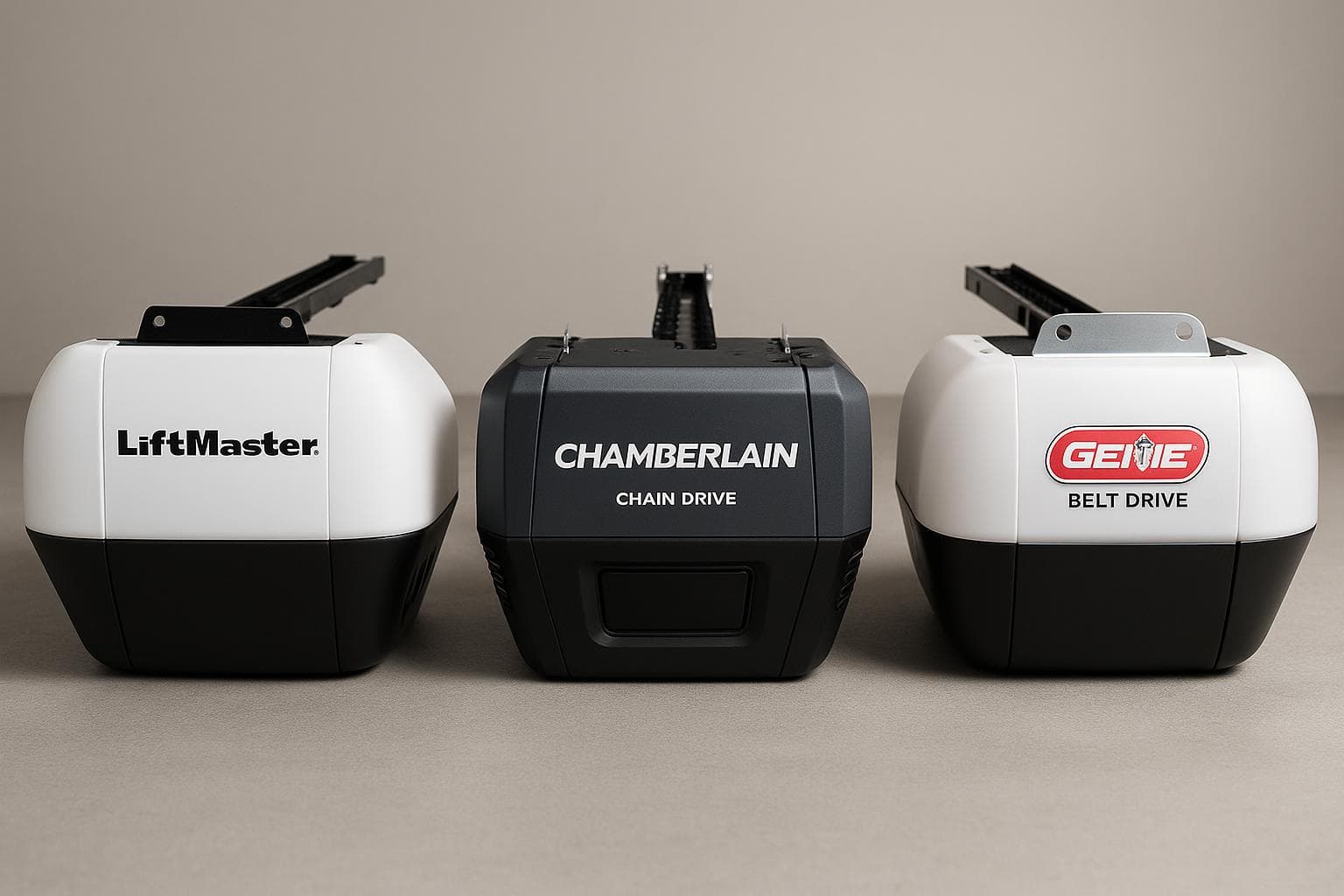
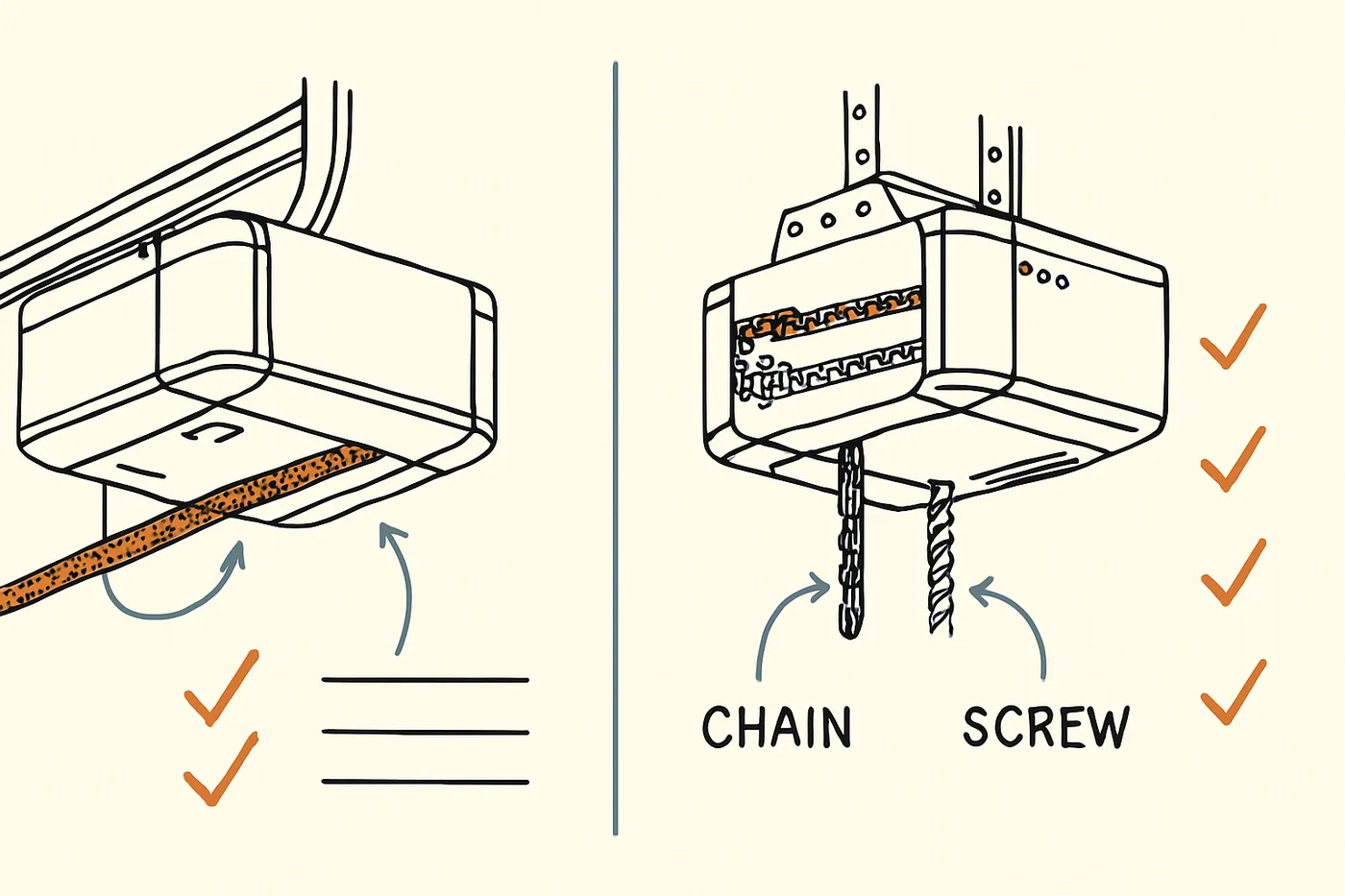
A chain drive uses a metal bicycle-style chain to pull the trolley along the rail. It's the oldest of the three designs and it still works exactly the way it did in 1985. The motor turns a sprocket, the sprocket turns the chain, the chain pulls the door.
Installed, a chain drive costs $350 to $500 and lasts 10 to 15 years with basic maintenance. The hardware itself is $150 to $250, and professional installation adds $150 to $300. Parts are available at any hardware store in the country, which matters when something breaks at 7pm on a Saturday.
The strength of chain drive is that it's the cheapest reliable option and every technician who has ever worked on a garage door knows how to service it. Nothing about the mechanism is proprietary or fussy.
The failure mode is noise. A chain drive runs at 70-plus decibels — loud enough to hear clearly two rooms away. If there's a bedroom above the garage, or someone works from home in the room next to it, this matters every morning.
Chain drive is right for you if the garage is detached, or if it's attached but no one lives near it, or if you're a landlord replacing an opener in a rental and cost is the deciding factor.
Belt drive
A belt drive uses a steel-reinforced rubber belt instead of a chain. Same mechanism otherwise — motor turns a pulley, pulley pulls the belt, belt pulls the door. The rubber absorbs the vibration that a chain transmits into the rail, and the rail transmits into the framing of your house.
Installed, a belt drive runs $450 to $650 and lasts 12 to 15 years. The unit itself is $200 to $400, plus $150 to $300 for installation. A mid-tier belt-drive replacement with battery backup and one extra remote totals about $660 installed for an attached two-car garage.
The strength of belt drive is noise, and it's not a small difference. A belt drive operates at roughly 50 dB versus a chain's 70-plus — the difference between audible and nearly inaudible in an attached garage with bedrooms above. If you've ever wondered why your garage door is so loud, the chain is doing most of the work.
The failure mode is belt drift. Over years, cheap belts can stretch and wander off the pulley, particularly on multi-piece rails. Better units address this — the Genie StealthDrive Connect 7155, for example, ships on a one-piece rail specifically to eliminate the most common cause of belt drift in the first year. If you buy a belt drive, buy one with a one-piece rail.
One thing to know if you're converting from chain to belt: belt drives require a belt-compatible rail, which is not always included in a standard installer quote. Ask before you sign.
Belt drive is right for you if the garage is attached, if anyone lives above or next to it, and if you plan to stay in the house five years or more.
Screw drive
A screw drive uses a threaded steel rod that turns to move the trolley. No chain, no belt — the trolley rides directly on the threads. Fewer moving parts, in theory more reliable, and historically the middle option between chain and belt.
In practice, most pros stopped recommending screw drives in the mid-2020s, and here's why. The grease on the threads becomes stiff in cold weather and loud in heat, and parts are harder to source than for chain or belt drives. Screw drives are temperature-sensitive in a way the other two are not. In a garage that swings from 20°F in January to 110°F in August — which is most garages — the mechanism is fighting the weather.
The strength of screw drive is that with fewer moving parts, when it works well it needs less maintenance. Some homeowners in temperate climates have run the same screw drive for 20 years.
The failure mode is climate. In cold winters or hot summers, the unit gets loud, slow, or both. And when a component wears out, your local supply house may not stock it.
Screw drive is right for you only if you live in a mild climate — coastal California, the Pacific Northwest — and you value low maintenance over quiet operation, and you have a technician you trust who still stocks parts. For most buyers in 2026, screw drive is the wrong answer.
The fourth option: direct drive
Direct drive — sometimes called jackshaft or wall-mount — has no rail at all. The motor mounts on the wall next to the door and turns the torsion shaft directly. Installed, it costs $650 to $900 or more, lasts 20 years or more with minimal maintenance, and most units come with a lifetime warranty on the motor.
Direct drive is worth pricing out if you're staying in the house long-term, if you have a high or unusually configured ceiling that makes a traditional rail awkward, or if the warranty and lifespan justify the premium for you. It is not the default answer for most homeowners, but it's the right answer for some.
Motor size and features that apply to all three
Regardless of drive type, get the horsepower right. For a double-car door, a solid wood door, or an insulated steel door over 16 feet wide, three-quarter horsepower is the minimum to avoid premature motor burnout. Half-horsepower is fine for a single-car steel door and nothing larger.
Two features to think about before you buy. Battery backup adds $75 to $150 as an accessory, and California's SB-969 has required it on all new residential installations since July 1, 2019 — if you're in California, this is not optional. WiFi adds $50 to $100 when built in, and most mid-tier and all premium openers in 2026 include it as standard. If you're buying anything but the cheapest chain drive, WiFi is coming along for the ride whether you asked for it or not.
One note on smart connectivity: CISA has issued advisories about vulnerabilities in the MyQ platform used by Chamberlain and LiftMaster. If security matters to you, that's worth reading before you buy into an ecosystem.
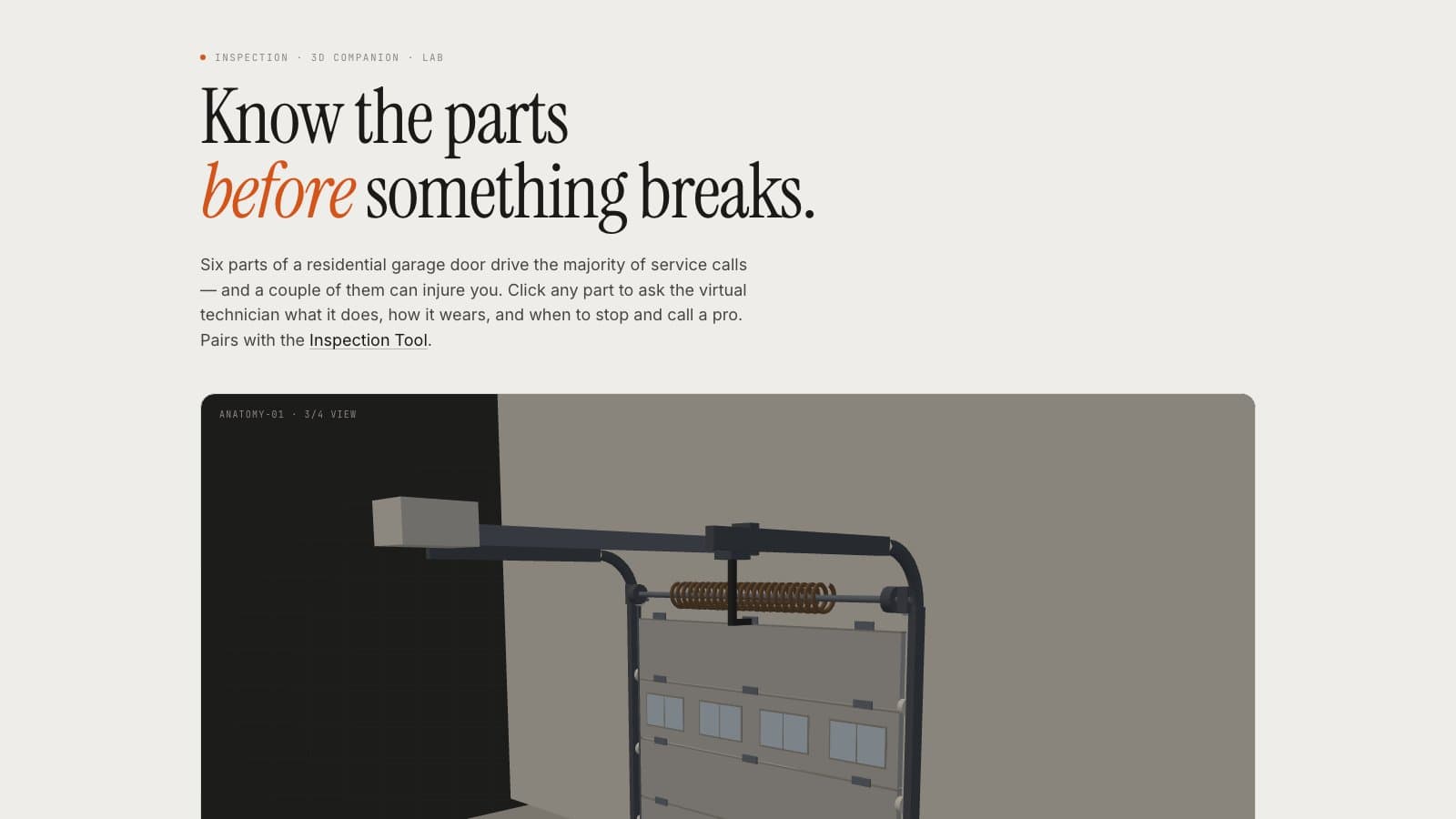
Finally, whichever opener you choose, the springs are doing most of the work. A good technician will check them during installation — Garage Door Pro Services (our affiliated installer) includes a free safety inspection with service calls, and Las Vegas homeowners can get same-day garage door repair in Las Vegas through A+ Garage Doors (our affiliated installer) if the inspection turns up a spring problem. A worn-out spring will burn out a new opener in a year. Have a look at the garage door anatomy lab to see how the springs, cables, and opener work together, or watch Maya break down the tech if you prefer video.
How to decide
One: is the garage attached or detached? If detached, chain drive is fine. Save the money. If attached, and there's living space above or adjacent, start with belt drive as your baseline.
Two: how long do you plan to stay? Under five years, chain or entry-level belt, don't over-invest. Five to fifteen years, belt drive is clearly right. Fifteen years or more, price out direct drive.
Three: what's your climate? If you're in a place that gets cold winters or hot summers — which is most of the country — cross screw drive off the list.
For the middle-of-the-road case — attached garage, five to fifteen years in the house, normal climate — a three-quarter horsepower belt drive with battery backup and a one-piece rail, installed in the $600 to $700 range, is the right answer. That's what most homeowners should buy.