Insulated Garage Door Payback Calculator: What the Numbers Actually Say in 2026
Use our insulated garage door payback calculator to estimate energy savings and ROI. See how quickly your investment pays for itself.

An insulated garage door upgrade costs $800 to $1,200 more than an uninsulated door of the same size and tier, and it pays itself back in roughly 3 to 4 years through energy savings alone — under 2 years if you live somewhere with brutal summers or hard winters. That is the headline number from our energy efficiency lab, and it is the number most contractors will not put in writing for you. The rest of this piece walks you through how the payback math works, what changes the answer, and how to use the calculator to model your specific house instead of trusting a generic range.
The cost gap you are paying back
Before payback means anything, you need to know what you are paying for. In 2026, mid-grade insulated steel doors with polyurethane foam and an R-value of 12 to 18 run $1,500 to $3,200 installed for a standard 16x7 opening. An uninsulated single-layer steel door at the same size lands closer to $800 to $1,400 installed. The delta — the amount you are trying to earn back through lower energy bills — sits in that $800 to $1,200 range for most homeowners.
That is the number to anchor on. Not the full door price. The upgrade premium. If a contractor tries to sell you payback on the entire $2,400 door, that is sales math, not real math. The uninsulated door was going to cost you money either way. You are only paying back the difference.
What the energy savings actually look like
The savings depend on three things: your climate, your garage configuration, and the R-value gap you are closing.
For a 16x7 attached garage in a hot-summer, mild-winter climate, going from an uninsulated R-0 door to a polyurethane R-18 door drops annual energy costs from $385 to $72 — a savings of $313 per year. At $1,000 in upgrade premium, that is a 3.2-year payback. In a more extreme climate — Phoenix summers, Minneapolis winters — the same upgrade can pay back in under two years because the temperature differential the door is fighting is larger for more hours of the year.
The physics under the savings is straightforward. Using the heat transfer equation Q = U × A × ΔT, a 112-square-foot door at R-0 with a 38°F temperature differential loses 4,256 BTU/hr, while the same door at R-18 loses only 237 BTU/hr — a 94% reduction. Your HVAC system, or in the case of an attached garage your house's HVAC system fighting heat bleed through the shared wall, is what pays for that loss. Cut the loss by 94%, and you cut the share of your energy bill that the garage door is responsible for by roughly the same amount.
Why polyurethane matters more than the brochure suggests
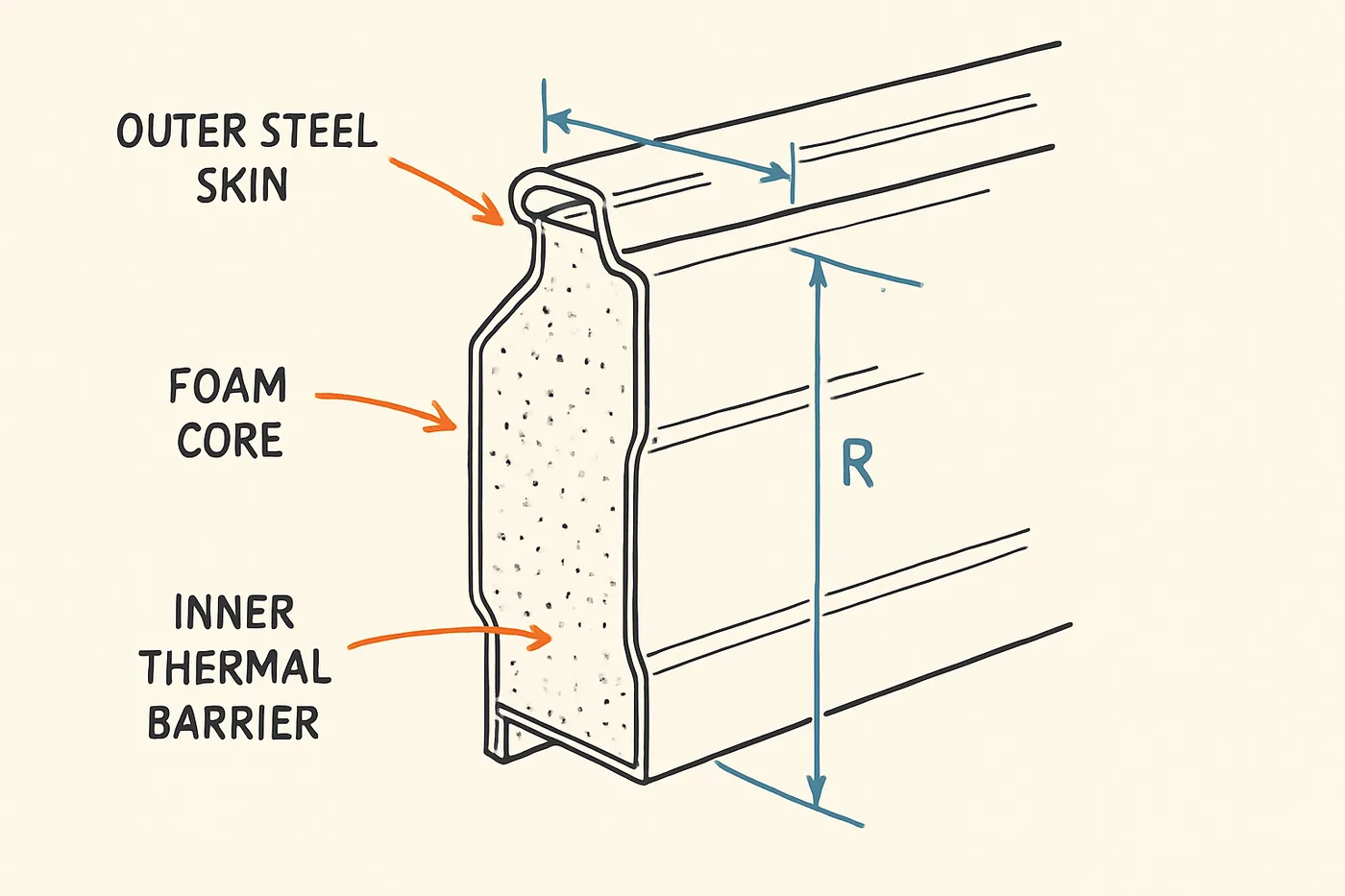
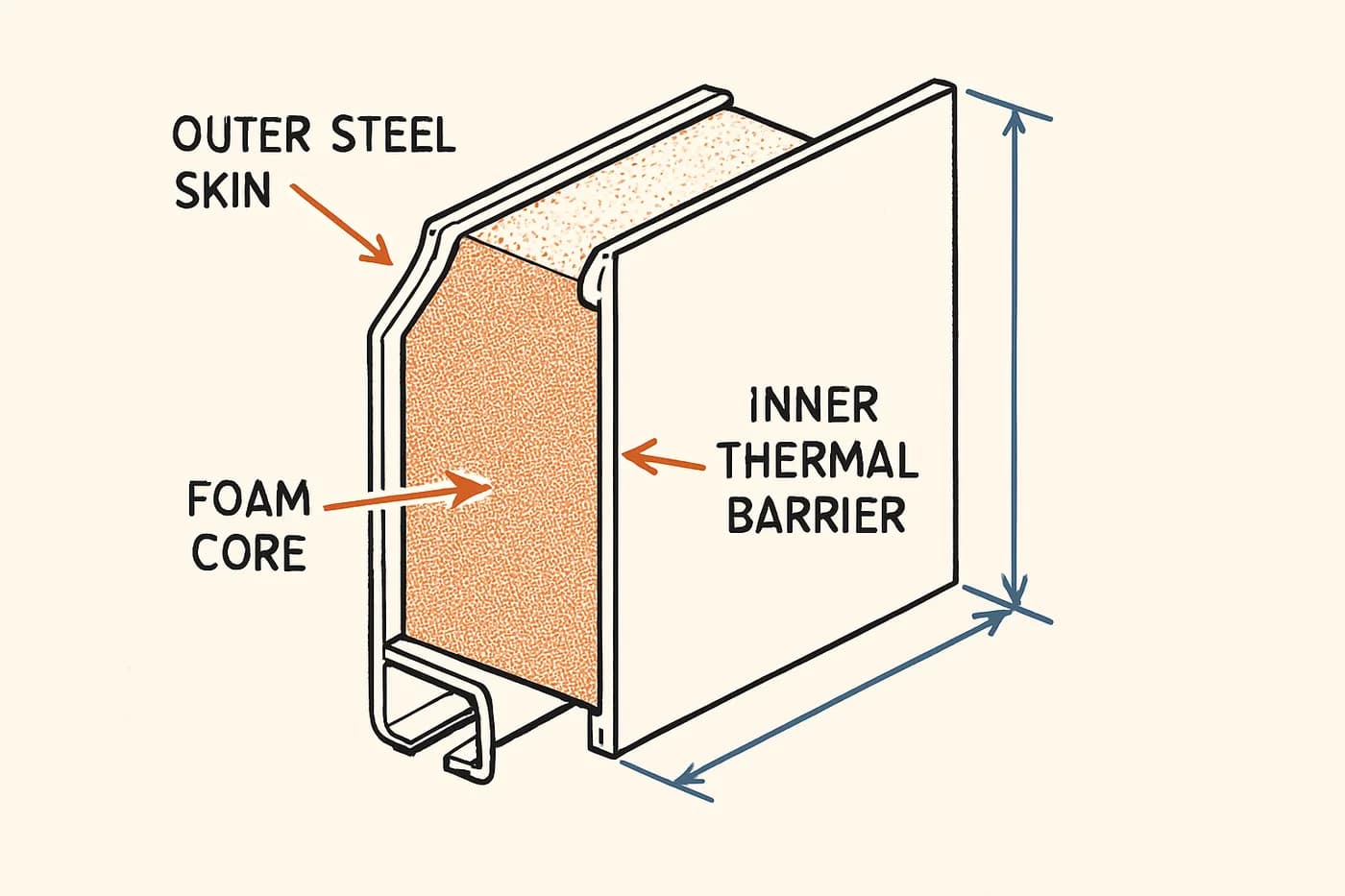
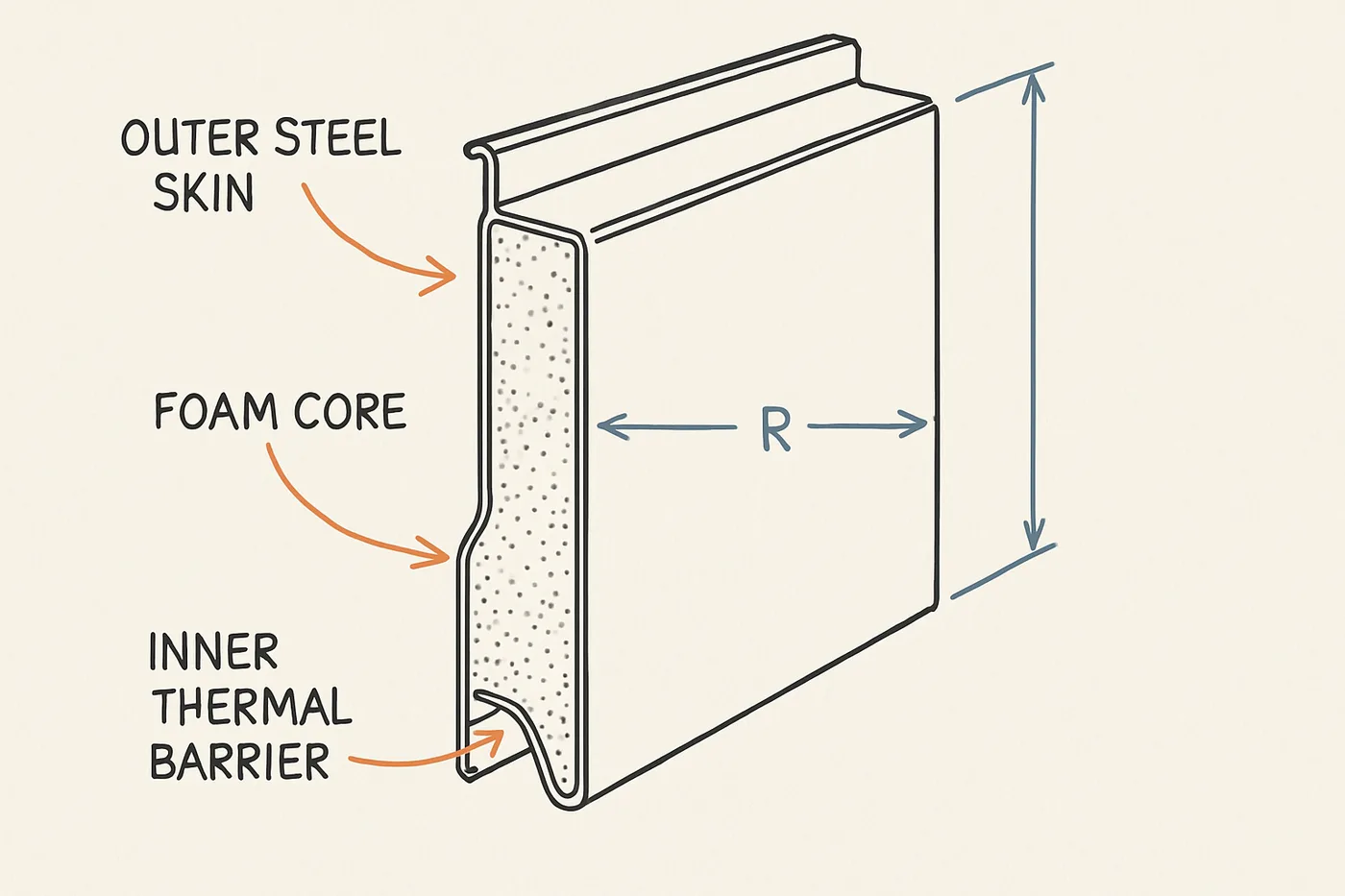
Two doors can both be marketed as "insulated" and not be comparable. The chemistry of the foam matters. Polyurethane delivers about R-6.5 per inch of thickness, compared to roughly R-4 per inch for polystyrene. A 2-inch polyurethane-injected door hits R-13. A 2-inch polystyrene-paneled door hits R-8 at best, and usually less because of thermal bridging at the panel edges.
If you are running payback math on a polystyrene door, your numbers will look worse than the ranges in this article. That is not a failure of insulation — it is a failure of foam selection. The payback assumptions in our calculator are built around polyurethane because that is the chemistry that moves your bill. And if you are looking at a rolling steel door rather than a sectional, you cap out at R-10 with foam-filled slats, which changes the math. The calculator handles both.
Using the calculator
The garage door ROI lab takes four inputs that matter: your climate zone, your garage configuration (attached vs. detached, heated vs. unheated), your current door's R-value (R-0 if uninsulated, R-6 to R-8 if you have a basic insulated door already), and the R-value of the door you are considering. It returns annual energy savings, a payback period in years, and a five-year total return that includes resale recoup.
That last piece is what most payback calculators miss. Energy savings is one income stream. The other is what the door does to your home's resale value. A new garage door returns 93.3% of its cost at resale on an average project price of $4,302, making it the highest-ROI home improvement project tracked nationally — ahead of kitchen remodels, bathroom remodels, and roofing. The mid-tier insulated steel doors at $1,500 to $3,200 are the tier that produces that recoup rate. Bottom-shelf doors and luxury wood doors both recoup less.
When you stack resale recoup, energy savings, and maintenance avoided, a $4,000 door held for five years returns about $5,083 in total value — a 127% total return, or roughly 5.0% annualized. That is not a thrilling number compared to the stock market, but it is a strong number for a thing you have to own anyway.
What the calculator does not include
Payback math is honest only if you know what is outside the model. The calculator estimates the energy and resale side. It does not include:
- Opener replacement. If the new door is heavier (insulated doors usually are), your existing opener may need an upgrade. Budget $350 to $900 if your opener is more than 10 years old.
- Haul-away of the old door. Some installers include it; many add $75 to $150.
- Weatherstripping refresh. A bottom U-seal strip costs $15 to $40, and jamb weatherstripping runs $40 to $80 for a single-car opening, but a threshold kit for a 16-foot door runs $50 to $120. Most quotes include a new bottom seal; almost none include a threshold kit. Ask.
- Insulation degradation over time. The U-seal that does half the work loses compression memory in 5 to 10 years. The payback math assumes you replace it when it fails. If you do not, your savings curve flattens.
When the math says do not upgrade
There are cases where the calculator will tell you to skip the insulated tier, and you should listen. A detached, unheated garage in a mild climate does not generate meaningful energy savings — you are heating outdoor air either way. For those homeowners, the answer is to keep the uninsulated door, add foam tape to the panel joints to reduce infiltration by 15 to 20%, and put the $1,000 toward something else.
The other case is a door that is functionally fine but ugly. If repair quotes are coming in under 50% of replacement cost at the same tier, repair is the financially correct move even if the door is not pretty. For a $2,400 mid-grade door, any single repair under $1,200 still favors keeping what you have. For Las Vegas homeowners weighing that call, A+ Garage Doors handles same-day repair on most residential systems, and Garage Door Pro Services offers a free safety inspection that will tell you whether your current door has years of life left or is on the way out.
Run your own numbers
The generic ranges in this article are useful for orientation. They are not a substitute for plugging in your actual utility rates, climate zone, and door configuration.
Open the garage door ROI lab and run two scenarios: your current door's lifetime cost over the next 10 years, and the insulated upgrade's lifetime cost over the same period. If the upgrade pays back inside 4 years and you plan to stay in the house longer than that, buy the insulated tier. If the payback runs longer than 6 years or you are moving inside 3, buy the cheapest door that does not embarrass the house and put the savings elsewhere.