Should you use WD-40 on a garage door?
Learn whether WD-40 is safe for garage doors. Discover the best lubricants and maintenance practices to keep your door running smoothly.

You've heard a squeak. You went to the shelf, grabbed the blue and yellow can, and now you're standing under the door with the nozzle pointed at a hinge, wondering if this is right or if you're about to make it worse.
It's the wrong can. And the reason it's wrong is not the reason most people think.
What WD-40 actually is
WD-40 is not a lubricant in the sense your garage door needs. It's a solvent. The name is shorthand for its original job: water displacement, formula forty. When you spray it onto a hinge or a bearing, it does two things in sequence. First it dissolves whatever oil or grease is already sitting on that metal. Then it evaporates. What it leaves behind is bare, dry steel, which is exactly what you did not want.
This is not folklore. A garage door treated with WD-40 is measurably drier one month later than a door that was never touched at all. Read that sentence twice. Doing nothing beats spraying WD-40. The homeowner who forgets about maintenance for a year comes out ahead of the homeowner who "took care of it" with the wrong can in April.
The squeak goes away for a week, maybe two, because there's residual solvent film and the metal is momentarily wetted. Then the film evaporates and the noise comes back louder, because now there's less lubricant on the part than there was before you started.
Why this matters more than a squeak
A garage door hinge or roller that runs dry doesn't fail overnight. It wears. Metal grinds against metal on every open and close, and every one of those cycles removes material that isn't coming back. Using WD-40 in place of a proper lubricant is the single biggest cause of premature roller and hinge wear, and it can cut a 15-year roller lifespan down to about 7 years.
Do the math on your own door. If you cycle it four times a day (leave in the morning, back at lunch, out for an errand, home at night) you're looking at roughly 1,500 cycles a year. A roller that should have lasted through 22,000 cycles is now grinding itself out at half that. You will replace rollers you shouldn't have needed to replace. You will hear noises you shouldn't have been hearing.
This is also why, when you're calling around for service, a technician who answers "WD-40" to the question of what they use on rollers and hinges is a red flag. It tells you what corner they cut on the last job and what corner they'll cut on yours.
What actually belongs on the moving parts
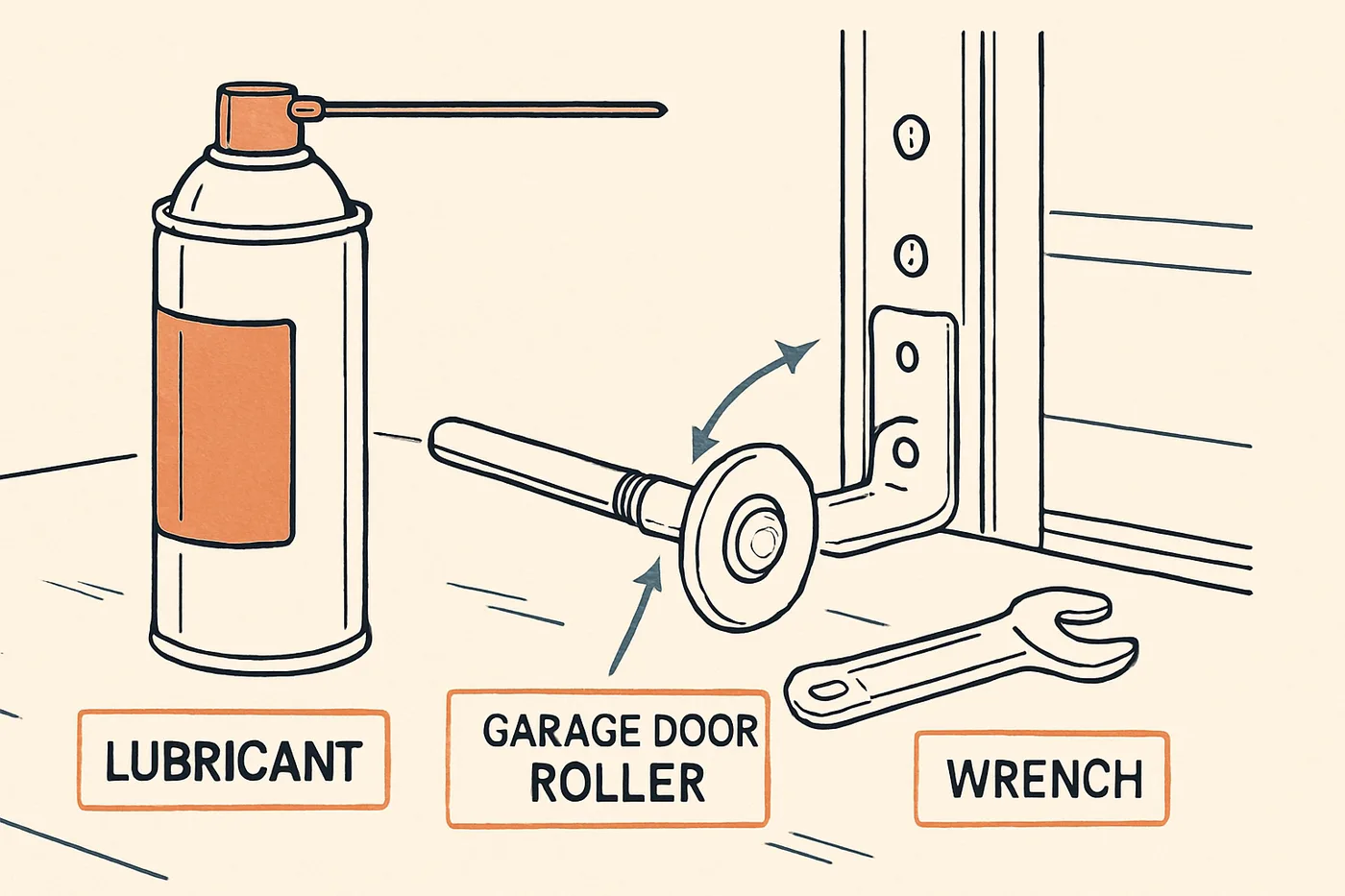
The correct answer is a can, but not that can. The right lubricants for rollers, hinges, and bearings are a silicone-based spray or a lithium-based spray, or a dedicated garage door oil sold specifically for the job. These are not solvents. They cling. They stay wet for months, not days, and they don't strip away what was there before.
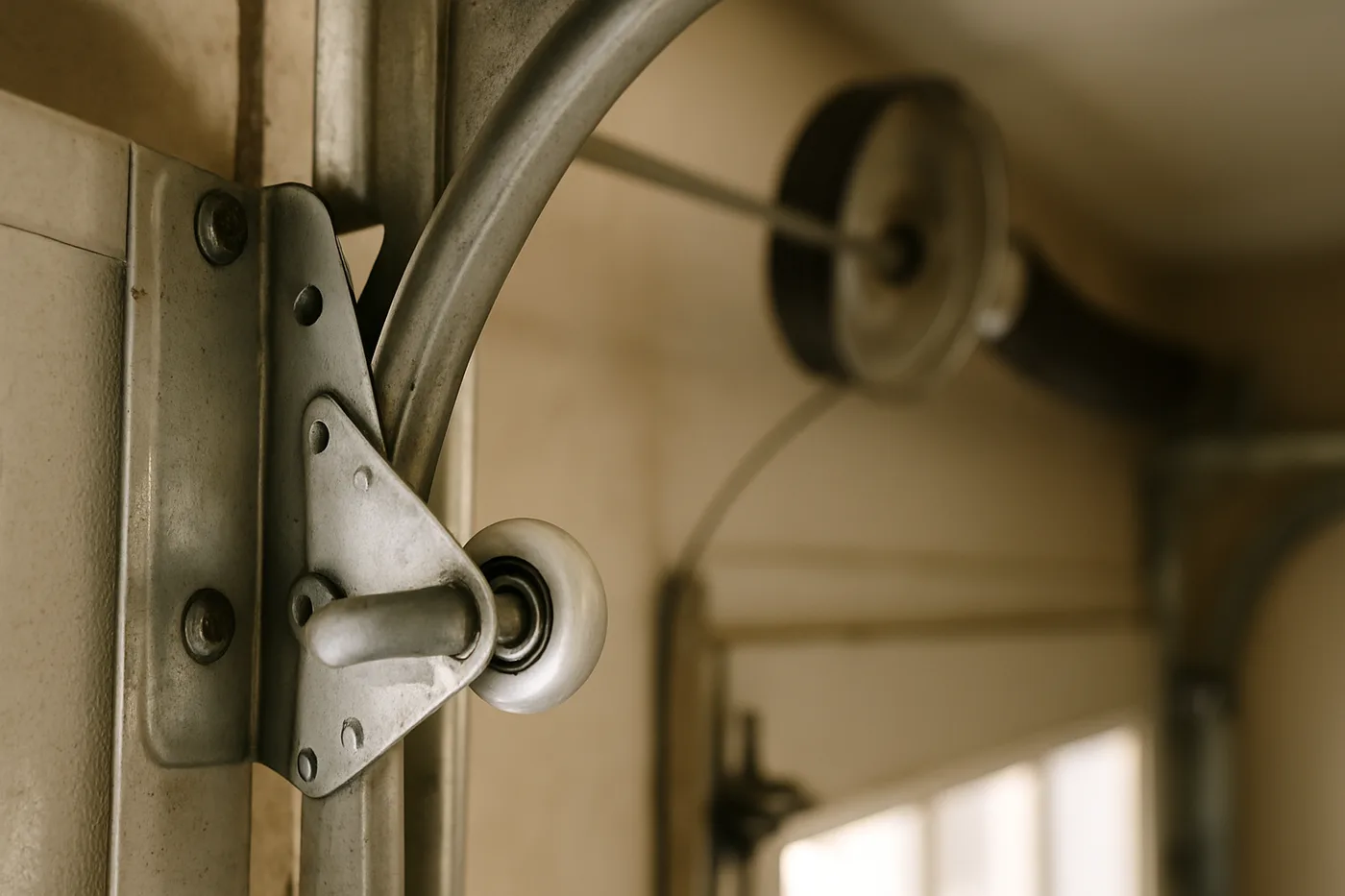
Apply them where the friction lives. A short bead on each roller axle, a shot into each hinge pivot, and a light coat on the bearing plates at either end of the torsion spring shaft. Not the roller wheel itself, but the axle it turns on. Not the outside of the hinge, but the pin it pivots around. Wipe off drips before they land on the door panel or the floor.
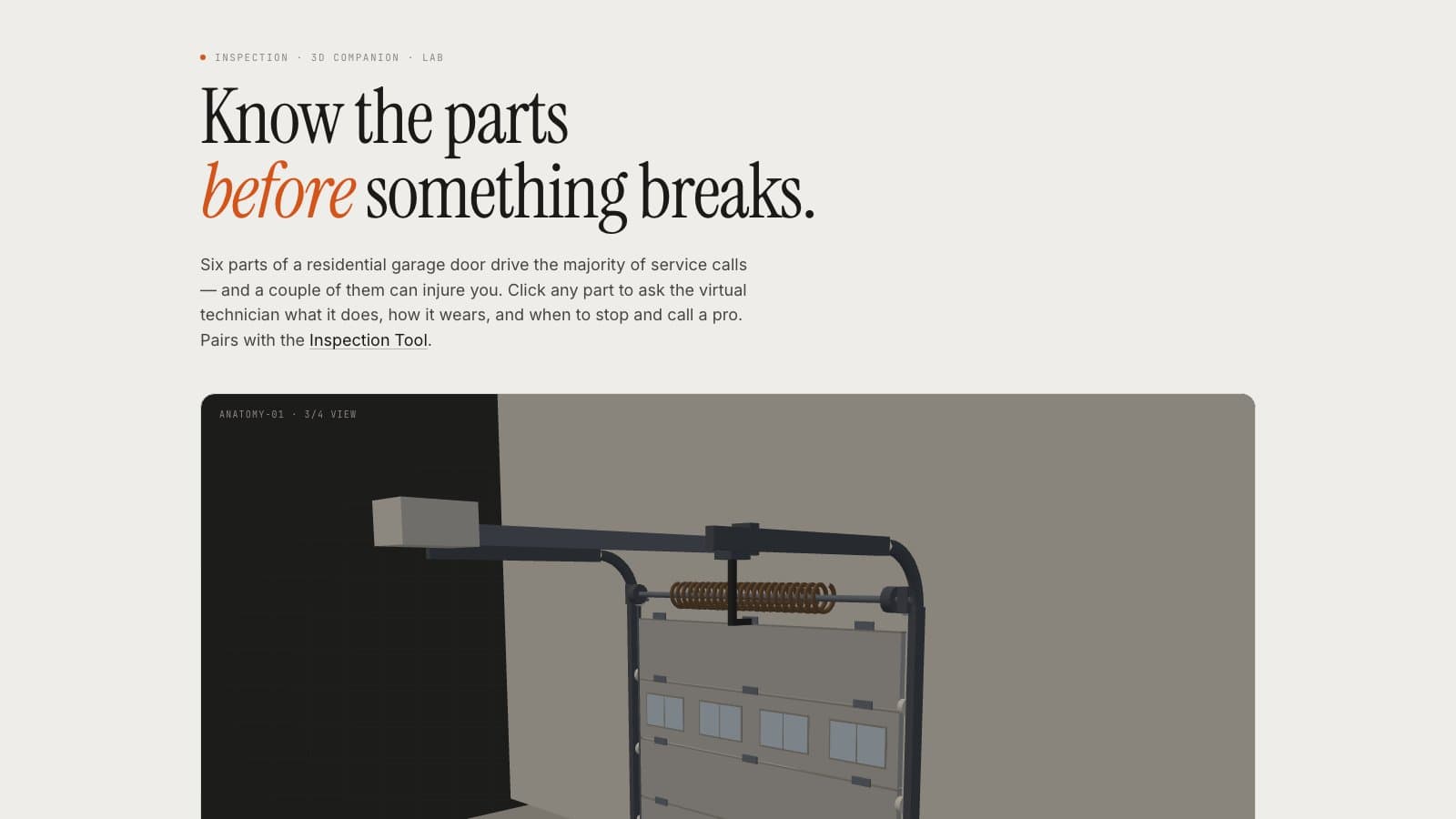
The schedule is not complicated. Rollers, hinges, bearings and the torsion spring get lubricated every six months, the spring above all, because it lives under constant tension even when the door isn't moving. Twice a year on all of it, and never on the tracks. If you want to see how those parts fit together before you point a nozzle at anything, the garage door anatomy lab is the map.
The one place lubricant does not belong
The tracks.
Do not spray anything on the tracks. Not WD-40, not silicone, not lithium, not garage door oil, not the stuff that worked so well on the hinges. The tracks are the one surface on the entire door that is designed to stay dry.
Here's why. The rollers are meant to roll along the inside of the track, not slide. Rolling is what keeps them centered in the channel. The instant you add lubricant to that surface, you introduce slip, and a slippery track causes the rollers to skid instead of roll at the curve where the vertical section meets the horizontal, which collects grit and can push a roller sideways hard enough to leave the channel entirely. A door that comes off the track is not a squeak problem. It's a call-somebody problem, and often an expensive one.
If your tracks are dirty, wipe them out with a dry rag. That's the whole maintenance procedure for tracks. Nothing wet.
The part you should not lubricate yourself even once
There is one component on your garage door where the right answer is not a can from your shelf and not a can from anyone's shelf. That's the torsion spring, when the spring itself needs more than surface oil: when it's showing rust bloom, gapping between coils, or the door is starting to feel heavier on the way up.
The spring is under continuous tension. It stores enough energy to lift a 150-pound door. That energy does not go away because the door is closed and you're standing next to it with a rag. If you are anywhere near a spring that shows cracking, corrosion pitting, or a visible gap in the coil, stop.
Put the can down.
Call someone.
A light six-month spray of lithium lubricant along an intact, healthy spring is homeowner territory. Anything past that (winding, tensioning, replacing) is not. The Maya on garage door tech, decoded walkthrough shows what a healthy spring looks like versus one that needs a professional, and if you're in Las Vegas, garage door repair in Las Vegas through A+ Garage Doors (our affiliated installer) is the kind of call this is. Companies like Garage Door Pro Services (our affiliated installer) also run free garage door safety inspections, which is a low-cost way to have someone look at the spring before you decide what needs doing.
The sound that started this
If you came here because of a noise, the noise was telling you something real. Dry hinges chirp. Dry rollers grind or thump. Dry bearings whine at a pitch that seems to come from everywhere at once. The why is my garage door so noisy breakdown matches specific sounds to specific parts, and it's worth ten minutes if you want to know what you're hearing before you spray anything.
But the fix for that noise is not the blue and yellow can. The fix is a lithium or silicone spray, on the right parts, on the right schedule. The wrong can silences the sound for two weeks and takes years off the hardware in exchange. The right can silences it for months and adds years back.
Put the WD-40 back on the shelf. It's a fine product for what it was made to do. Your garage door is not that thing.