Garage Door Repair Cost Guide: What Homeowners Actually Pay in 2026
Learn what homeowners typically pay for common garage door repairs. Our cost guide covers springs, openers, cables, and more.

Most garage door repairs in 2026 land between $150 and $600 all-in, with the service call itself running $75 to $150 on top of parts and labor. A single-spring replacement on a standard door is closer to the bottom of that range; a two-panel replacement on a discontinued model is well above it. Here is what each of the common repairs costs, what a fair quote looks like on paper, and the two situations where you should stop paying to fix the door and start pricing a new one.
The repairs, by price
| Repair | Installed cost (2026) | Notes |
|---|---|---|
| Torsion spring (single) | $150–$350 | Add $100–$150 to replace the second spring at the same time |
| High-cycle spring upgrade | $250–$500 | $100–$200 premium over standard |
| Cables (pair) | $150–$250 | Always replaced in pairs |
| Single panel | $250–$800 | Higher if the door model is discontinued |
| Chain-drive opener | $350–$500 | 10–15 year lifespan |
| Belt-drive opener | ~$100–$150 more than chain | Quieter, better under a bedroom |
| Direct-drive opener | $650–$900+ | 20-year lifespan, lifetime motor warranty common |
| Battery backup add-on | $75–$150 | Required by law on new installs in California |
| Service call | $75–$150 | On top of parts and labor |
That table is the whole article in one glance. The rest of this piece explains what moves you within each row, and what a contractor's quote is probably leaving out.
Springs: the most common repair, and the most commonly overcharged
A broken torsion spring on a standard residential door costs $150 to $350 installed, and adding a second spring when replacing as a pair adds $100 to $150 more. That second spring is almost always worth it. If one spring broke after roughly the same number of cycles as the other has seen, the other one is on the same clock. Paying $250 to $500 once beats paying $200 twice, six months apart, with two separate service calls.
The upgrade decision is the more interesting one. A high-cycle spring rated for 25,000 to 100,000 cycles runs $250 to $500 installed — about $100 to $200 more than a standard spring. If you open the door four to six times a day, a standard 10,000-cycle spring is a five-to-seven-year part; a 25,000-cycle spring gets you closer to fifteen. In a garage that gets heavy use — home office, multi-driver household, detached shop — the upgrade pays for itself before it fails.
One warning on spring pricing: a torsion spring one wire gauge off from specification will leave the door out of balance, because the spring constant varies with wire diameter raised to the fourth power. If a contractor quotes you a suspiciously low spring price, ask what gauge and length they are installing and whether they are matching the original. A cheap spring installed to the wrong spec costs more than the right spring installed once — you pay in downstream wear instead of up-front dollars. The science of garage door springs lab covers why. If you live somewhere cold, the spring fatigue in cold weather lab explains why springs break in January more often than in July.
Cables, rollers, and the small stuff
Cable replacement runs $150 to $250 installed for a pair, and cables should always be replaced as a pair — if one has stretched or frayed, the other is not far behind. Any contractor quoting a single cable replacement is either cutting corners or setting you up for a second service call. Push back.
Rollers, hinges, and the bottom seal are inexpensive parts that get bundled into other work. If a technician is already there for a spring or cable job, adding rollers costs $75 to $150 for the full set. Doing them as a standalone service call is not worth the trip charge.
Panels: the repair where "still manufactured" is the whole answer
Single panel replacement runs $250 to $800, and the cost depends almost entirely on whether your door model is still in production. If it is, you pay list price for the panel plus an hour or two of labor. If it is not, the installer has to source a discontinued panel or convince you to swap the whole door — and the whole-door conversation is where the math gets serious. More on that at the end.
Openers: the choice is quieter, not fancier
A new garage door opener runs $300 to $900 installed in 2026, with most homeowners replacing a standard opener on an attached two-car garage paying between $450 and $700. Professional installation is $150 to $300 of that number, higher if the installer has to run new wiring and an outlet rather than swapping into an existing setup.
The drive-type decision is a noise decision, not a performance one. A chain-drive opener costs $350 to $500 installed and lasts 10 to 15 years; a belt-drive costs $100 to $150 more and runs at roughly 50 dB versus the chain drive's 70-plus dB. A direct-drive unit runs $650 to $900 or more, operates at about 45 dB, can last 20 years, and most units come with a lifetime motor warranty. A 20 dB drop is a fourfold reduction in perceived loudness, which is why the belt or direct drive is worth every dollar if the garage sits under a bedroom — and irrelevant if it does not.
Battery backup adds $75 to $150 and is legally required on new residential opener installations in California under SB-969. If you live in California, this is not a line item to argue about. Everywhere else, it is a judgment call based on how often your power goes out and how attached your garage is to your primary entry.
One thing every opener sold since 1993 must have, by federal rule: two independent entrapment protection systems under UL 325. If a contractor tries to sell you an opener without functioning safety sensors, walk away. That mandate cut garage door injuries by roughly 85 percent from the pre-1993 rate of about 30,000 per year — it is not a feature, it is the floor.
What the quote probably does not include
Every repair quote should be read for what is missing. The common exclusions:
- Haul-away of the old part or door
- Balance test after the repair (should be free — ask)
- New bottom seal if the door is more than 10 years old
- Cycle rating on the new spring (ask for the number, in writing)
- Lubrication of remaining hardware with lithium or silicone spray — not WD-40, which is a solvent that flushes out existing lubricant and evaporates
- Warranty terms on parts and labor, separately
If any of those are missing, ask before you sign. Garage Door Pro Services offers a free safety inspection you can use as a baseline second opinion; for Las Vegas homeowners, A+ Garage Doors does same-day spring and cable work at published rates.
The compounding-damage problem
The reason a $200 spring job turns into a $600 repair is almost always the same: the door was out of balance for months before the spring broke. An out-of-balance door wears the spring, the opener's nylon gears, and the cables simultaneously. By the time you call someone, you are not buying one part — you are buying a spring, a set of cables, and a set of opener gears that all reached end-of-life within a few weeks of each other.
The fix is not more repair. The fix is catching the imbalance early. If you disconnect the opener and lift the door by hand and it will not stay put at the halfway mark, the spring is losing tension. Getting it retensioned or replaced before the cables and gears start compensating for it saves you the other two repairs.
When repair stops being the answer
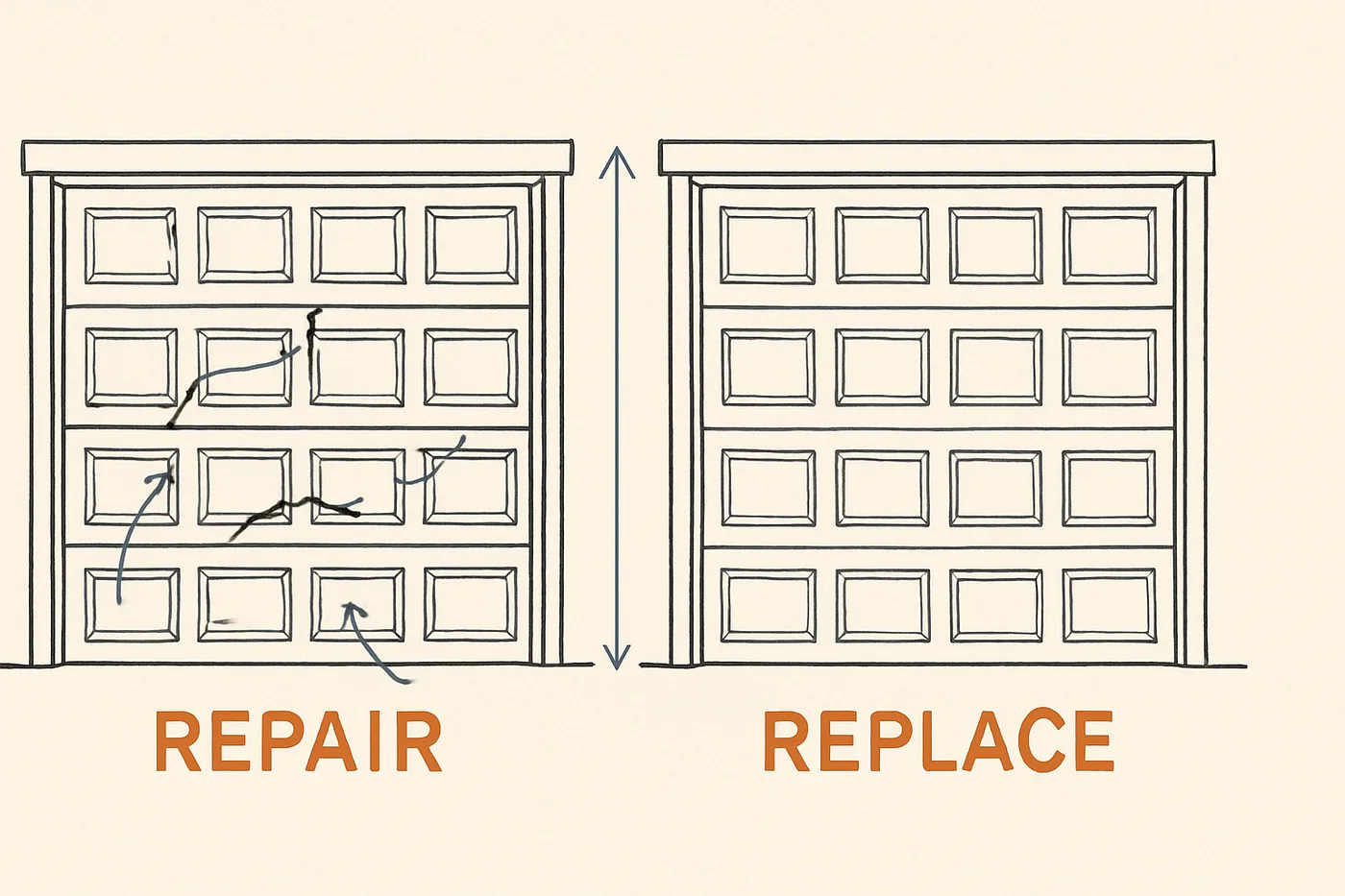
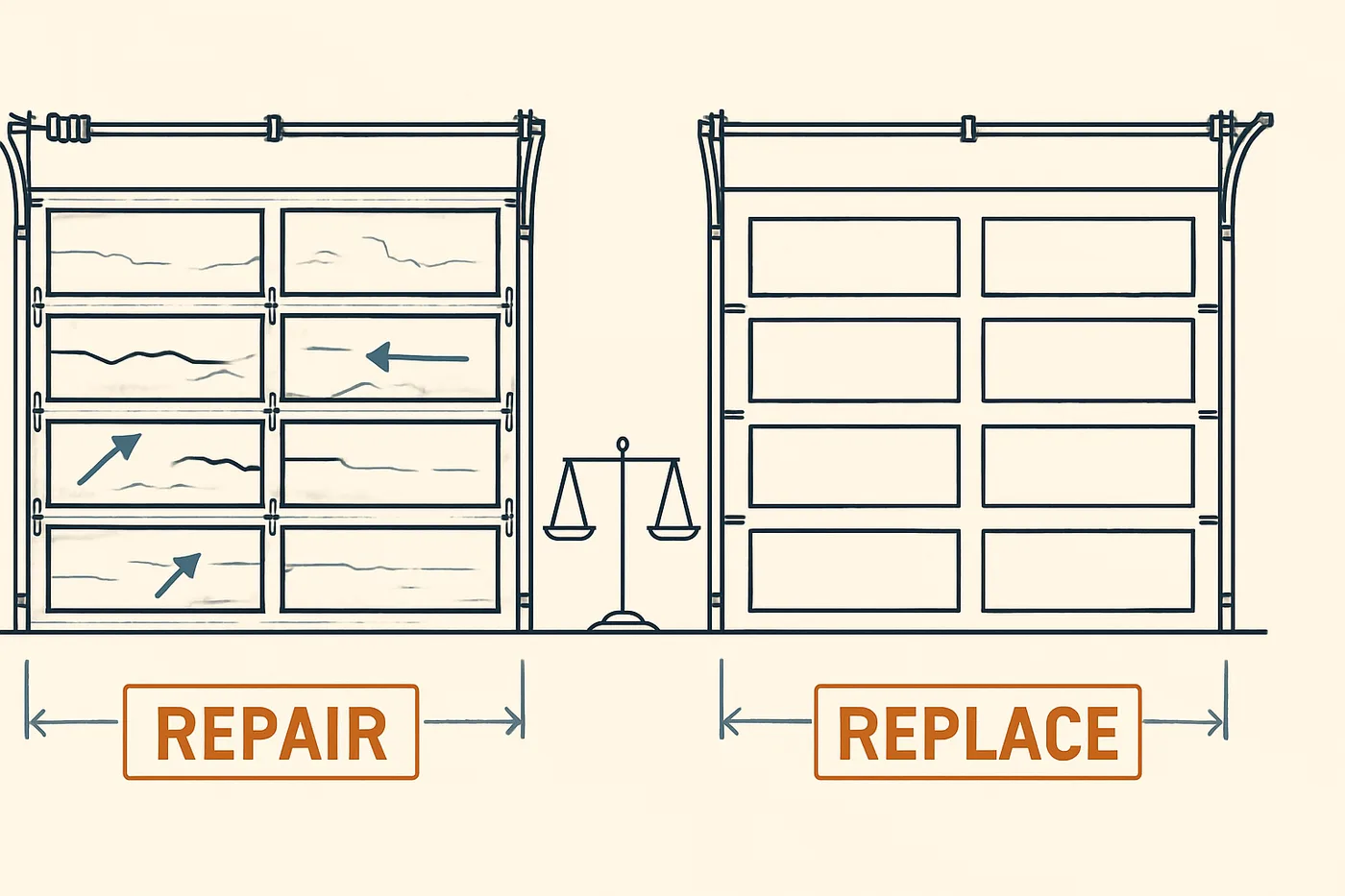
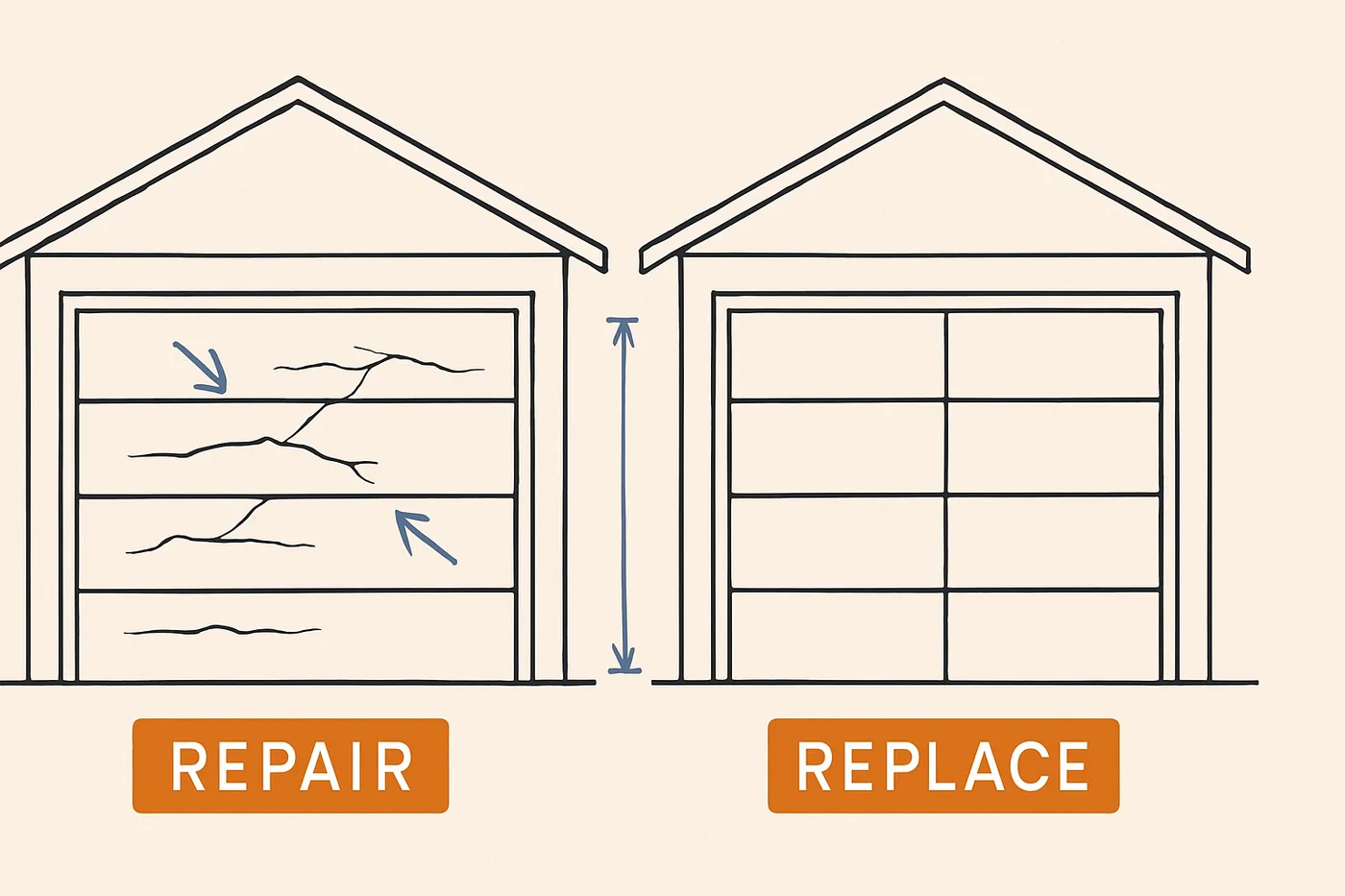
Two rules cover the repair-versus-replace decision.
First: if a single repair quote exceeds 50 percent of the cost of replacing the door with the same tier, replacement is the better financial decision. A mid-grade insulated steel door runs $1,500 to $3,200 installed; if you are looking at a $1,600 repair on that door, you are one bad panel away from having bought a new door at a premium.
Second: a well-built residential steel sectional door typically lasts 15 to 30 years, but past the 20-year mark the probability that the next component is also near end-of-life climbs every year. If your door is 22 years old and you have already replaced springs, cables, and an opener in the last three years, the panels and tracks are next. A full installation runs $1,950 to $3,900 for a standard 16x7 double-car opening with a mid-grade insulated steel door and a belt-drive opener — model your specific situation in the ROI lab before you decide.
Three questions before you approve any repair quote: What is the cycle rating on the replacement spring? Is haul-away and a post-repair balance test included? What is the labor warranty in months, separately from the parts warranty? If the technician cannot answer all three at the door, get a second quote.