Which garage door should you actually buy? A homeowner's guide to types and materials
Learn about garage door types, materials, and how to select the best option for your home. Compare steel, wood, aluminum, and composite doors.

You are about to spend somewhere between $1,500 and $10,000 on a thing you use every day and have never thought about. The showroom has forty doors on the wall. The contractor is quoting three. The internet has opinions.
The good news: for most homeowners, the decision comes down to four questions, in order, and the answer to each one eliminates about half of what's on the wall. Let's get you to the right door.
The four materials, honestly
There are four materials worth considering for a residential garage door. Here is what each one is, what it costs, and what it does badly.
Steel is what you're almost certainly going to buy. Roughly 80% of replacement garage doors installed in North America are insulated steel sectional doors, and it's not fashion — it's because steel does everything reasonably well at a price nothing else matches. A mid-grade insulated steel sectional runs $1,500 to $3,200 installed in 2026 with an R-value of 12 to 18. Failure mode: dents. Steel doesn't rust the way it used to, but a basketball at the wrong angle leaves a mark you'll see every time you pull in.
Wood is real wood — cedar, mahogany, redwood, sometimes reclaimed timber — built as a custom door with a real frame. It looks like nothing else, and if your house is designed for it, nothing else will look right. Custom wood doors run $4,000 to $15,000 installed depending on species and hardware, and require refinishing every three to five years. Failure mode: the refinishing. Skip two cycles and the door starts to check, warp, and rot from the bottom up. Wood is a commitment, not a purchase.
Aluminum with glass is the full-view door — an aluminum frame holding large panes of frosted, clear, or tinted glass. It's what you see on modern houses and on car collectors' garages that double as showrooms. It's the lightest option, doesn't rust, and lets in an enormous amount of light. Failure mode: thermal performance is poor, glass panels are expensive to replace, and privacy is whatever the glass gives you.
Composite and faux-wood is a steel or fiberglass door with a wood-grain overlay, or a wood-composite skin over an insulated core. It gives you a wood look at steel prices and doesn't need refinishing. Failure mode: it looks like a composite door up close. From the street, it passes. Standing next to it, it doesn't.
Insulation matters more than you think
If your garage is attached to the house, or has living space above it, or you use it as a workshop, insulation is not a nice-to-have. It's the single spec that will affect your quality of life the most.
Two kinds of insulation show up in steel doors, and they are not equivalent. Polystyrene insulation — a foam board slid into the panel — provides R-6 to R-10, whereas polyurethane injected foam bonded to both steel skins provides R-12 to R-18 in the same panel thickness and adds structural rigidity beyond the thermal performance. The polyurethane door is also quieter and more resistant to denting because the foam is structurally part of the panel.
The top-tier version of this is a three-layer polyurethane sandwich door. The Amarr Olympus reaches up to R-18, putting it in the same thermal class as an insulated exterior wall, and costs $1,700 to $2,900 installed for a standard 16x7 opening. If your garage shares a wall with a bedroom, this is the door you want.
For a detached garage you don't heat or work in, none of this matters. Buy the cheapest single-layer steel door that fits the opening and move on.
Sectional vs. rolling steel
Almost every residential door is sectional — horizontal panels hinged together that ride up and back on tracks into the ceiling. A few homeowners with tall ceilings or unusual openings consider rolling steel, the coiled-slat doors you see on storefronts and self-storage.
The trade-off is durability versus insulation. Rolling steel doors are rated for 25,000 to 500,000-plus cycles compared to 10,000 to 50,000 for sectional doors, but sectional doors max out at R-18 with polyurethane injection while rolling steel maxes out at R-10 with foam-filled slats. For a residential garage, sectional wins almost every time. Rolling steel is right for a detached shop where you're opening the door dozens of times a day and don't care about heating it.
Panels: long, short, and with windows
Once you've picked material and insulation, you'll be asked about panel style. Two things to know.
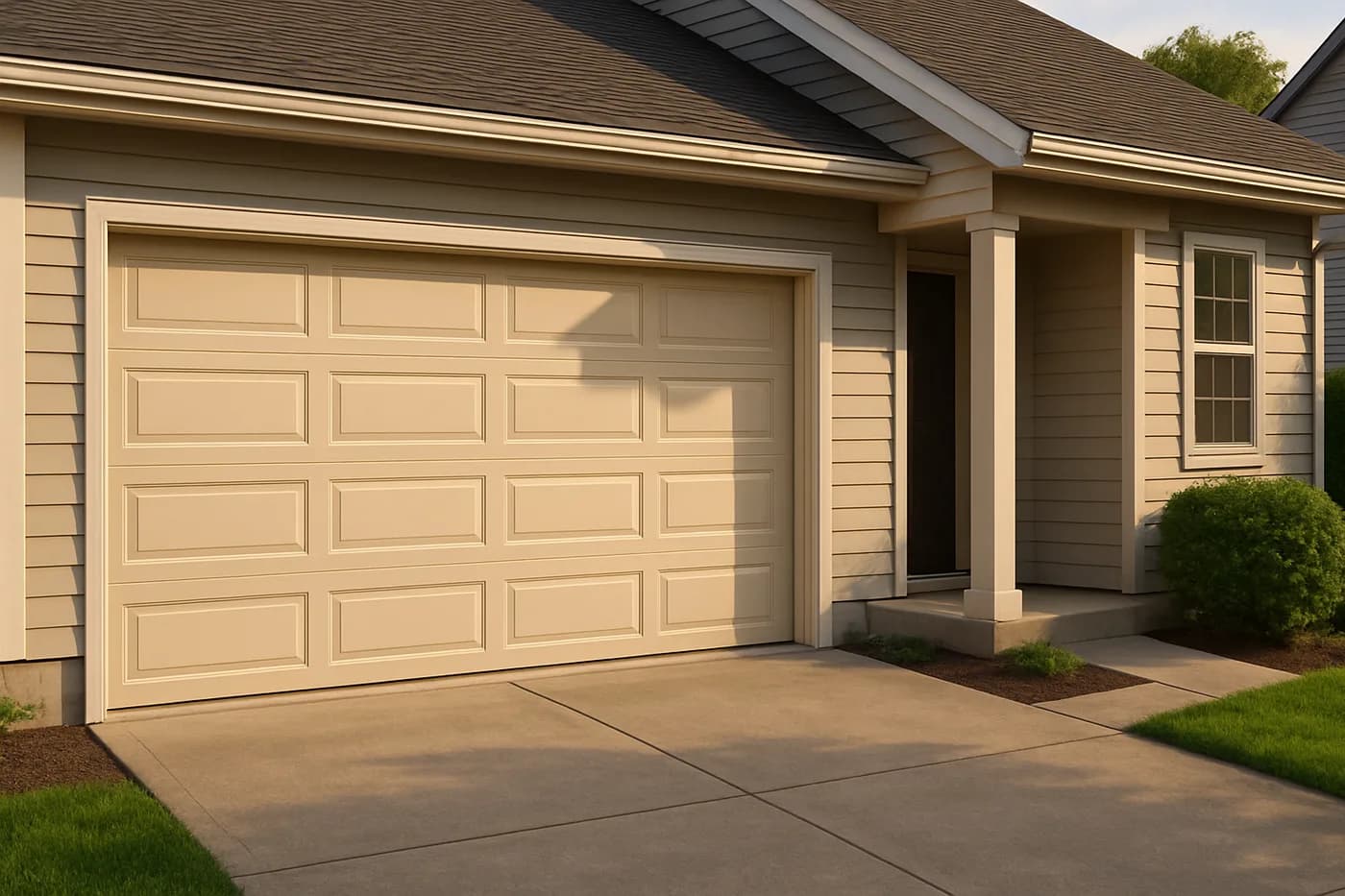
First, long panels dent more visibly than short panels because a dimple lands in the middle of a wide, flat, unbroken surface, while the same dent on a short-panel door is partially camouflaged by the surrounding subdivided pattern. If you have kids with basketballs, pick short panels.
Second, the panel style itself doesn't change the price at the base tier. On the Amarr Lincoln entry-level line, a standard 16x7 double-car opening costs $1,100 to $1,700 installed regardless of whether long or short panels are chosen. Where you pay more is windows and carriage-house overlays: the Amarr Carriage Court and Hillcrest premium lines run $3,500 to $7,500 installed once window sections and overlay hardware are added, with the full-view aluminum Hillcrest capable of climbing past $10,000 for wider openings.
The parts you'll be quoted alongside the door
Don't buy the door in isolation. Three other line items matter.
Springs. Standard torsion springs are rated to 10,000 cycles — roughly 7 to 10 years of daily use — while high-cycle springs rated to 25,000 to 100,000 cycles cost $75 to $150 more upfront and last proportionally longer. If you use the garage as your primary entry, pay for the high-cycle springs. It's the highest-ROI upgrade on the quote.
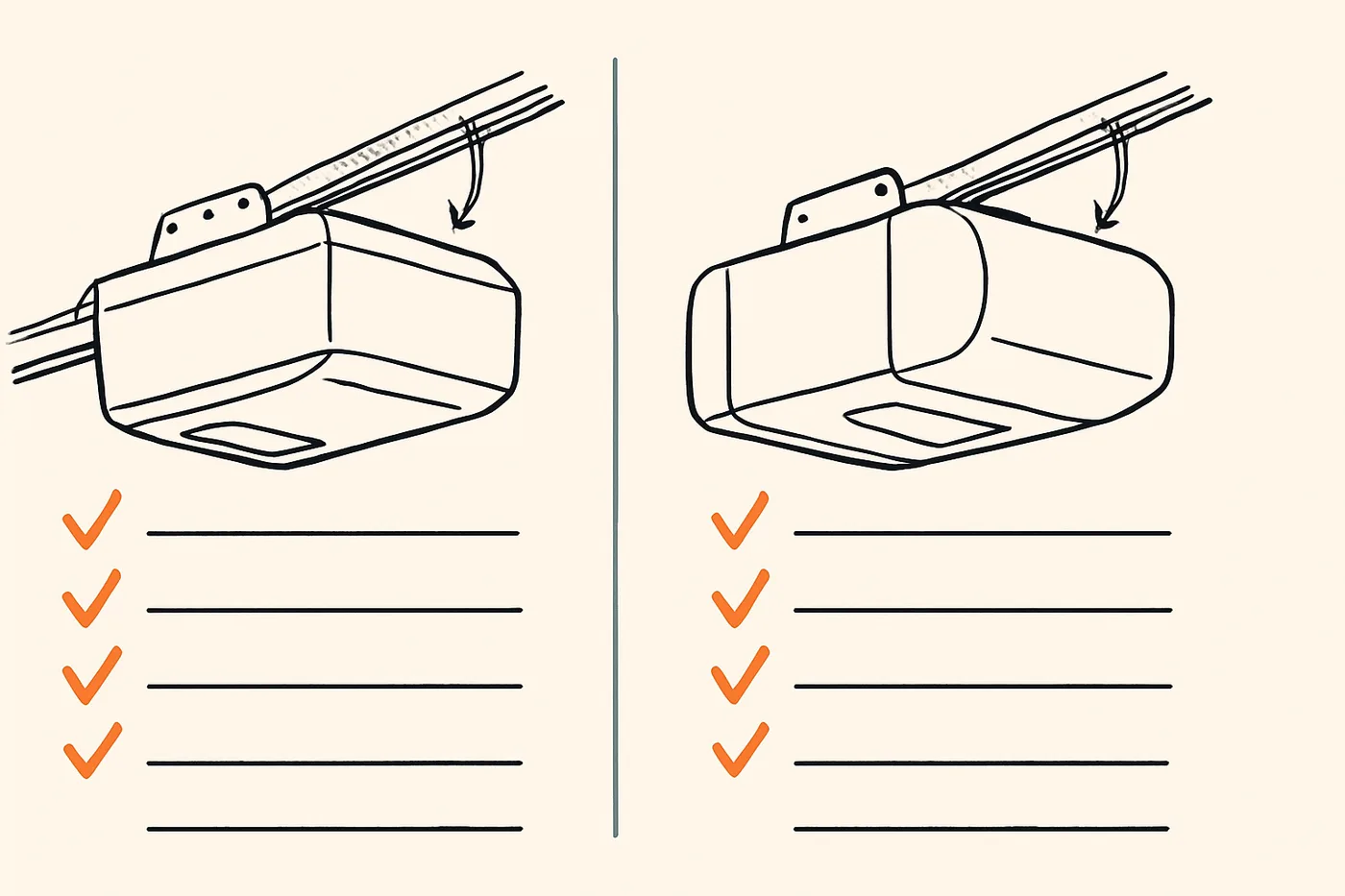
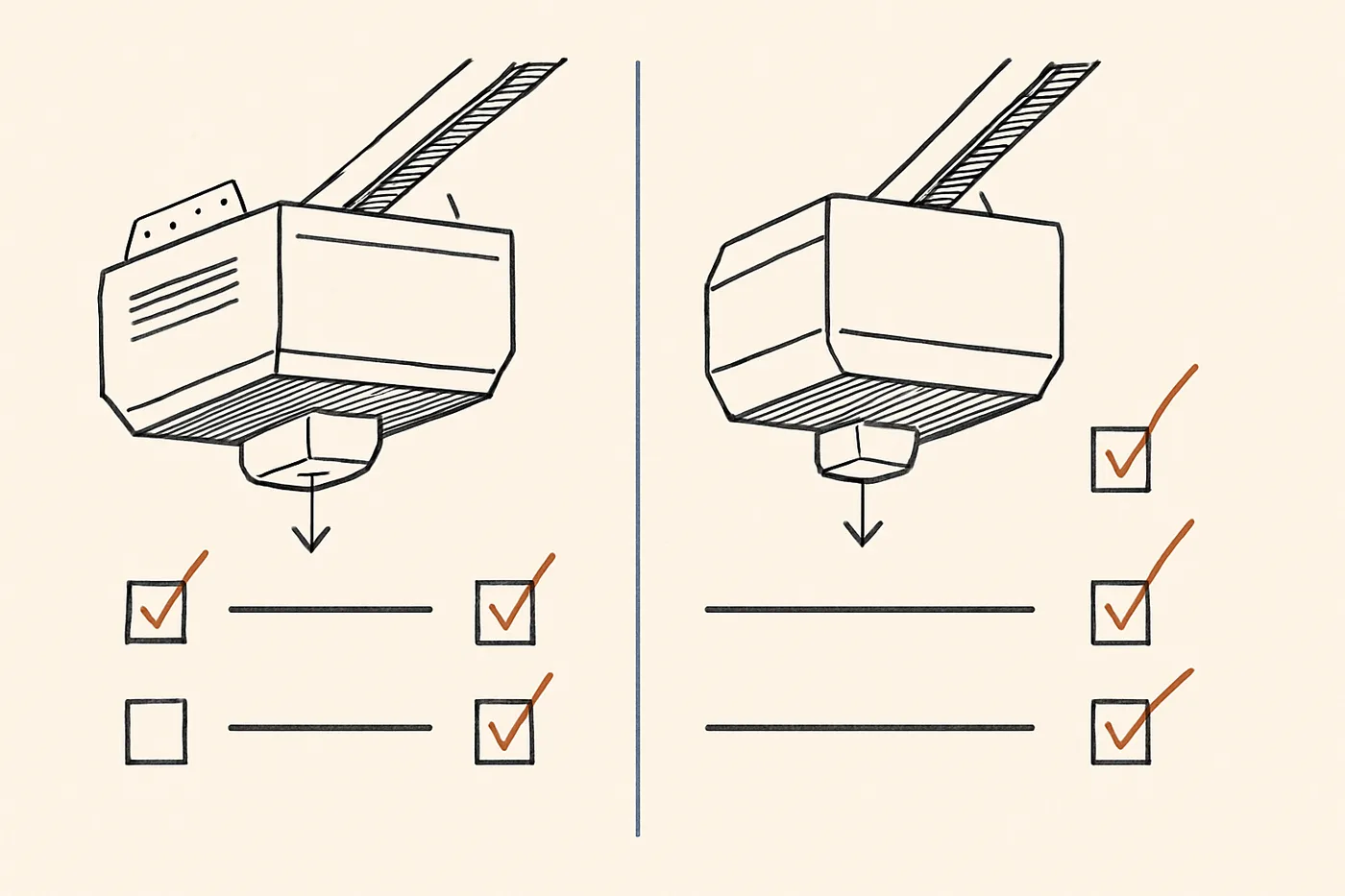
Opener. For most attached garages, belt drive is the right answer. A chain-drive opener costs $350 to $500 installed and lasts 10 to 15 years, while a belt-drive opener costs $450 to $650 installed and lasts 12 to 15 years, with the belt drive operating at roughly 50 dB versus the chain drive's 70-plus dB. Skip screw drive — the grease on the threads stiffens in cold weather and gets loud in heat, and parts are harder to source, which is why most professionals stopped recommending them. If you're planning to be in the house 15+ years, direct-drive openers cost $650 to $900 or more installed, last 20 years or more with minimal maintenance, and most units carry a lifetime warranty on the motor. Whatever you pick, for a double-car door, a solid wood door, or an insulated steel door over 16 feet wide, three-quarter horsepower is the minimum opener size to avoid premature motor burnout.
Battery backup. It adds $75 to $150 to the opener cost and is legally required on all new residential opener installations in California under SB-969. Even where it isn't required, add it.
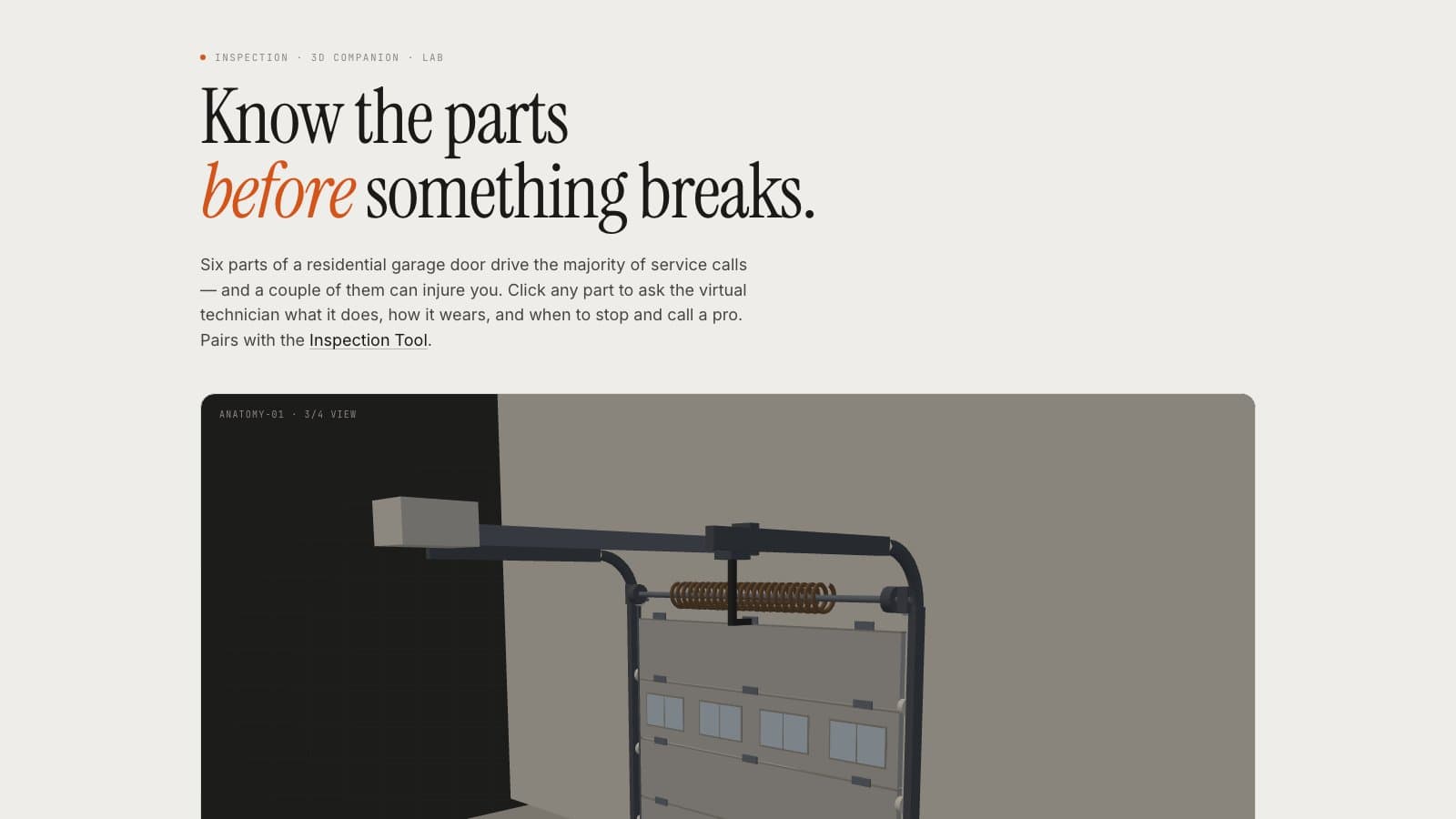
Before you sign anything, ask the installer for a written inspection of the existing opening — Garage Door Pro Services offers a free garage door safety inspection that will surface framing or track issues before they become change orders, and if you're in Nevada, A+ Garage Doors does the same for garage door repair in Las Vegas. If you're on the fence about replacing at all, the rule is simple: if a single repair quote exceeds 50 percent of the cost of replacing the door with the same tier, replacement is the better financial choice. You can see how the whole assembly fits together in the garage door anatomy lab, and Maya walks through the tech tiers in this video.
The three questions that get you to a door
One: is the garage attached to living space? If yes, buy a polyurethane-insulated steel door with an R-value of 12 or higher. If no — detached garage, no living space adjacent — buy the cheapest single-layer or polystyrene steel door that fits, and put the money somewhere else. If door noise is already bothering you in an attached setup, this video on garage door noise explains what's usually causing it.
Two: does the architecture demand real wood? Look at your house honestly, not aspirationally. If a wood door is the difference between the front elevation looking right and looking wrong, budget $4,000 to $15,000 and commit to refinishing every three to five years. If the answer is "it would be nice," buy a composite or faux-wood overlay on a steel door and put the $6,000 difference into insulation, high-cycle springs, and a belt-drive opener.
Three: how long are you staying? Under five years: mid-grade insulated steel, standard springs, belt-drive opener. Five to fifteen years: polyurethane steel, high-cycle springs, belt-drive opener with battery backup. Fifteen years or more: three-layer polyurethane door, high-cycle springs, direct-drive opener. Spend where the payback period fits your horizon, and not a dollar past it.
For the middle-of-the-road homeowner who doesn't fit an edge case — attached garage, staying seven to ten years, no strong architectural constraint — the answer is a polyurethane-insulated short-panel steel sectional in the $2,000 to $2,800 installed range, paired with a three-quarter horsepower belt-drive opener with battery backup and a set of 25,000-cycle springs. That's the door. You can stop reading now. If you want to understand why the physics of that door works the way it does, the science of garage doors lab and the pop art physics video are where to go next.